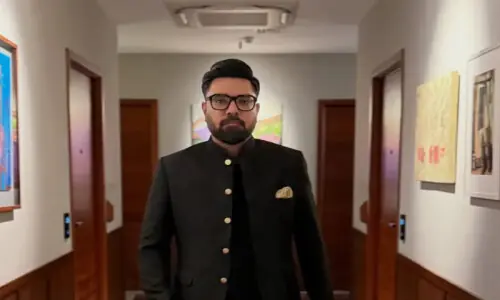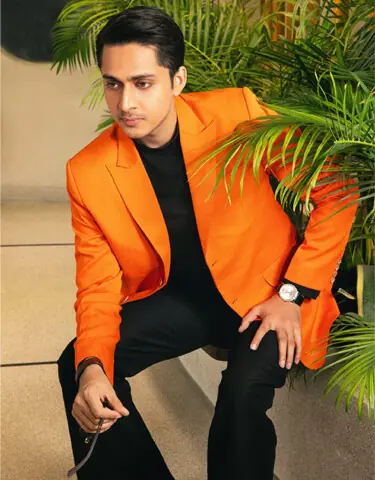
In a television landscape often dominated by high-pitched melodrama, Ali Ammar is carving out a distinct niche for himself as an actor of restraint, range and physical control.
From the dusty world of rural feudalism in Jhok Sarkar to the rigid, emotionally fraught corridors of abuse in Tan Man Neelo Neel and, more recently, as the eponymous hero in Captain Isfandyar Shaheed, Ammar’s recent body of work reflects a preference for complex, restrained characters.
The actor opens up about navigating the early stepping stones of his career, taking on physically challenging and emotionally demanding roles and working with industry legends.
How did you transition from theatre and minor television appearances to mainstream roles?
My journey in theatre started at the PNCA [Pakistan National Council of the Arts] in Islamabad, where I played leads in commercial plays such as Wafa Ke Putlay [2019] and Ishara Train [2022] while simultaneously working in short films and commercials. On television, I started off with minor roles in Ehd-i-Wafa [2019], Shikaar [2023], Wehshi [2022], Jhok Sarkar [2023], Lagay Aag Iss Mohabbat Ko [2024] and Woh Ziddi Si [2024-25].The minor roles were the stepping stones that kept me going, eventually paving the way for mainstream leads. The mainstream projects that allowed me to show my true range as an actor include Tan Man Neelo Neel [2024-25], Dastakhat [2025] and this year’s Captain Isfandyar Shaheed.
The rising TV actor recently portrayed Captain Isfandyar Shaheed in a mini-serial. But his journey to real-life hero came on the back of taking on vulnerable and often complex characters. He opens up to Icon about his craft…
Which of your earlier dramas are your most memorable?
Jhok Sarkar was my launchpad in a sense — the character of Jeevan was my first real supporting role and, for the first time, I felt the excitement of facing the camera. However, it also required a steep learning curve. At the time, I wasn’t familiar with camera technicalities and I remember feeling very self-critical, wishing I had performed with much more ease. The project gave me the opportunity to showcase my acting potential to TV drama directors.
Jeevan was at the centre of a tense, feudal power dynamic. How did you prepare for such a vulnerable character?
Jeevan proved to be my entry point into intense, character-driven television dramas. He was a vulnerable rural youth caught in the harsh grip of feudal oppression, making him an easy target for manipulation by the local elite. Preparing for Jeevan required me to embrace a raw, rustic demeanour and lean heavily into physical body language that conveyed helplessness, hesitation and fear. As I was working alongside Hiba Bukhari, who played my sister Sassi, my focus was on building a visible, authentic sibling bond with her, so that Jeevan’s gradual descent into a dangerous orbit felt like a real emotional weight for her character.

Taking on the role of Moon in Tan Man Neelo Neel saw you navigate the deep psychological trauma resulting from physical assault. What did it take, emotionally and physically, to step into the skin of a survivor?
Stepping into the skin of Moon has, perhaps, been the most emotionally demanding challenges of my career so far. Moon dealt with heavy trauma and the role required sensitivity, and the drama touched upon deeply poignant social issues. When I was offered the script, I had doubts and consulted my mentors, because it required tapping into painful emotional depths. To prepare, I had to disconnect from my own personality and immerse myself in the vulnerability of a survivor.
What do you think sets director Saife Hassan’s directorial process apart when handling sensitive, narrative-driven projects such as Tan Man Neelo Neel?
Saifee sahib’s unique strength lies in his deep emotional intelligence and intuitive connection to the narrative. He truly feels the story and possesses an incredible ability to make silent, unsaid emotions speak volumes on screen. While working with him in Tan Man Neelo Neel, I saw first-hand how he draws out an authentic vulnerability from his actors — he creates an environment where actors can express raw feelings naturally in front of the camera. This allows him to deliver complex psychological arcs that resonate with the audience.
In Dastakhat, how did you approach portraying Hamza’s awkward shift from treating Tara as an elder sister to being her husband?
Portraying Hamza was an exercise in restraint, subtlety and navigating deep internal conflict. The transformation was psychological rather than physical — I had to portray a young man suddenly thrust into a forced marriage with his orphaned older cousin, Tara (Nadia Afgan), whom he had spent his life addressing as ‘aapi’. I focused on having guarded expressions, hesitant dialogue delivery and a distant body language to reflect the jarring shift from addressing someone as my older sister to then being married to them. Navigating Hamza’s lingering attachment to Emaan Ahmad’s Ramsha, his real love interest, alongside his marital obligations, required balancing quiet resentment with underlying guilt, ensuring the awkwardness felt grounded and authentic — without resorting to melodrama.
Shifting from emotionally complex roles to heroism, portraying Captain Isfandyar Shaheed demanded strict military discipline. How did you prepare to step into the boots of a real-life national war hero?
Embodying the role of Isfandyar Shaheed brought on an incredible sense of responsibility and honour. Portraying a military figure demands a completely different calibre of discipline — both physically and mentally. For this role, my transformation centred on rigorous physical conditioning, mastering military posture, having a drill demeanour and understanding weapon handling in order to do full justice to the uniform. Beyond the physical prep, understanding the psyche of a soldier — the unwavering patriotism, sense of duty and readiness for the ultimate sacrifice — martyrdom — required deep emotional preparation. It was about bringing genuine grit, soldierly dignity and heart to the screen.
What is Haseeb Hasan’s unique strength as a director, and how did he guide you in a demanding role such as Captain Isfandyar Shaheed?
Haseeb sahib’s biggest unique selling point is the creative freedom and trust he offers to his actors. When I was first approached for this project, and learned that he was directing it, I accepted the challenge without hesitation, despite the physical demands of portraying such a character. He gives you the space to interpret the role and bring your own vision to the character. Once you present your craft, he refines it, provides precise guidance and elevates the final execution to a whole new level.
Which dramas are currently keeping you busy?
Beti Ka Ghar Kaunsa is an incredible experience. I have the privilege of sharing the screen with industry veterans and legends such as Behroze Sabzwari, Saba Faisal, Humayoun Ashraf and Ali Abbas. Watching these seasoned actors at work is a constant source of inspiration for me. Every single scene feels like a masterclass in acting, making it an invaluable learning opportunity for me.
The writer is a freelance contributor with over two decades of experience in entertainment. He can be reached at asifkhan.media@yahoo.com
Published in Dawn, ICON, September 20th, 2026