Iran opens door to talks if US ends economic squeeze
• Tehran says US pressure doesn’t work; ties reopening of Hormuz to end of naval blockade
• Washington unveils fresh Iran-related sanctions; claims Iranian sea mines have been cleared
• Mediators push efforts to revive stalled peace process; China urges return to negotiations
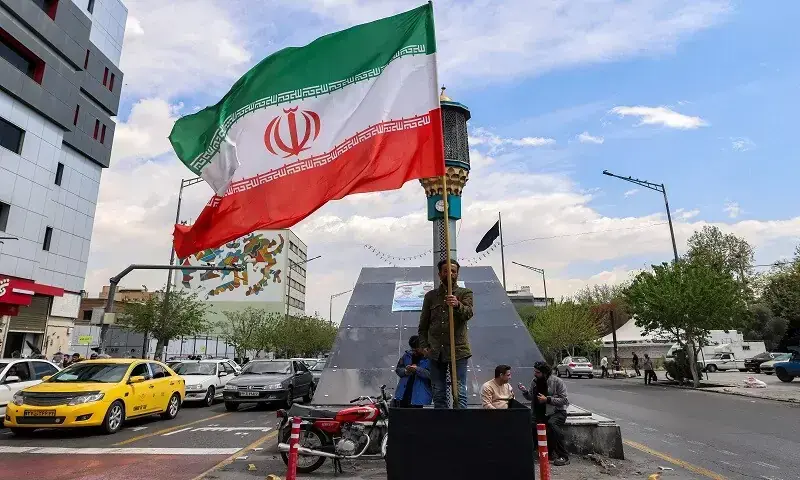
TEHRAN: Iran has signalled it remains open to diplomacy with the United States, six months into a war that has upended the Middle East, but insisted negotiations would not resume unless Washington abandoned its campaign of economic pressure.
“Putting diplomacy back on track isn’t impossible. It hinges on US understanding of one simple fact: pressure doesn’t work,” Iran’s foreign minister, Abbas Araghchi, wrote on X on Friday. He said Washington needed to “build trust, speak respectfully, acknowledge our rights and uphold commitments”.
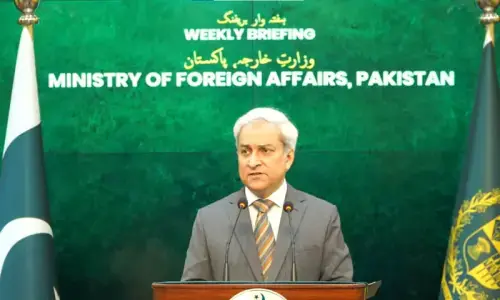
Pakistan and Qatar are among the mediators attempting to bring an end to the conflict, which was launched by the US and Israel in late February. An April ceasefire brought the most intense fighting to a halt, and the sides signed a memorandum in June setting out a path towards a final peace agreement.
However, the MoU collapsed because both Washington and Tehran accused each other of breaking the ceasefire terms and failing to honour their commitments.
Meanwhile, the US announced further Iran-related sanctions on Friday, after the treasury secretary, Scott Bessent, warned of an escalating “economic D-Day” against the country.
A US official said Donald Trump’s administration planned to restrict Egypt’s Banque Misr over its dealings with Tehran by removing US financial access from the bank’s branches in the United Arab Emirates.
If finalised, the measure would cut Banque Misr UAE off from correspondent banking relationships with US financial institutions.
The US Treasury separately imposed penalties on a Hong Kong-based entity and an individual linked to Iran’s Bank Melli.
Bessent said “no one is above the reach of US sanctions”, as Washington prepares to urge foreign finance officials to sever Tehran’s economic lifelines at an upcoming G20 meeting in North Carolina.
Tehran condemned the measures as “state terrorism” and urged governments around the world not to enforce them.
Iran’s foreign ministry argued that countries were obliged under international law to reject unilateral US sanctions and said those implementing them risked becoming complicit in what it described as an unlawful campaign.
It called the sanctions a “crime against humanity” that threatened civilian livelihoods and appealed to the UN and other international bodies to intervene.
Hormuz remains flashpoint
Tensions also remained high around the Strait of Hormuz, one of the world’s most important energy corridors.
The Iranian lawmaker Esmail Kowsari warned that unless Washington lifted its naval counterblockade and sanctions in accordance with the June memorandum, the waterway would remain closed.
“Not only will the Strait of Hormuz remain closed, but the United States must be ready for our offensive actions,” he told state television.
Before the conflict, about a fifth of global oil supplies passed through the strait, making its reopening a central focus of international mediation.
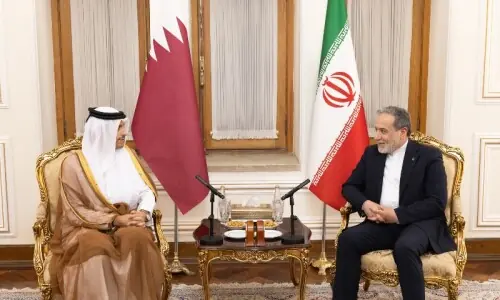
Qatar’s prime minister, Sheikh Mohammed bin Abdulrahman Al Thani, met Araghchi in Tehran on Thursday and stressed the importance of restoring maritime traffic.
Mohsen Rezaei, secretary of Iran’s supreme national security council, said Tehran was preparing conditions under which the waterway could reopen, including an end to the regional war and the lifting of the US blockade.
The US military, meanwhile, said American forces had cleared sea mines planted months earlier by Iran’s Islamic Revolutionary Guard Corps.
“Today, international shipping lanes are open and momentum is building,” said Admiral Brad Cooper, the commander of US Central Command.
Commercial shipping through the region, however, remains subdued amid continued Iranian threats and uncertainty over whether a lasting settlement can be reached.
China calls for negotiations
China renewed its call for diplomacy on Friday, saying negotiations remained the only viable route out of the confrontation between Washington and Tehran.
“China opposes illegal, unilateral sanctions, and our position is consistent and clear,” the foreign ministry spokesperson Lin Jian told reporters in Beijing.
Beijing has continued purchasing Iranian crude using overland trade routes that do not depend on passage through the Strait of Hormuz.
Published in Dawn, August 29th, 2026