

THE Israeli prime minister’s public rejection of the US-backed Gaza roadmap came as little surprise. Last month, the Board of Peace (BoP) announced a 15-point plan to implement the next phases of President Donald Trump’s peace initiative. Brokered by the US, agreement on the plan was announced by Trump on July 30. He called this a “major milestone”. The 15-point document’s aim was to move the peace process forward by reaffirming and fleshing out specific commitments for implementation by the parties to the conflict.
The second of the 15 points required Israel to abide by all “remaining obligations” under the Sharm el-Sheikh Memorandum especially an end to its military operations. It called on Hamas and other Palestinian factions to cease their military actions under the peace plan. The 15 points also detailed the framework for Gaza’s governance including the National Committee for the Administration of Gaza’s (NCAG) responsibilities for running the Strip. Composed of Palestinian technocrats, the transitional body was established by the BoP in January. But it was prevented by Israel from entering Gaza. It has since remained stuck in Cairo. The 15-point framework makes it clear that in the specified timetable NCAG must enter the Strip and start to assume day-to-day governance.
The roadmap involves reciprocal steps. It mandates a link between decommissioning of armed militias including Hamas and “an Israeli withdrawal, in phases, from areas under its control in Gaza”. Point 13 commits Israeliforces “to complete their phased withdrawal from Gaza Strip according to an agreed upon timetable”. The plan provides for the inventorying and storage of Hamas’s heavy weapons under NCAG’s supervision. Hamas would disarm in exchange for a gradual Israeli military withdrawal and establishment of governance by the technocratic Palestinian committee.
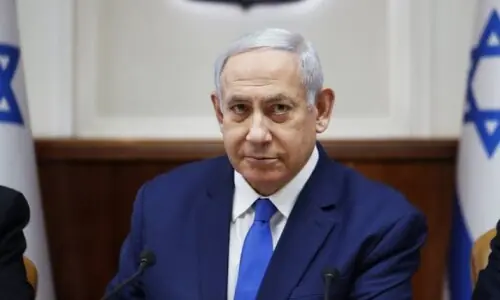
Rejecting the plan, Benjamin Netanyahu declared his country’s troops will not withdraw until Hamas is “genuinely disarmed”. The Israeli leader’s wholesale rejection of the 15-point plan threatens to derail the peace process altogether. It makes the ceasefire’s fate uncertain and pushes it to the brink of collapse. For its part, Hamas agreed to the plan, with the BOP announcing on July 31 that the resistance group had consented to disarm. Hamas said it would surrender its weapons in stages. After Israel’s rejection of the plan, Hamas reiterated its commitment to it while urging the BoP and mediators to prevent ceasefire violations.
Netanyahu’s rejection of the 15-point roadmap threatens to derail the peace process.
Several Western analysts attribute Netanyahu’s opposition to the plan to electoral politics with general elections due in two months. The Oct 27 poll poses a major challenge for Israel’s longest-serving prime minister, whose declining public support places his political future in jeopardy. But elections alone do not explain Netanyahu’s rejection. Israel was never really committed to the Trump plan, despite signing on to the Sharm el-Sheikh agreement. Netanyahu has since done everything to block its implementation.
Several of Israel’s actions testify to that. It has conducted almost daily military strikes on Gaza defying the ceasefire brokered by the US last October. Over 1,000 Palestinians have been killed since the ceasefire came into effect. Israel also intensified its bombings of Gaza after announcement of the 15-point plan. It has seized control of over 70 per cent of the Strip and deepened its occupation. Israeli defence officials vowed their forces would indefinitely remain in so-called “security zones” in Gaza, with no timetable for withdrawal. Netanyahu also did not allow the 13-member Palestinian NCAG to enter Gaza.
Israel has carried out deadly military raids into the West Bank, along with its de facto annexation and engaged in ethnic cleansing of the Bedouin and herding communities. A senior UN official warned the West Bank was at “breaking point”. But Washington had nothing to say on these actions. Only a single incident of Israeli settler violence prompted a rare rebuke from the US envoy. Israel’s military assaults on Lebanon and occupation of its southern areas also showed Tel Aviv’s aggressive designs and lack of interest in a truce.
So far, there is silence from Washington over Netanyahu’s rejection of the Gaza plan. Trump claimed he would give his reaction on social media. He never did. The US may be distracted by its conflict with Iran. But that doesn’t explain why it hasn’t said anything about Israel’s abandonment of the Gaza plan. Trump administration officials privately tell journalists they are willing to give “leeway” to Netanyahu to navigate the looming elections. Jared Kushner, Trump’s son-in-law and envoy, is however set to visit Israel next week accompanied by Nickolay Mladenov, BoP’s high representative, for talks on the Gaza plan.
Following Netanyahu’s Washington visit in July, the BoP contradicted its own 15-point plan by announcingIsrael will only be obligated to withdraw after “complete” disarmament. But after Netanyahu’s rejection, a Board member told a Middle Eastern media outlet that the peace process will still be based on the original plan for “phased, reciprocal commitments”.
From the very inception of Trump’s Gaza plan, the US never committed to an even-handed approach. Instead, it adopted a pronounced pro-Israel stance. It did nothing to stop Israel from violating the ceasefire and cease the killings of Palestinians in Gaza. It turned a blind eye to Israeli expansion of areas under its control. Washington frequently demanded Hamas should disarm but said nothing about the reciprocal obligation for Israel to withdraw from the enclave.
Vice President J.D. Vance occasionally criticised Israel for its stance. But this did not change the heavy influence of the Israeli lobby on the Trump administration’s Middle East decisions. This continues to be the case despite Israel’s plummeting standing among the majority of Americans. A new book Israel’s Lobby describes it as the most powerful foreign policy lobby that has for decades held America in its grip.
Future prospects for peace in Gaza hinge on how much pressure, if any, the US is prepared to mount on Israel to compel it to drop its opposition to the Trump plan. If it is unable or unwilling to do this, and the tail wags the dog, then it won’t just be Israel that will sabotage the plan. The US will end up defeating its own peace initiative.
The writer is a former ambassador to the US, UK and UN.
Published in Dawn, August 17th, 2026