
WHAT is the meaning of progress when the future becomes more uncertain than the past?
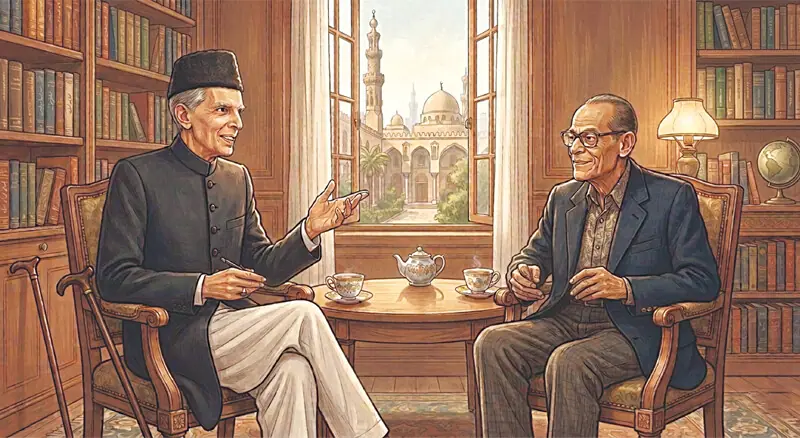
Naguib Mahfouz, Egypt’s Nobel Prize-winning chronicler of social change, captured this tension perfectly in his Cairo Trilogy where progress is not portrayed as a clean break from history, but as an ongoing struggle between tradition and modernity, continuity and change. Pakistan’s own journey reflects the same tensions. Since the country’s independence in 1947, successive generations have carried forward the aspirations, contradictions, and challenges inherited from those before them, making choices to shape a future firmly rooted in the country’s history and potential for progress.
Despite exceptions, these choices were made in an environment of relative predictability, underpinned by a multilateral order that valued cooperation over isolation and dialogue over confrontation. Today, the multilateral order that Pakistan joined with optimism and an outward-looking vision in 1947 has been profoundly shaken. This is happening at a time when the need for such a system has never been greater. The world is grappling with the highest number of active conflicts since the Second World War, even as the capacity for multilateral peacebuilding and the institutions designed to prevent and resolve conflict are under increasing strain. And, once sectoral issues, like climate change, now intersect with poverty, food insecurity, gender inequality, and health challenges, creating interconnected risks that transcend national borders and demand collective action.
This year, I celebrate my fourth Independence Day in Pakistan.
Today, Pakistan’s active participation in regional peacebuilding efforts echoes Jinnah’s vision of an outward-looking country committed to peace within its borders and goodwill towards the wider world.
The contrast between the world I encountered when I first arrived and the one we inhabit today could not be starker. Yet the future cannot be separated from the past, and Pakistan’s history offers a rich legacy of ideas, and ideals, that can help the country navigate an increasingly unsettling period. These include Jinnah’s vision of an inclusive, modern, and outward-looking nation-state; Iqbal’s concept of a society that prepares for the future while holding firmly to its ideals; Asma Jahangir’s unwavering belief that justice, human dignity, and equal rights are indispensable foundations of a peaceful and democratic society; and Mahbub ul Haq’s humane and people-centred paradigm for development, reimagining the collective good in terms of human potential rather than abstract theories of economic growth and trickle-down economics.
These ideas derive their strength from being both historically grounded and forward-looking. Conceived in response to the defining challenges of their time, they remain remarkably relevant because many of the issues confronting Pakistan today are continuations of those same historical challenges. Today, Pakistan’s active participation in regional peacebuilding efforts echoes Jinnah’s vision of an outward-looking country committed to peace within its borders and goodwill towards the wider world. Similarly, the country’s engagement with modernity and globalisation, and its continuing search for a home-grown path to progress and future readiness, are reminiscent of Iqbal’s vision. Mahbub ul Haq and Asma Jahangir, likewise, remain lasting sources of inspiration for generations seeking to advance a more humane model of development and protect the rights of the most vulnerable and marginalised.
These stories of hope, resilience, and renewal remain inspiring in times of deep and overlapping crises. They, indeed, should help us recognise the Pakistan that is ready to emerge and take off, as envisioned by Uraan Pakistan, but remains unseen because of limited economic opportunity for youth, education systems that still leave far too many behind, and persistent development discrepancies within and between provinces.
While the current global disorder is beyond Pakistan’s control, its impact can be mitigated through sustained investments in people, institutional leadership, equitable al__cpLocation of resources, and stronger systems of governance that are accountable and responsive to local needs — priorities echoed unequivocally by the highest leadership in the country. The next step is always the more difficult one — transforming this vision and its underpinning values into sustained, irreversible policy, law and practice.
History is rarely shaped by extraordinary individuals acting alone. The change that endures is cumulative: it grows through countless acts of initiative, responsibility and cooperation, sustained over time by a shared sense of purpose. The lesson for Pakistan is equally compelling. Its future will depend on strong institutions capable of bringing these efforts together and giving them the scale and continuity to shape national progress. The task is not simply to cultivate more leaders, but to create the conditions in which people at every level can lead, and lead together in concert.
Across Pakistan, the leaders these institutions must recognise and enable are already present. They can be found in vulnerable communities self-organising to respond to recurring climate-induced disasters, women heads of households acquiring new skills to support their families in the face of adversity, and young people building social enterprises that create opportunities for others. It is evident in communities working together to improve access to basic services, women in law enforcement and legal professions breaking gender barriers, and marginalised groups delivering lifesaving services to those who need them most. Leadership exists at every level of society.
The challenge is not the absence of leadership, but our ability to recognise it, nurture it, and create the conditions for it to flourish, especially as we move towards an increasingly uncertain world. Pakistan already possesses the historical foundations, constitutional and legal frameworks, and indigenous capacities upon which inclusive and resilient development can be built.
Since joining the United Nations on September 30, 1947, Pakistan has remained an active contributor to the multilateral system. From its service on the Security Council and its longstanding role as one of the world’s leading contributors to United Nations peacekeeping, to its engagement across the General Assembly and other multilateral forums, Pakistan has consistently demonstrated its commitment to the principles of the UN Charter and to the pursuit of peace, development, and international cooperation.
As Pakistan looks towards the next chapter of its development journey, the UN is likewise preparing for a new chapter in its institutional leadership. This year, a new secretary-general will be elected to succeed António Guterres, taking the helm of an organisation in the midst of deep governance and efficiency reforms, and heavily stressed due to the state of multilateralism. Both moments invite reflection on a shared question: how do we strengthen the institutions, partnerships, and capabilities needed to respond to the increasingly complex challenges of the 21st century? The stakes could not be higher, nor the ambition greater.
The present moment should not be viewed as a temporary disruption to an otherwise stable international order. Rather, it reminds us that uncertainty is not an exception to be managed, but a defining feature of our time. The resilience of our institutions will therefore depend not on their ability to preserve the status quo, but on their capacity to adapt, innovate, and prepare for the challenges that lie ahead. The leaders serving in these local, national, regional and global institutions face a daunting but sorely needed mission.
Aged 79 and 81 respectively, both Pakistan and the UN were born in a moment of hope: a belief in a future shaped by trust, cooperation, and the peaceful coexistence of nations. Today, the institutions established in that era face unprecedented pressures. Yet the values that inspired their creation remain as relevant as ever. In this regard, the future of multilateralism may lie in more agile, issues-based coalitions, united not only by shared interests but by a deeper commitment to human solidarity, human rights, and sustainable development.
Naguib Mahfouz observed that while human will may create more than one future, we have only one past from which there is no escape. For both Pakistan and the UN, that shared past is rooted in the ideals of human solidarity, multilateral cooperation, and peaceful coexistence. The challenge before us is not to leave that past behind, but to draw on its enduring values as we build what comes next. Mahfouz’s warning was that we cannot escape our past; his hope was that the future remains ours to make. For Pakistan, and for the institutions it helped shape, that is the truer measure of progress: not certainty about what lies ahead, but the resolve to shape it.
The writer is the Resident Representative of the United Nations Development Programme (UNDP) in Pakistan.