Global food inflation risks for Pakistan
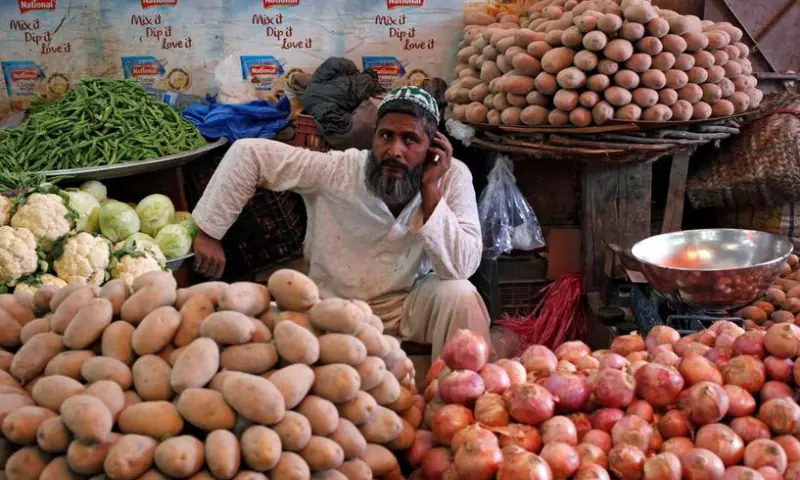


KARACHI: The State Bank of Pakistan (SBP) has said food prices could rise more than expected, potentially becoming a global issue.
In its biannual monetary policy report issued on Monday, the central bank reviewed the situation. It noted that the regional war had a more serious impact on food prices in countries such as Pakistan.
The SBP report said higher oil prices had pushed up fertiliser prices, ultimately hurting the agricultural sector. Pakistan is already facing higher food prices, while 46 per cent of the population is facing hunger-like conditions.
“The prices of agricultural commodities may also remain elevated, led by the unfolding impact of higher gas prices and risk of El Niño during the first half of FY27, which may lead to a more than expected increase in global food inflation,” said the report.
SBP warns fertiliser, gas prices may drive costs up
Agriculture in Pakistan is already facing water scarcity due to an outdated irrigation system that causes significant water losses, while modern technology has not been adopted on a large scale.
The sector is also facing high input costs, such as fertiliser, electricity and expensive seeds, while an unpredictable climate is causing further losses, particularly for small farmers.
“The Middle East crisis also impacted the global gas market, as supply from Qatar, which accounts for around 19 per cent of global LNG exports, was disrupted. This resulted in a spike in fertiliser prices, which, in turn, led to an increase in the prices of agricultural commodities,” said the SBP report.
“The re-escalation in the conflict in July led to the resurgence in energy prices. In addition, agriculture product prices continued to increase driven by a spike in fertiliser prices and prospects of a stronger El Niño this year,” said the SBP report.
Global commodity price developments since the January Monetary Policy Committee (MPC) meeting resulted in a greater-than-expected deterioration in Pakistan’s terms of trade, the report said.
Exports of food products from Pakistan fell by 25pc in FY26, reflecting the impact of higher input costs and global commodity price inflation. In FY26, food exports fell to $4.744 billion compared to $6.330bn in FY25.
Rice exports suffered the biggest decline, falling by 31pc in FY26 to $2.045bn from $2.954bn in FY25.
“The global growth outlook has also become more uncertain since January, with the IMF revising down its global real GDP growth projection for CY26,” the SBP report said, adding that the revision was largely driven by weak growth prospects in energy-importing countries due to reduced real incomes following the energy price shock.
These developments in global commodity prices have implications for inflation in both advanced economies (AEs) and emerging economies (EMs), the report said.
Global food inflation is calculated using the food price index, a monthly composite index published in the World Bank Commodity Price Data (The Pink Sheet — July 2026). This index is based on prices of key food grains, sugar, edible oils and meats.
Published in Dawn, August 12th, 2026