CM Murad rules out possibility of Sindh’s division
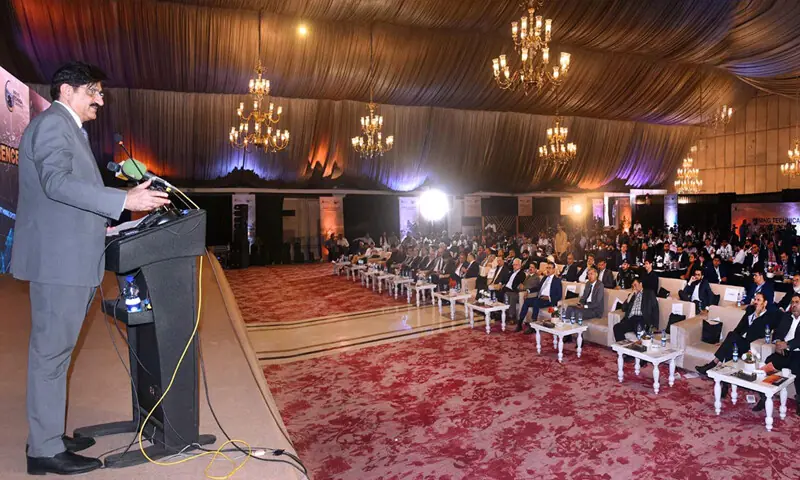
KARACHI: Chief Minister Syed Murad Ali Shah on Thursday ruled out any possibility of dividing the province, saying that the Pakistan Peoples Party (PPP) and the Sindh Assembly had “unanimously and 100 per cent” opposed the creation of new provinces within Sindh.
Speaking to reporters after the first Mining Technical Conference 2026, organised by Sindh Engro Coal Mining Company (SECMC), he addressed the renewed debate over carving out new provinces from Sindh and Punjab.
The chief minister said that Sindh could not be divided without adhering to the constitutional procedure, and reiterated that the provincial assembly had repeatedly passed unanimous resolutions opposing the carving out of any new province from Sindh’s existing boundaries.
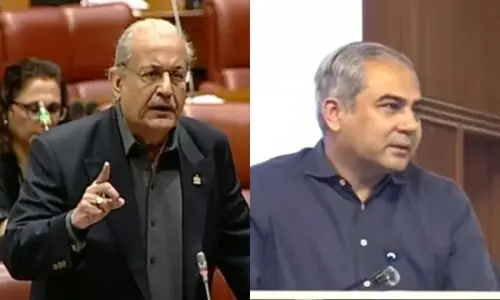
The controversy resurfaced recently after Interior Minister Mohsin Naqvi urged “serious thought” be given to creating smaller administrative units to tackle governance challenges in Pakistan’s largest provinces.
Says Constitution allows creation of a province only with a two-thirds vote in the provincial assembly
Though Naqvi had not named any specific province, his comments were immediately linked to long-standing calls to divide Punjab and Sindh.
While the Pakistan Muslim League-Nawaz, the federal ruling party, has so far avoided endorsing any specific division, leaders of the Muttahida Qaumi Movement-Pakistan have publicly said that it was the right time to hold a democratic debate on the issue. The Pakistan Tehreek-i-Insaf (PTI) leaders linked it to a public referendum and a constitutional amendment.
The chief minister said that, to form a province, the Constitution clearly stated that if a provincial assembly passed a resolution with a two-thirds majority to divide a province, it would be possible. “The Sindh Assembly has many times unanimously opposed the creation of any new province within Sindh,” he added.
He said that there was no harm in debating. “But I would also request you not to dramatise it so much that “there will be bloodshed”. God willing, nothing like that will happen,” he added.
In response to a question about recent remarks by Interior Minister Naqvi, the chief minister said that a debate on constitutional matters was not inherently dangerous, but expressed confidence that the people of Sindh “trusted the PPP government to protect the province’s interests. The people of Sindh know that the PPP has both the commitment and the capacity to safeguard Sindh,” he said.
CM Murad also defended the provincial government’s handling of a recent PTI protest in Karachi that led to major road closures. “Everyone has the right to protest. But is this the way to protest, with all traffic coming to a standstill and the whole city being brought to a halt? If you try to block traffic, then preparations have to be made,” he said.
CM highlights Thar mining success
Addressing the conference earlier, the chief minister described the transformation of Thar from a drought-hit region into Pakistan’s largest energy and mining hub as a template for resource development nationwide.
“The Thar model of mining, rehabilitation of affected communities and support for local populations should be replicated elsewhere in Pakistan to unlock the country’s vast mineral potential.”
He said that unlocking Pakistan’s mineral wealth required sustained investment, modern technology and a predictable policy environment. “Sindh pioneered the sector through a public-private partnership framework introduced in 2008,” he added.
The chief minister stressed that the future of mining hinged on human resource development, urging companies to invest in universities and technical institutions to train geologists, engineers and skilled technicians.
Highlighting progress in Thar, he said that Block-I, developed by Sino Sindh Resources Limited, and Block-II, by SECMC, were producing over 15 million tonnes of coal annually and generating around 2,640 megawatts for the national grid. “These projects are saving Pakistan more than $1.5 billion a year in foreign exchange by cutting reliance on imported fuel,” he added.
Murad said that power generation from Thar was expected to approach 3,000MW soon. “With estimated lignite reserves of 175 billion tonnes, only a fraction of Thar’s potential has been tapped,” he added.
Tracing the project’s history, he said progress remained slow for nearly two decades after the reserves were discovered in the late 1980s.
He said that through the Thar Foundation and public-private partnerships, there were 75 schools serving 5,000 students, free healthcare for nearly 500,000 patients, 33 reverse osmosis (RO) plants supplying 12 million litres of clean water monthly, and the plantation of one million trees.
The chief minister said that the government remained committed to facilitating investment and regulation in the mining sector.
Published in Dawn, August 7th, 2026