ISLAMABAD: Despite the enactment of Pakistan’s anti-torture law in 2022, torture and other cruel, inhuman or degrading treatment have persisted because of weak implementation, inadequate safeguards and a lack of accountability, the Human Rights Commission of Pakistan (HRCP) warned at a roundtable held earlier today as part of its campaign ‘Against Torture’ .
Supported by the European Union, the consultation brought together legal experts, government representatives and civil society to identify the obstacles to implementing the Torture and Custodial Death (Prevention and Punishment) Act 2022 and to develop recommendations for strengthening the country’s anti-torture framework.
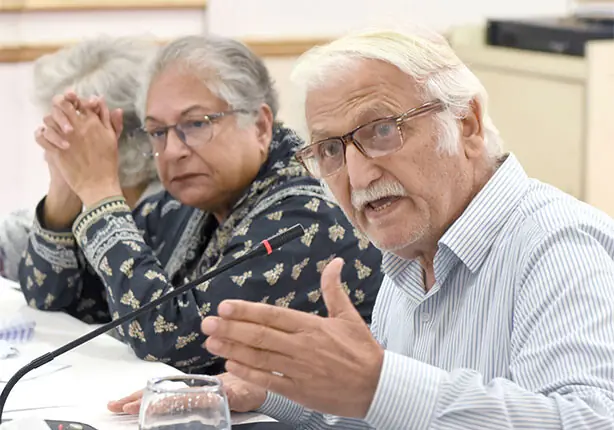
HRCP Council member and former chairperson Hina Jilani observed that preventing and addressing other cruel, inhuman or degrading treatment or punishment - including psychological torture - was equally important, given that its consequences could be just as severe and long-lasting as physical torture.
Without clear procedures and practical guidance for law enforcement agencies on how to identify, investigate, document, and respond to cases of torture and ill treatment, the law cannot be implemented effectively, she said.
Participants also noted that torture and ill-treatment were not committed solely by state actors but emphasised that the state was responsible for preventing such acts, protecting victims and ensuring accountability.
Referring to the findings of the UN Committee against Torture, lawyer Asad Jamal noted that many of the concerns it had raised in 2017, during Pakistan’s last review, had been reiterated at the country’s recent review in 2026.
This, he said, demonstrated that the underlying structural problems that enabled the practice of torture to continue had yet to be addressed.
Pakistan must establish clear protocols to prevent arbitrary detention, amend the Prison Rules in line with human rights principles and ensure that its legal and institutional framework complies with international standards, he added.
Law ministry advisor Usman Ali invited HRCP to submit recommendations on strengthening the implementation of the anti-torture framework.
PTI leader Taimoor Jhagra welcomed HRCP’s campaign but stressed that civil society had a key role to play in changing behavioural norms, adding that the failure to prevent torture was not limited to the failure of legislation.
Concluding the consultation, HRCP Council member Farhatullah Babar drew attention to the use of internment centres in Khyber Pakhtunkhwa, which he cautioned should either be abolished or brought under the civilian prison system with independent civilian oversight.
He also urged the government to ratify the Optional Protocol to the Convention against Torture (OPCAT), which would allow a national preventive mechanism to conduct regular, unannounced inspections of all places of detention.
Published in Dawn, July 31st, 2026