0
0

EVERY year — year after year — federal budget triggers a predictable debate over defence allocations, and understandably so. In times of economic constraint, inflation and competing development priorities, questions regarding increased defence expenditure are legitimate and necessary. Public resources are finite, and every budget reflects difficult choices.
However, defence spending cannot be assessed in isolation. It has to be seen within the context of the strategic environment the government intends to address. Budgets are not merely financial documents; they are instruments of national policy. They reflect a government’s assessment of risk, its constitutional obligations and its responsibility to safe-guard the state’s sovereignty and stability.
Pakistan’s security environment remains complex and dynamic. The lessons of the May 2025 Pakistan-India conflict, continuing challenges along the western frontier, and the accelerating evolution of warfare through drones, cyber operations, precision weapons and electronic warfare underscore a fundamental reality; military preparedness cannot be improvised during a crisis. It has to be done in peace-time. It is built steadily through sustained investment in personnel, training, logistics, main-tenance, intelligence and modernisation.
Much public commentary equates defence expenditure with the acquisition of weapon systems. That is an incomplete understanding. The greater part of any defence budget sustains institutional readiness, such as the salaries of personnel, operational logistics, communications, engineering support, maintenance, ammunition reserves, training and the infrastructure that enables military formations to respond effectively when called upon. Modernisation is not syno-nymous with expansion; more often, it is the continuous process of replacing obsolete capabilities and ensuring that existing forces remain operationally relevant.
The economic rationale for defence deserves equal consideration. The purpose of military preparedness is not to wage war, but to prevent it. Deterrence reduces the likelihood of conflict by raising the costs of aggression beyond acceptable limits.
While defence expenditure does not generate immediate economic returns, the economic consequences of strategic failure, like damaged infrastructure, disrupted trade, diminished investor confidence and prolonged fiscal instability, would be immeasurably greater. In that sense, defence is best understood as an investment in strategic stability.
This does not place defence beyond scrutiny. Accountability, efficiency and transparency remain essential to sound governance. Likewise, no serious national security practitioner would dispute the imperative of investing in education, healthcare, scientific innovation and human capital. These are indispensable pillars of comprehensive national power. Yet, it would be equally mistaken to conclude that Pakistan’s developmental challenges stem principally from defence expenditure.
The country’s fiscal constraints are rooted in broader structural issues, including a narrow revenue base, persistent debt obliga- tions, limited tax compliance and modest economic growth. Sustainable investment in both security and development ultimately depends upon expanding the national economy and strengthening overall fiscal governance.
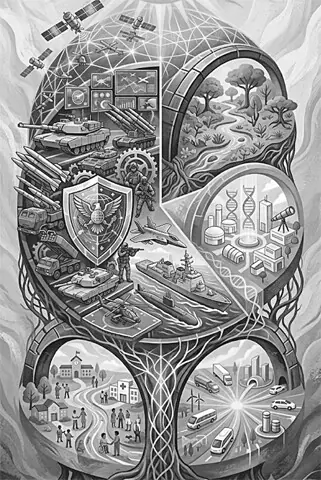
The strategic question, therefore, is not whether Pakistan should choose defence over development or the other way round. Enduring national strength requires both. Security provides the stable environment within which economies grow, institutions mature, and societies prosper. Economic resilience, in turn, provides the resources necessary to sustain credible national defence.
Pakistan’s defence budget should, therefore, be judged not by its headline figure alone, but by whether it enhances operational readiness, strengthens deter-rence, improves institutional efficiency and modernises capabilities within the nation’s economic means. That is the standard of responsible defence planning, and the benchmark by which strategic policy should ultimately be assessed.
Lt-Col (retd) Syed Raziuddin
Rawalpindi
Published in Dawn, July 24th, 2026