KARACHI: A play titled Naql-i-Makani by Rajinder Singh Bedi (1915 – 1984) and directed by Farhan Ahsan completed its three-day run on Sunday evening at the Arts Council of Pakistan. The play was part of the council’s ongoing School of Visual and Performing Arts alumni series.
Let’s, in the beginning, say that given the young director and a relatively younger cast, there was a lot in the production that one can praise. For example, the purity of intention with which the drama was put up came through. Then most of the actors did a fine job, especially Alaiza as Azra. The actress has tremendous potential, because not only does she act well, her use of diction, with reference to the timeframe in which the play was set, was worth taking note of. The only criticism that one can think of is the low production value, which, perhaps, could be overlooked.
The play highlights a yawning gap between perception and reality
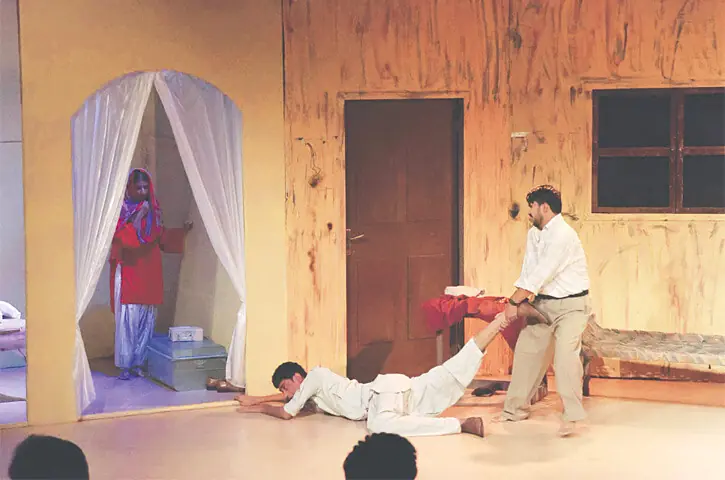
Naql-i-Makani is about a married couple Nafees (Adil Shakir) and Azra (Alaiza) who are not affluent. They have just shifted to a new house which has a strange, uneasy vibe. While they’re trying to settle in, Azra finds anklets on the floor. This, and a couple of other things, makes them worried. They call Panwari (Farhan Rahim) to inquire about the found object. It turns out that the place was previously inhabited by a dancing girl called Shado. The important piece of information perturbs Nafees and Azra, but they decide to stay put. Soon, a drunken young man Sayyan (Hamza Ranjha) walks into the house looking for Shado. Nafees tries to make him understand that Shado has gone. Sayyan doesn’t listen. He keeps insisting moving into the room where Azra is standing quietly. Once Azra speaks and tells him that she’s not Shado, he gets bitterly disappointed.
It doesn’t take time for the people living in the neighbourhood to mistake the pair for morally questionable man and woman. It leads to an altercation between Nafees and two men as a result of which a police inspector (Hasan) and constable (Aayan Aamir) come to investigate what’s happening around the house. The circumstances prove to be an unnerving experience for the couple, the kind of experience that makes them question their existence.
Naql-i-Makani is a sharp study of the yawning gap between perception and reality, and how society can have a terribly unhinging effect on modest, unassuming individuals by merely imposing its perceptions on them. Farhan Ahsan’s attempt to convey this predicament was a successful one.
Published in Dawn, July 20th, 2026