THE US-Iran deal, electronic signatures and all, hardly signals a resounding peace. But corporate and social media are nevertheless awash with much chest-thumping about the government’s successful mediation. This can only drown out Pakistan’s domestic cauldron for so long. Indeed, the people’s frustrations are growing with each passing day.
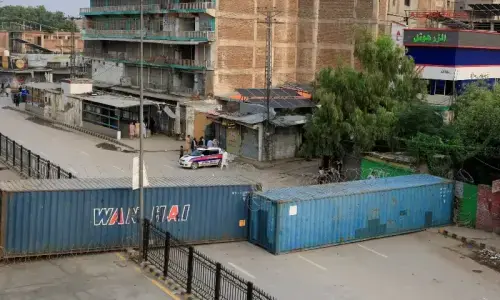
The ongoing protests in Azad Kashmir are the latest manifestation of a social order breaking at the seams. Predictably, there have been attempts to dismiss the popular upsurge as the work of ‘traitors’, an accusation often deployed in Balochistan and even KP. To do it in AJK is to effectively acknowledge that even relatively integrated populations are increasingly less willing to buy standardised ideological tropes.
Much ado has been made about the demand for the abolition of 12 seats for refugees from Indian-occupied Kashmir. The problem, however, runs much deeper than the manipulation of AJK’s ramshackle system of political representation. When the first wave of protests kicked off in 2025, they were driven largely by the bleak economic prospects of the region’s young people, including those who are well educated.
Hyperbolic comments about AJK weighing down Pakistan’s economy, inordinate subsidies and so on cannot distract from the fact that most of AJK’s working-age males emigrate to earn a living. There is no industrial sector to absorb the swathes of people leaving agriculture, and the region’s unemployment rate is 11 per cent, with the figure at almost 30pc for youth.
A youthful mass of working people sees no light at the end of the tunnel.
Like pretty much everywhere else in Pakistan, this is a straightforward story of an exceedingly youthful mass of working people who see virtually no light at the end of a long, dark tunnel. How this frustration is being channelled depends on where one is located in a highly variegated socio-spatial context.
In rain-fed parts of northern Punjab, for instance, the situation is not dissimilar to AJK. Entire villages in districts like Gujrat and Mandi Bahauddin have sent their young men off to ‘poor’ European countries like Italy and Greece. Some secure official documentation, but many do not and never live to tell the tale. It is Punjabi and Kashmiri men who make up the vast majority of Pakistan-origin ‘illegal’ migrants who perish when boats capsize in the Mediterranean Sea.
This is the situation of the ‘better-off’ and more integrated parts of the country. Go deeper south, and the situation deteriorates further. Seraiki migrant labourers have flocked to Pakistani cities in recent years, the vast majority confined to menial occupations, especially in the construction sector. Some amongst them also seek to go abroad by any and all means necessary. Sindh has experienced more outmigration from rural areas over the past two decades than in most of its history, the effect of repeated floods and growing land inequality being brought to bear in unprecedented ways. Most Sindhis go to Karachi, with emigration abroad relatively less prevalent. Either way, very few secure dignified work sufficient to meet their needs.
The Pakhtun and Baloch cases are distinct inasmuch as the ravages of war and repression alienate many young people from the mainstream. This is on top of agrarian distress and natural resource grabs by the state and capital. It is thus that for Pakhtun youth in particular, emigration abroad is perceived as the best way out of an untenable situation.
Not only does the mainstream refuse to acknowledge the underlying material anxieties of youthful masses across metropolitan and peripheral areas, it continues to resort to the refrain of the foreign hand to explain away expressions of popular discontent. This is tunnel vision at best, and a recipe for disaffection to intensify.
Meanwhile, formal exercises like the unveiling of the federal and provincial budgets are out of touch with actually existing realities on the ground, both because the overwhelming majority of working people live and work in the informal economy and because the budgets deliberately pretend politics is unconnected to economics.
In a similar vein, official commentators here have lots to say about the Gen Z uprisings in other parts of South Asia. They become highly refined sociologists with an eye on class, demography and the effects of digital technology. But they demonstrate no such clarity in making sense of the organic triggers of discontent here.
The massive gulf between officialdom and the people has been reproduced time and again, with no lessons being learned despite many egg-on-face moments. Today, we are in the midst of a demographic explosion that will not abate till the middle of the century. The volcano will erupt sooner or later.
The writer teaches at Quaid-i-Azam University, Islamabad.
Published in Dawn, June 19th, 2026