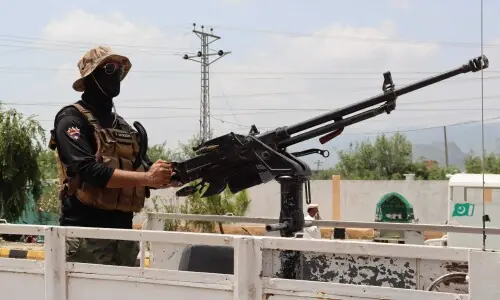
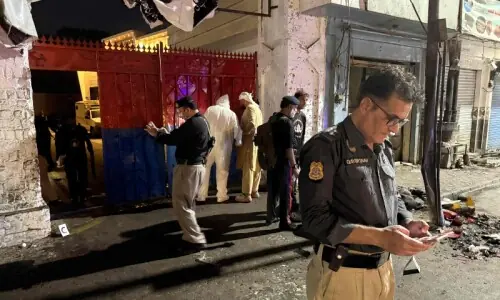
IT is a bitter irony that terrorists struck a protest against violence in Swat on Sunday, causing at least 17 fatalities. Both policemen and civilians were martyred in the atrocity.
Reports indicate that a suicide bomber blew himself up near a police station as the anti-terror protest was underway when officers tried to search him. Some media outlets have said the banned TTP has claimed responsibility for the bombing.
This bloodbath should lead to thorough counterterrorism action, as the people of Swat — and indeed the rest of KP — deserve to live in an atmosphere free of terrorism and violence.
Unfortunately, as pointed out in an exclusive report published in this paper, gaps in training have left LEAs in KP vulnerable to ‘double-tap’ or ‘two-stage’ attacks by terrorists. Moreover, the casualty numbers from July, and the first half of 2026, indicate that a fresh CT strategy is needed to bring down the number of fatalities, and effectively neutralise the threat of terrorism.
The fact is that terrorists appear to be operating without fear of consequences, while LEAs are unable to stay ahead of them. A string of recent ‘two-stage’ attacks in KP illustrate this point.
The terrorists’ modus operandi involves attacking security facilities, waiting for reinforcements to arrive, and then staging secondary attacks. A number of security personnel have been martyred in these attacks.
Police officials say forces lack the training to counter these attacks, while experts also question how terrorists are able to maintain their supply lines. The gaps in training need to be filled so that security forces are able to defend themselves, gain the upper hand over violent elements, and, through better intelligence, break up their networks and thwart their attacks.
At present, the terrorism figures, particularly in Balochistan and KP, do not paint a reassuring picture. According to the PICSS think tank, there were over 600 fatalities in July. While the vast majority was of terrorists, over 200 security men, civilians and peace committee members were martyred last month. Balochistan saw the highest levels of violence, while KP was not far behind.
Overall, in the first six months of 2026, Pakistan has witnessed over 900 fatalities involving LEAs and civilians. This is far too high a toll, and the state needs to urgently refine its CT strategy to prevent further loss of precious lives.
It is a matter of great concern that despite the martyrdom of so many policemen and soldiers, as well as civilians, the state is unable to vanquish the monster of terrorism. Hostile external forces may indeed be creating problems, but as security experts point out, we have failed to secure spaces within our borders where terrorists operate from. This continuous bloodbath must end so that people can live in peace.
Published in Dawn, August 4th, 2026