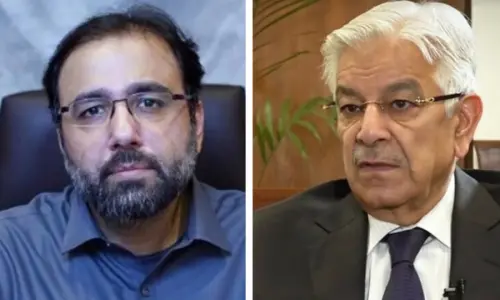
Naqvi vows crackdown on sectarian content online as Muharram Peace Committee meets in Islamabad

ISLAMABAD: Federal Interior Minister Mohsin Naqvi and Minister of State for Interior Tallal Chaudhry on Tuesday chaired a special meeting of the Paigham-i-Aman Committee to discuss arrangements for Muharram and measures to curb sectarian incitement.
Muharram is a month of mourning, observed in particular by Shia Muslims worldwide. It commemorates the Battle of Karbala in 680AD, where, amongst many, the grandson of Prophet Muhammad (Peace Be Upon Him), Imam Husain (RA), was martyred. The first of Muharram will fall on Wednesday, June 17 while Ashura will be observed on June 26.
The committee discussed in detail steps to promote inter-sect harmony and religious tolerance during Muharram. It decided that action would be taken against those spreading incitement and sectarianism on social media.
Naqvi said maintaining strong and sustained contact with the ulema was among the ministry’s priorities. “The Paigham-i-Pakistan Committee will be made active and effective down to the district level,” he said.
He said public awareness against terrorism and extremism in light of the Holy Quran and Sunnah was the need of the hour, noting: “There is no room in Islam for rebellion against the state and spreading chaos. The ulema should guide the public in this regard.”
The minister announced that a coordinator would be appointed for the peace committee and termed the maintenance of law and order during Muharram a “collective responsibility”.
Naqvi also credited Prime Minister Shehbaz Sharif with leading Pakistan’s role in US-Iran negotiations, which contributed to the announcement of an agreement on Monday. He added that Chief of Defence Forces (CDF) and Chief of the Army Staff (COAS) Field Marshal Syed Asim Munir played a key role “as captain on the ground” and said all officials, including himself, had performed their duties “like team players”.
“A historic agreement between the two countries was reached as a result of this teamwork,” he said. He added that CDF Munir was a personality trusted by all sides in the US-Iran talks, saying, “Many countries also tried to mediate, but could not succeed.”
The minister said the field marshal spoke firmly when needed and pointed out mistakes, which strengthened mutual trust.
He recounted that when the ceasefire talks were near collapse, the CDF told Iranian negotiators that on the Day of Judgement they would bear witness that he had tried sincerely to save even a single life, and that the responsibility for war, if it occurred, would lie with them.
“These words influenced the Iranian negotiators and talks moved forward,” he said.
The meeting was attended by prominent religious scholars, including Allama Tahir Mahmood Ashrafi, Senator Hafiz Abdul Karim, Mufti Abdul Raheem, Allama Arif Hussain Wahidi, Pir Naqeeb ur Rehman, Allama Muhammad Hussain Akbar, Dr Muhammad Raghib Hussain Naeemi, Maulana Tayyab Qureshi, Allama Ziaullah Shah Bukhari, Bishop Azad Marshall, Rajesh Kumar Hirdasani and Sardar Ramesh Singh Arora.
Coordinators of provincial and regional peace committees and representatives of registered madrassa boards were also present, along with the interior secretary, additional secretary for religious affairs, information secretary, and Islamabad’s chief commissioner and inspector general of police.
Religious scholars at the meeting paid tribute to the prime minister, CDF and interior minister for the peace agreement. Chaudhry said the role of the peace committee was commendable.
The meeting concluded with a special prayer for the country’s security, stability and law and order.