WILLIAM Caxton established the first printing press in England and printed the first book in 1473, thereby unleashing a revolution that was to bring a sea change to the world through print culture. Charles Wilkins, an English orientalist, translator and typographer, is often dubbed ‘the Caxton of the subcontinent’ as he was the first to have cast the metallic moveable typeface used in printing for Bengali and Persian scripts.
According to Muhammad Ateeq Siddiqi, newspapers and books in Persian and Urdu in the late 18th and the early 19th centuries were printed through the typeface invented by Wilkins. The popularity of Wilkins’ typeface can be gauged by the fact that his typesets were used for printing the Persian books at Haileybury College, (Hindustani Akhbaar Navisi Company Ke Ehd Mein, Aligarh, 1957, p. 42), established in England for teaching oriental languages. Wilkins is credited for casting typeface to get the material printed in Devanagari script, too. Wilkins had also tried to get cast nast’aleeq type, a more favoured font of Urdu as compared to naskh, but the nast’aleeq typesets were considered much complicated and were abandoned once he left for England. In 1802, at Calcutta a printing press named Hindustani Press was working and had printed a few books for Fort William College. Of them, at least one Urdu book, titled Akhlaaq-i-Hindi, was printed at Hindustani Press.
Akhter Shahanshahi, an Urdu book by Akhter-ud-Daula Haji Syed Muhammad Ashraf, published in 1888, is considered an important source on the history of Urdu journalism and printing in the subcontinent. But the book is also responsible for some of the misconceptions widespread among the scholars of Urdu. For instance, the book says Moulvi Muhammad Ikraam Ali had established the Hindustani Press in 1810. But Muhammad Ateeq Siddiqi in his book Gilchrist Aur Us Ka Ehd (Aligarh, 1979, P. 28-29) has clarified that Hindustani Press was set up by John Gilchrist in 1802 and it printed books in Persian and other scripts as well.
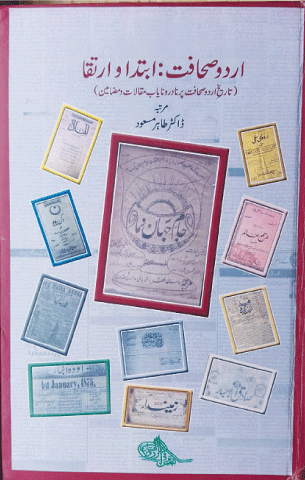
Qazi Abdul Ghaffar, a well-known writer and journalist, in one of his articles repeated this piece of incorrect information about Hindustani Press. The article was first published in November 1940 issue of Nigaar. Now Qazi Sahib’s article has been included in a book titled Urdu Sahafat: Ibtida-o-Irtiqa (Urdu journalism: the beginning and the development). Compiled and annotated by Prof Dr Tahir Masood and published by Karachi’s Anjuman Taraqqi-i-Urdu Pakistan, the book is a collection of some very important and rare articles, written by some stalwarts, on Urdu journalism and its history. Some articles also mention the earliest printing facilities for Urdu and other languages in the subcontinent. Tahir Masood has done a good job by compiling and annotating these articles, correcting several inaccuracies and misconceptions in his footnotes.
Some of the articles included in the book are nearly a century old and are packed with rare information on Urdu printing, publishing and journalism. For instance, Pandit Brij Mohan Dattatreya Kaifi’s article, titled ‘Ab Se Aadhi Sadi Pehle Ke Urdu Akhbaar’, or the Urdu newspapers published half-a-century ago, not only gives some vital information on Urdu newspapers published in the early 18th and the late 19th century but also skilfully sums up some historical, political, social and journalistic trends in the subcontinent. Abdus Sattar Siddiqi in his article has provided the readers with some information that is uncommon and hard to come by, for instance, he says the subcontinent’s first printed newspaper was Hickey’s Bengal Gazette, launched from Calcutta (now Kolkata) on Jan 29, 1780. It was an English-language newspaper. The article describes some of the earliest Bengali, Persian and Urdu newspapers published in the subcontinent.
Other articles that have made it to the book are by such veterans as Abul Lais Siddiqi, Ziauddin Barni, Abdul Majeed Salik, Shanti Ranjan Bhattachariya, Imtiaz Ali Arshi, Jamna Das Akhter, Imdad Sabri, Haamidullah Afsar, Ateeq Siddiqi, Naadim Sitapuri, Raees Ahmed Jafri, Maalik Ram, Khwaja Ahmed Farooqi and Khalid Hasan Qadri. Biographical notes by Tahir Masood at the back of the book proffer important information on the writers whose articles are included.
Prof Dr Tahir Masood (born 1957) is a senior academic, journalist and researcher. Aside from his journalistic contributions, he has served as the professor and head of Mass Communication Department, University of Karachi. During his research work for his doctoral dissertation on Urdu journalism, he came across some rare and significant articles on Urdu journalism and, fortunately, preserved them. Now presented in a 714-page book, these articles are a treasure-trove of information for the students and teachers of media studies.
Published in Dawn, June 8th, 2026