US slaps fresh sanctions as rockets, drones fly in Hormuz
• Centcom denies Iranian claim of firing ‘warning shots’ at American destroyers
• Oman port comes under attack; US forces board sanctioned vessel in Indian Ocean
• Araghchi threatens Gulf states hosting US bases, again
• Iranian official says deal hinges on fate of ‘frozen assets’
• IAEA chief claims US, Iran close to agreement on N-framework
• Lavrov backs Pakistan-mediated talks
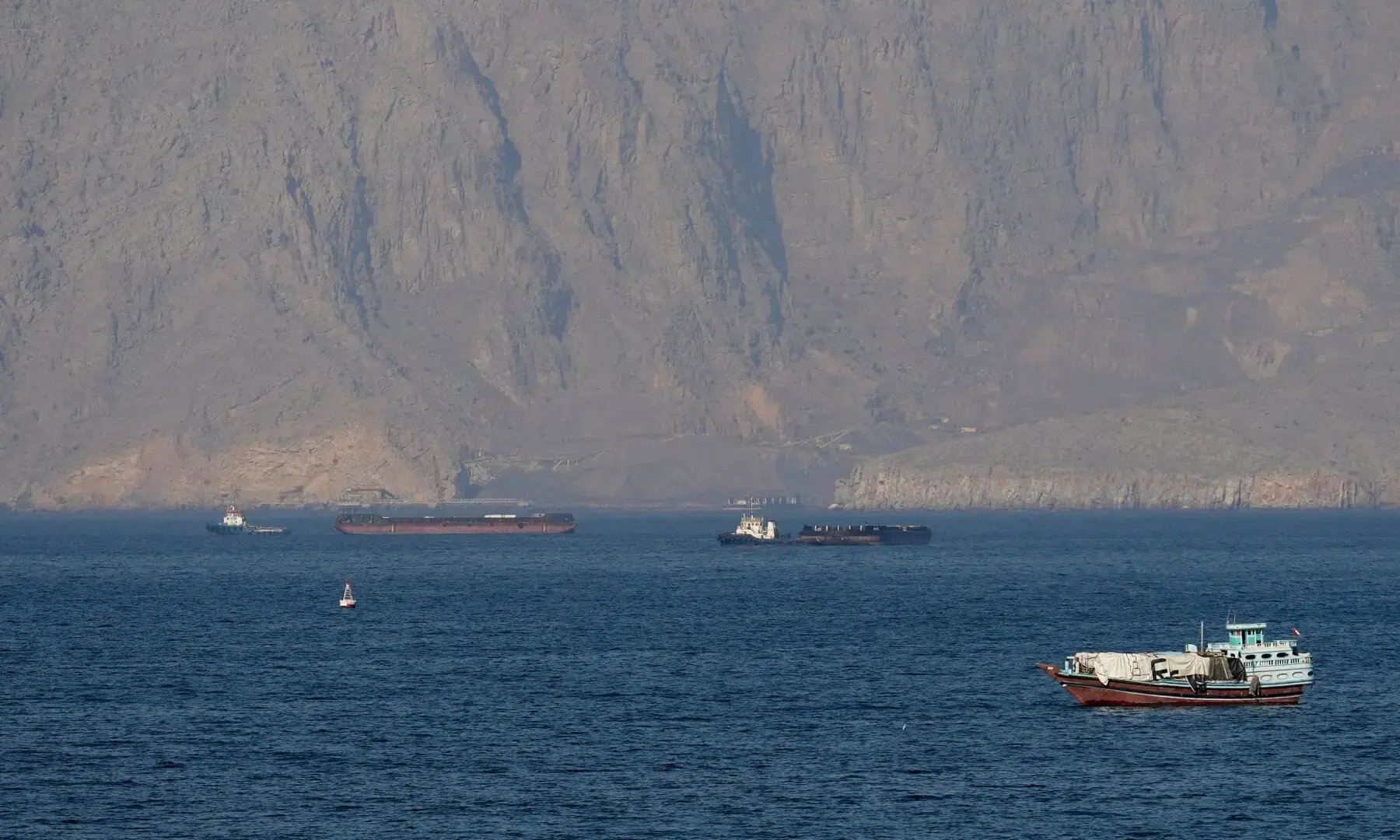
WASHINGTON / TEHRAN: Tensions remained high in the Strait of Hormuz, as Iran claimed to have fired ‘warning shots’ at US vessels, while Washington denied the claim, and responded with a fresh set of sanctions targeting Iranian assets and vessels.
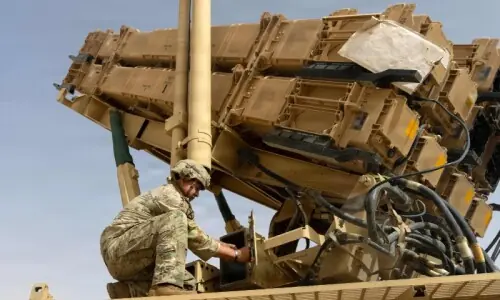
According to the Tasnim news agency, the Iranian navy fired missiles attack drones, forcing two US destroyers to leave the Sea of Oman.
However, the US military denied the claim. “Iranian forces did not attack or fire at US Navy warships. Doing so would be a gross violation of the ceasefire. US forces continue to operate freely in regional waters while fully enforcing the ongoing blockade against Iran,” Centcom wrote on X.
However, around the same time, Oman’s Mina al Fahal terminal briefly suspended oil loading following an explosion near its single-buoy mooring (SBM) berths. It later said that operations were proceeding normally, but the development causes oil prices to fluctuate.
Separately, US forces announced the interception of a sanctioned tanker in the Indian Ocean.
The Davina, a supertanker capable of carrying up to two million barrels of crude oil, was placed under US sanctions in October 2024 for Iranian oil trading, according to ship tracking data.
The vessel, also known as the Lenore, was last seen on June 5 off Sri Lanka’s southern coast, ship tracking data on the MarineTraffic platform showed on Friday.
The exchange comes amid heightened tensions over maritime security, and follows attacks on US bases in Kuwait and other neighbouring Gulf states.
On Friday, Iran’s Foreign Minister Abbas Araghchi issued another direct warning, saying: “We warned regional states that US bases used for any aggression against Iran are legitimate targets.”
He said that “standing against the world’s greatest power, equipped with nuclear weapons, for 40 days is no joke”, and that “the world has realised the true power of the Iranian nation”, Al Jazeera reported.
Meanwhile, the US Treasury imposed sanctions on a network of individuals, entities, and tankers smuggling Iranian-origin liquid petroleum gas disguised as Omani LPG to South and East Asia.
The latest targets include 12 entities, five of which are based in the Marshall Islands, four in the UAE, and one in China, according to details posted on the department’s website. Six LPG tankers were targeted, including four Panama-flagged vessels.
The Treasury Department, in a statement, alleged the network used front companies in the UAE and China, as well as foreign bank accounts, to move millions of barrels of Iranian LPG while concealing its origin to evade US sanctions.
Moscow backs negotiations
Russia on Friday said it supports ongoing negotiations between Iran and the United States and that any potential agreement must take into account the interests of Iran and its neighbours.
In an interview with Izvestia, a state-aligned Russian newspaper, Foreign Minister Sergey Lavrov said Washington recognised the tensions with Iran and was disturbed by the situation, but did not know how to resolve it.
“Of course, they themselves are primarily responsible for this situation,” he added.
However, Mr Lavrov said Moscow backed the negotiations, “taking place in one way or another between officials in Washington and Tehran with Pakistani mediation”.
Saudi Arabia and Egypt are also trying to contribute to the process, he said, adding that it was very important that these dialogues continue.
“Any agreement reached must take into account the interests of Iran and its neighbouring countries,” he said.
Meanwhile, Russian President Vladimir Putin also weighed in on the US-Iran war, saying that Moscow wanted oil prices on global markets to be balanced and stable.
Speaking at Russia’s annual economic forum, Putin said that the reduction in oil supplies was causing concern in the market, but that Russia was participating in OPEC+ in order to balance the market.
Trump ‘upbeat’
Even though the dialogue process between the warring sides is at an impasse, US President Donald Trump appeared upbeat about the prospects.
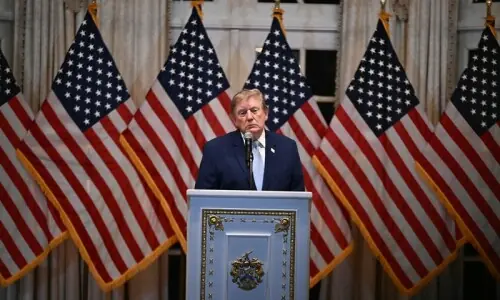
Washington is having “great success” with Iran, he claimed, saying: “They’re in no position to have a nuclear weapon.”
Asked about oil prices and production in the US, he responds, “We have everything we need, the world doesn’t.
“But I will say, people thought it was going to be a lot worse,” he told reporters aboard Air Force One.
However, CNN reported that a potential agreement between Washington and Tehran hinges on the Trump administration agreeing to release $24 billion in frozen Iranian assets.
According to Mohsen Rezaei, an adviser to Iran’s supreme leader: “The negotiations are at a deadlock and [US President Donald] Trump must break this deadlock,” he said.
‘Close to agreeing N-framework’
The head of the UN’s nuclear watchdog says Iran and the US are close to agreeing on a nuclear framework, which would give both parties time to address outstanding issues.
International Atomic Energy Agency (IAEA) chief Rafael Gross says the organisation is in contact with both sides but is not directly involved in talks.
“Our sense is that they seem to be pretty close to agreeing on what I would describe more with regards to the nuclear … to sort of a framework, organisational structure to give themselves time to look into the different problems,” he states.
Grossi made the comments following an emergency meeting of the IAEA’s Board of Governors in Vienna.
The meeting was requested by Egypt, Jordan, Morocco, and Saudi Arabia in response to Iran attacking the UAE’s Barakah Nuclear Power Plant last month — an incident that Grossi said was “unacceptable”.
Earlier, at the board of governors, Iran detailed how the US and Israel carried out 17 waves of strikes against Iranian safeguarded nuclear sites in 2025 and 2026.
It called on the international community to adopt a “zero-tolerance policy” toward armed attacks on peaceful nuclear facilities
In a statement, Iran’s delegation said one of the gravest attacks targeted a structure just 350 metres from the reactor at the Bushehr Nuclear Power Plant, which contains thousands of kilogrammes of nuclear material.
The IAEA director general has previously said a direct hit on the plant could result in a “very high release of radioactivity to the environment.”
Iran maintained that the attacks constitute war crimes and acts of aggression, entailing international responsibility and individual criminal liability for the perpetrators.
Published in Dawn, June 6th, 2026