THE UNRAVELLING OF THE AMERICAN EMPIRE
“My name is Ozymandias, king of kings:
Look on my works, ye mighty, and despair!
Nothing beside remains. Round the decay
Of that colossal wreck, boundless and bare
The lone and level sands stretch far away.”
— Percy Bysshe Shelley, Ozymandias
“I am in blood,
Stepped in so far that, should I wade no more,
Returning were as tedious as go o’er.”
— William Shakespeare, Macbeth
PROLOGUE
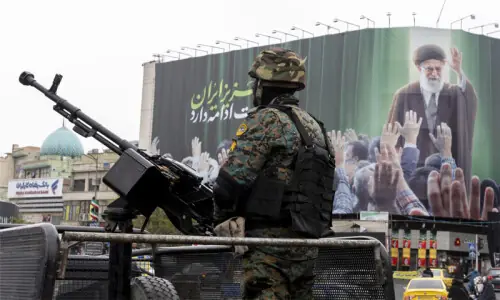
This is and isn’t about America’s illegal war against Iran. It is primarily about hiding an empire in plain sight and now watching it unravel in plain sight.
The war against Iran becomes a consequential event in tandem with other structural weaknesses, a fillip of sorts. It reminds one of the Soviet war on Afghanistan. That war, in and of itself, did not bring down the Soviet Leviathan. The process inhered in the very make-up of the Soviet Union. The war just shoved it over the precipice. But let’s get on with our purpose here.
In August 2022, then-US President Joe Biden signed the CHIPS and Science Act into law. A $280 billion legislative package, it sought to revitalise domestic semiconductor manufacturing.
The act was a response to a startling vulnerability: the world’s most advanced chips, essential for everything from F-35 fighter jets to surgical equipment to artificial intelligence, are overwhelmingly manufactured by a single company, the Taiwan Semiconductor Manufacturing Company (TSMC), located on an island claimed as sovereign territory by America’s primary strategic rival, China.
This dependence is not an accident of geography or a supply chain anomaly. The semiconductor industry wasn’t even hobbled by Covid 19. Despite its complex and far-flung operations, the industry works smoothly. The US dependence is the logical endpoint of a decades-long corporate strategy that maximised profit by outsourcing physical production while retaining only the high-value design and marketing ends of the value chain, the so-called “Smile Curve” strategy.
The undoing of the United States in the Iran war may be far more significant than its defeats in Vietnam, Iraq and Afghanistan. It may well mark a historic milestone in the fraying of the position of the US as a global hegemon. But the seeds of this erosion of American dominance, argues Ejaz Haider, were laid long before its misadventure in Iran…
The Italian economist and sociologist Giovanni Arrighi, to whom I shall return, would have been amused to see the revered smile curve — taught at prestigious business schools and which encourages firms to outsource capital-intensive manufacturing to focus solely on high-margin research and development (R&D), branding and marketing — as a classic trap of late-stage capitalism.
In fact, the CHIPS Act stands as a state-level admission that this strategy, so profitable for individual corporations like Apple and NVIDIA, to name just two, has become a major geopolitical vulnerability for the US. This is the central paradox of America’s declining empire. The very mechanisms that generated unprecedented wealth have systemically dismantled the material and industrial foundations upon which that wealth ultimately rests.
The decline of the American empire is not a partisan talking point.
The US is a behemoth. It won’t just collapse one day like the Berlin Wall. Nor is a snapshot view the way to go. It is an ongoing structural process and a number of scholars have used longitudinal designs to analyse the trend lines.
I argue that it is a slow, systemic unravelling across interconnected domains.
First, the financialisation of capital, theorised most rigorously by Arrighi. Capital shifts from productive investment to speculative finance, generating short-term profits at the cost of long-term industrial vitality. It hollows out domestic industrial and political power, a process identified by American sociologist and political scientist Ho-fung Hung, who argues that off-shoring of production destroys the industrial ecosystem, skilled labour base and, ultimately, the social cohesion required for great power competition.
Second, the erosion of the alliance system. And no, it’s not just Trump. Three deeper currents are involved: the gradual unravelling of the post-WWII security architecture; the economic failure of neoliberalism; and the imperial outreach baked into the very idea of neoliberalism.
Third, the lateral diffusion of technologies, now commodified and everywhere. They help innovative and determined weaker powers offset the asymmetric advantage of bigger powers: Ukraine versus Russia; Hamas/Hezbollah/Houthis versus the US-Zionist duo; and now Iran versus the US-Zionist duo.
As I note later in this space, the war against Iran is a much bigger setback for the US than its wars in Vietnam, Afghanistan and Iraq.
Corollary: the post-WWII ‘Pax Americana’ is transitioning from a period of hegemonic stability, to use American historian Charles Kindleberger’s concept, into a protracted and likely irreversible, terminal crisis, to borrow Arrighi’s term. But let’s first begin with the peg: the war against Iran.
THE PRESENT
Since its inception, America has been at war: wars of choice, wars of conquest, wars for resources, wars to defend its hegemony, wars to spread “American values.” How or why does the Iran war stand out?
Foremost, the conflict has confirmed the structural limits of US coercive diplomacy in a shifting multipolar world. It has exposed acute structural vulnerabilities in defence economics and inventory endurance, as well as a critical absence of pragmatic post-war planning and a misreading of societal resilience. The conflict has also underscored the changing nature of global alignments in a multipolar world.
This comes with the collapse of coercive economic power. For four decades, the US has relied on sophisticated sanctions and lawfare to pressure Iran into subjugation. It has failed, showing the limits of sanctions, especially on fungible commodities. Even sanctions on non-fungible elements like technology can be circumvented. As in Iran’s case, the sanctioned state can develop indigenous expertise through varied strategies.
There’s clear evidence that Tehran has developed complex and sophisticated non-dollar lifelines with China and Russia, rendering unilateral sanctions increasingly ineffective. It has used an array of strategies to blunt the effect: interchangeability (can’t sell to X; sell to Y); value retention (barter, use of cryptocurrencies); substitution and evasion (relying on third parties, covert ship-to-ship transfers, use of shell companies).
Unlike the insurgencies in Vietnam, Iraq and Afghanistan, the US is not involved in ground combat in Iran (so far). It has relied on high-tech aerial and missile attacks through its formidable ISTAR (Intelligence, Surveillance, Target Acquisition and Reconnaissance) capabilities.
Iran has not responded through elusive, hit-and-run ground attacks. It has countered US technology through technology in a non-contact war. But its employment of technology is grounded in asymmetric capabilities: a large arsenal of ballistic missiles, cruise missiles, and one-way attack drones. The cost-exchange ratio, by most accounts, is unfavourable for the US.
For instance, the Iranian Shahed-136 one-way attack drone has an estimated unit cost of $20,000 (some estimates put it at around $10,000). It is a simple, slow-moving, and relatively easy to detect drone. But it is also cheap and plentiful. To intercept it with costly SM-2 or ESSM missiles creates a cost-exchange ratio of between 30 to one and 100 to one.
It is also a shoot-and-scoot system. Iran can afford to lose hundreds of such drones and produce some 1,000 per month. The US cannot afford to fire thousands of interceptors at them. And those interceptors take three to four years to manufacture. It is a cost-asymmetric war.
Similarly, the US has been pulling out assets from the Pacific to the Gulf. The USS Boxer amphibious group is an example. Diverting naval assets from the Pacific physically manifests deployment overstretch. As Robert Farley, visiting professor at US Army War College notes, resources needed to prevail in one theatre guarantee weakness in another. It’s the same with all force deployments and employments: “Every missile allocated to one target is unavailable for another.”
The contrast with Vietnam, Iraq and Afghanistan is instructive. In those theatres, the US was defeated by determined insurgencies, even as it bombed and bombed. The adversaries were willing to absorb enormous casualties, drag it out and inflict mission fatigue on the US. In both Iraq and Afghanistan, broadly speaking, the US won the conventional war expeditiously but then got bogged down.
In the Iran conflict, while Tehran has demonstrated the ability to absorb much pain, the US is not facing elusive insurgents but a state with a sophisticated missile programme, a sharp understanding of force employment, a network of allies across the region (Hezbollah in Lebanon, Ansar Allah in Yemen, and Hashd al-Shaabi in Iraq and Syria), and the ability to close the Strait of Hormuz, through which 20 percent of the world’s oil passes.
Iran has also demonstrated adaptation under fire, used the operational strategy of dispersal and delegation, exercised deception, demonstrated growing targeting capabilities through ISR, rapid repair of underground sites after US-Zionist bombing and consistently shifted locations for counterattack operations.
Can the US still bomb Iran? Of course. Will that be painful? Yes. Will Iran respond? Hell, yes. Would that raise the overall cost? You can bet your dime on it. It will be proof, yet again, that it is a slow grind and the US cannot achieve its objectives at a sustainable cost.
Yet, it is stuck, because to walk away means it loses credibility. Trump needs a win; Iran is not prepared to give him that. The war has changed the ground realities. There is no status quo ante. The objectives remain strategically incompatible — ie we might get a pause, even a long one, but the essential causes remain unaddressed. Spoiler alert: Zionist entity.
THE POINTILLIST EMPIRE: HOW IT BEGAN
American imperialism did not begin with grand pronouncements like the Monroe Doctrine or the Big Stick diplomacy of Theodore Roosevelt, though they give us a potent sense of a rising, expansionist power. It literally began with bird poop, which sounds about right if one were to understand imperialism as a crap enterprise.
The Guano Islands Act of 1856 allowed US citizens to claim uninhabited, guano-rich islands. The act set a precedent for later overseas acquisitions. Historian Daniel Immerwahr calls this a “pointillist” empire. This practical, resource-driven, and often hidden expansion set a pattern that would define America’s power and military bases for the next century.
The Mexican-American War (1846-1848) established the continental empire, seizing vast territories from Mexico. This wasn’t a war of liberation but a war of conquest, not manifest destiny but a fig leaf to cover the musty crotch of violent expansion, economic greed and racial supremacy. The 1848 Treaty of Guadalupe Hidalgo formalised the seizure of over half of Mexico’s territory.
The Spanish-American War of 1898 definitively projected American power overseas. Theodore Roosevelt’s Secretary of State John Hay, in a personal letter to Roosevelt, called it a “splendid little war.” By its end, the US had seized Cuba, Puerto Rico, Guam and the Philippines.
But the “splendid” label concealed a brutal reality, just like the payload of Trump’s “gorgeous B-2 bombers.” The subsequent Philippine-American War (1899-1902) resulted in Filipino genocide. That savagery has been systematically erased from American popular memory, even as Mark Twain was scathing in his condemnation and also did a fantastic job of calling out Rudyard Kipling for The White Man’s Burden.
But this wasn’t all. Immerwahr documents that American forces employed waterboarding (yes, much before the darned ‘War on Terror’), concentration camps (“black sites”), and scorched-earth tactics that would be recognisable to any student of colonial atrocities.
After World War I, US President Woodrow Wilson attempted a new form of imperialism: liberal internationalism, rather than direct territorial control. Much has been written about the “Wilsonian moment.” British historian and diplomat E. H. Carr called it a utopian project, divorced from the reality of power politics. In fact, it wasn’t. The project was essentially colonial and Wilson’s liberal internationalism fit it perfectly. The mandates were thriving.
The US Senate’s refusal to join the League of Nations left a vacuum that no amount of idealistic pronouncements could fill. War did come. Carr gives us insights into why it became inevitable. The US emerged from the war as the leading power. The post-WWII order was a direct lesson learned from the intervening two decades. No more “isolationism”. The US must play the role of the hegemonic stabiliser.
The core argument was simple and powerful: a stable world economy requires a single power to act as lender of last resort, maintain an open market for distressed goods, and coordinate macroeconomic policies. The US did that via the Bretton Woods system, the Marshall Plan and a vast security architecture that spanned the globe.
The quid for the quo? American dominance. The US was now fully involved. It bore the cost but the return on investment was handsome. It kept the US in the lead, even during the bipolarity of the Cold War and beyond. With the Berlin wall crumbling, American political scientist Francis Fukuyama became the mascot for neoliberalism. History had ended; all the wagon trains were destined for one town. Some might arrive late, but arrive they would.
Europe was pacified and rebuilt. Japan was demilitarised and transformed into a manufacturing powerhouse. The dollar became the world’s reserve currency, giving the US what French President Valery Giscard d’Estaing called “exorbitant privilege.”
For three decades, from 1945 to the early 1970s, this system appeared to confirm the virtues of hegemonic stability. Real GDP growth in Western Europe averaged nearly five percent annually, and the US share of world manufacturing output remained above 40 percent. But beneath the surface, the seeds of decline were already being sown.
ARRIGHIAN COUNTER
World-systems theorists like Immanuel Wallerstein and Giovanni Arrighi were not focused on immediate “imperial overstretch” in the manner of British historian Paul Kennedy. Kennedy argued that empires declined when their military commitments outpaced their economic base. The US, he warned, was suffering from imperial overreach.
For Arrighi, the decline was gradual and subtle. He argued that capitalist hegemonies move through repeating “systemic cycles of accumulation.” A phase of material expansion where capital is invested in production, infrastructure and trade, inevitably gives way to a phase of financial expansion, where capital seeks profit through speculation, lending and financial engineering.
The material foundation is hollowed out even as the financial superstructure appears to boom. This was the logic of capitalism. The “autumn” of each hegemon is marked by a dazzling financial belle époque that masks terminal decline.
The smile curve strategy is the purest expression of this financialisation and Apple is a textbook case. It designs its products, develops its chips, creates the operating systems, controls the branding, marketing and the retail experience. But it manufactures almost nothing. The iPhones and MacBooks are assembled by Foxconn in Zhengzhou and by Pegatron in Shanghai. The advanced chips are fabricated by TSMC in Taiwan. The displays come from Samsung in South Korea and LG Display.
Apple captures an estimated 80-90 percent of the profit from each device, while the suppliers who do the actual physical work fight over the remaining scraps. Business schools love this strategy because it maximises corporate profits and shareholder value.
But as Hung argues in his work on global value chains and the Arrighian counter, what maximises corporate profits does not necessarily maximise national power. In fact, it may systematically undermine it.
By outsourcing the middle of the smile curve, the US has drastically hollowed out its industrial ecosystem. Combine it with the faith in short, sharp wars of shock and awe through high-tech precision weapons and we get the full picture of what has happened in the war against Iran. This is very different from the WWII industrial base of America.
This brings us to TSMC and the chokepoint crisis. It manufactures chips designed by other companies (Nvidia, AMD, Qualcomm) rather than designing and selling its own chips. Over three decades, TSMC has built an unassailable lead in advanced process nodes. By 2025, it was manufacturing 92 percent of the world’s most advanced chips. The entire global technology industry (including the US military and intelligence apparatus) became dependent on a single cluster of fabs (fabrication plants) in Hsinchu, Taichung and Tainan.
China, which views Taiwan as a breakaway province to be reunited with the mainland by force if necessary, has the physical means to blockade or invade the island. Whether it would do so or should is a different debate. On ground, the People’s Liberation Army has been systematically building anti-access/area denial (A2/AD) capabilities, to prevent US intervention in a Taiwan scenario.
It’s a fairly absurd position from the US point of view! Its technological supremacy is guaranteed by a factory complex on an island which, in theory, its primary strategic rival could potentially seize or blockade.
To circle back to the CHIPS Act, this is the background. TSMC is now building a fab complex in Arizona. Intel is expanding in Ohio and Arizona. Samsung is building in Texas. But, as a 2023 Marketplace report noted, replicating TSMC’s “deep, deep process knowledge” will take years. The fab in Arizona has already faced delays, cost overruns, and labour disputes. Taiwanese engineers are reluctant to relocate to the United States. The set goes to Arrighi.
THE DOLLAR DILEMMA
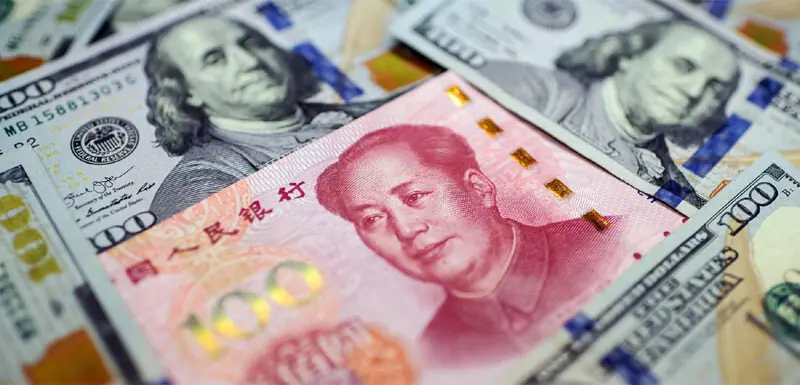
The dollar’s role as the world’s primary reserve currency has been a central pillar of American power since the Bretton Woods agreement of 1944. This exorbitant privilege allows the US to borrow in its own currency, run persistent trade deficits without penalty and, crucially, impose unilateral financial sanctions on states, corporations, and individuals.
This weaponisation of the dollar has accelerated efforts by China, Russia and other BRICS members to create alternatives. China has been aggressively promoting its own Cross-Border Interbank Payment System (CIPS) as an alternative to Swift. The People’s Bank of China has signed bilateral currency swap agreements with dozens of countries, allowing trade to be settled in renminbi rather than dollars.
Russia has demanded payment in rubles for its natural gas exports. India has established a rupee settlement mechanism for trade. Brazil and China have agreed to trade in their own currencies. The Central Bank of Brazil has announced that it is diversifying its reserves away from the dollar.
And yet, the actual pace of de-dollarisation has been glacial. Several structural factors explain this “stickiness”, to use American political economist Benjamin Cohen’s term.
First, there is network stickiness. The dollar’s dominance is not simply a matter of policy; it is an issue of deep, self-reinforcing infrastructure. Global supply chains, commodity exchanges, derivatives markets, and correspondent banking networks are all built around the dollar.
Second, as various experts have argued, there is a lack of viable alternatives. The Chinese renminbi, despite China’s enormous economic weight, is not a free-floating, fully convertible currency. China maintains capital controls, a heavily regulated financial system, and a non-independent central bank. No foreign investor can be certain that their renminbi holdings would not be frozen or devalued by arbitrary state action.
The euro, the second-largest reserve currency, is hobbled by the Eurozone’s fragmented fiscal system and the lingering scars of the 2011 debt crisis. Gold is impractical for everyday transactions. And cryptocurrencies are far too volatile and illiquid to serve as a reserve asset.
Third is the absence of a deep, liquid and open bond market. A reserve currency requires a “safe asset” in which foreign central banks can park their surplus reserves. The US Treasury market, with $25 trillion in outstanding debt and extraordinary liquidity, is the only game in town. Result: while China and Russia publicly call for de-dollarisation, their central banks have themselves continued to accumulate US Treasury securities, because there is nowhere else to go.
Corollary: the near-term prognosis for de-dollarisation is not collapse but slow erosion. IMF data shows the dollar’s share of global reserves has declined from over 70 percent in 2000 to approximately 58 percent in 2025. This is not a precipitous decline, but it is a steady one. The debate is not if the dollar will lose its dominance but when.
I have no expertise in this area and I have relied on studying existing expertise. Most analyses measure the timeframe in decades, not years. From that, my understanding is that increasing uncertainty, further weaponisation of the dollar, continuing application of sanctions and asset freezes will (a) erode the confidence that underpins the entire system and (b) force experts (and governments) to find alternatives.
EPILOGUE: TERMINAL CRISIS
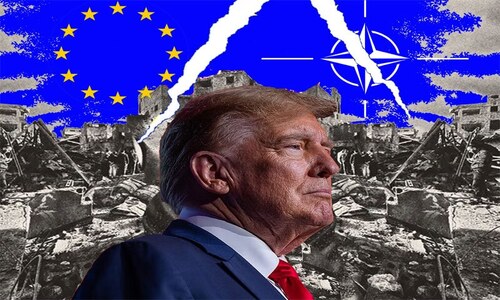
Two other issues are important but I am only flagging them here for paucity of space: the implosion of neoliberalism and its internal effects and the fraying of the transatlantic alliance. Both are exacerbated by Trump but neither is a direct result of his election. Both are extremely consequential.
The United States has not collapsed; not yet. Nor can it be defeated from outside. But it can crumble from within.
The future is not about a return to US hegemony, certainly not in a unipolar sense. The industrial base may be gone but it can be rebuilt, albeit not overnight. Alliances are frayed; trust cannot be easily restored. The fiscal position is precarious, with a $35 trillion US national debt. Internal politics is deeply polarised, with a significant portion of the American electorate believing that the system is rigged against them. A lot of these factors, singly and in combination with other factors, are self-reinforcing.
The future also lies in terra incognita, a contested transition to a multipolar world, whose contours remain unknown. A recent book by German political analyst Marc Saxer, Geopolitical Conflict in the Wolf World, is a sobering structural assessment of where the world and the US are headed.
“Homo homini lupus est” (Man is a wolf to man) is how Saxer begins. With that statement, we are back to Plautus and Hobbes. This is not mere rhetorical flourish. Saxer’s wolf world is an analytic category, a systemic condition characterised by the absence of a hegemon capable of enforcing rules, the demise of neoliberalism, the collapse of shared legal-normative frameworks, the return of great-power competition, the rise of Middle Powers, many with regional hegemonic aspirations, and the normalisation of coercion as a primary instrument of statecraft.
As I said to Saxer during the launch of his book in Lahore, for the Global South, it has always been a wolf world. Pax Americana did not keep the peace for the periphery. It financed selective peace on credit. The bill has now come due.
The writer is a journalist interested in security and
foreign policies. X: @ejazhaider
Published in Dawn, EOS, May 31st, 2026
The writer has an abiding interest in foreign and security policies and life’s ironies. He tweets @ejazhaider