Shaheen defends pitches made for Australia ODI series


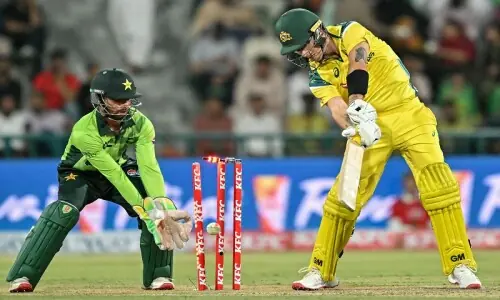
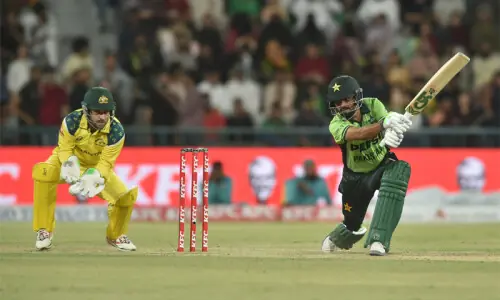
LAHORE: Pakistan skipper Shaheen Shah Afridi has defended the pitch strategy following his team’s One-day International series victory over Australia at home.
The Green-shirts defeated Australia by four wickets in a low-scoring third ODI to win the series 2-1 at the Gaddafi Stadium on Thursday night.
The hosts chased a moderate 158-run target in 41.5 overs for the loss of six wickets as Babar Azam top-scored with an 84-ball 40. Earlier, Shaheen (3-30, eight overs), Abrar (2-19) and Shadab Khan (2-28, nine overs) restricted the tourists to a below-par total despite a fighting 65 by captain Josh Inglis.
The hard-earned victory gave Pakistan a 2-1 series win — their third successive ODI series victory over Australia — after they won the first match by five wickers in Rawalpindi. Australia levelled the series by winning the second game by 41 runs, also staged in Lahore.
The series was played on predominantly low, spin-friendly tracks in Rawalpindi and Lahore where the tourists largely struggled with the bat.
As some former players and analysts, criticised the surfaces – prepared for the said series – were tailor-made to favour home team, Shaheen dismissed such criticism.
“When you have to play against such a team [like Australia], you have to prepare such pitches because your objective is to win the series,” Shaheen said while talking to reporters in the post-match media conference at the Gaddafi Stadium.
“When we visited Australia, they prepared green pitches because they were playing against an Asian team and believed those conditions would favour them. Despite that, under Mohammad Rizwan’s captaincy, we won the series there,” the skipper recalled.
The Pakistan skipper noted that the 50-over ICC World Cup 2027 is still 14 to 15 months away and that the team had ample time to fine-tune its preparations.
“We also have Test cricket coming up, and some of our Test players featured in this [ODI] series. Playing on such challenging pitches provided valuable match practice,” he said.
Shaheen revealed that despite changes in the playing XI over the past year, the management has largely retained a core group of players.
“Although there have been changes in the team, there has not been a major change in the pool of 20 players we have identified,” he said.
He acknowledged that the pitches used during the Australia series were demanding but expressed confidence that Pakistan would be better prepared for similar conditions in the future.
“As we move closer to the [2027] World Cup, the team will gain more experience on pitches similar to those found in South Africa and Zimbabwe,” he noted.
Shaheen confirmed that Saim Ayub, Fakhar Zaman and Abdullah Shafique remain part of Pakistan’s World Cup plans, adding that the final squad would likely be finalised about a month before the tournament.
INGLIS LAUDS AUSSIE FIGHTING SPIRIT
Meanwhile, despite the disappointing result, Inglis praised Australia’s fighting spirit during Pakistan’s chase in the series decider.
“I thought the boys never stopped having a crack the whole time. We all believed we were still in the game and could still win it. Everyone applied themselves really well in that second innings,” Inglis said after the match.
The captain accepted responsibility for the middle-order collapse and admitted he should have stayed at the crease longer.
“I’ll hold my hands up. I’m accountable for that collapse. If I had stayed there another 10 or 15 overs and taken the game deeper, I think we would have got to a really good total,” Inglis said.
He also pointed to costly run-outs and poor communication between the wickets as major factors behind Australia’s downfall.
“Run-outs don’t help, especially on wickets that are tough to bat on and tough to start your innings. We saw in Pakistan’s innings as well that once you get a wicket, momentum can quickly swing your way,” he said.
Inglis also defended Australia’s decision to bat first, citing previous experiences in Pakistan where batting became more difficult as matches progressed.
“During the T20 series we played here [in Pakistan] before the World Cup, the wickets got harder to bat on as the games went on. We felt batting first and putting runs on the board was the right option,” he said.
The wicketkeeper-batter maintained that a score above 200 would have been highly competitive on such surfaces.
“In the second ODI, we scored 230 and won comfortably. Anything over 200 is a very good score on these wickets.”
Inglis described the conditions as extremely challenging, with variable bounce, spin and reverse swing making stroke-making difficult throughout the innings.
Published in Dawn, June 6th, 2026