Waste dumping in Leh Nullah raises flood risk
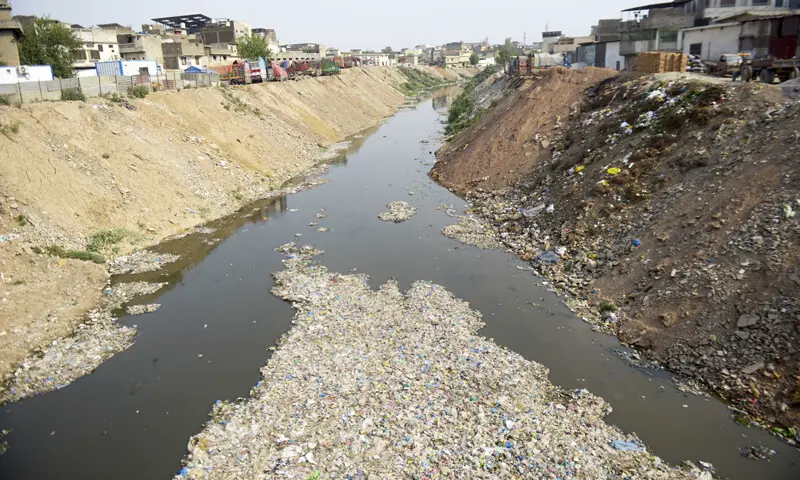

RAWALPINDI:With monsoon season only a month away, the dumping of construction debris from ongoing development projects, as well as waste discarded by local residents into Leh Nullah, has emerged as a potential flooding hazard for the twin cities of Rawalpindi and Islamabad during heavy rainfall. Continuous dumping has significantly reduced the width of the nullah, particularly behind Ganjmandi police station, where the nullah has been narrowed to just a few metres.
Despite the situation, civic agencies in the garrison city, including the Rawalpindi Municipal Corporation (RMC) and the Water and Sanitation Agency (Wasa), have turned a blind eye to the issue. The Punjab government allocated funds to clear Leh Nullah and 11 major drains in the city, but these efforts appear to be going to waste as construction material dumped along the nullah has led to encroachments.
Abdur Rehman, a resident of Ganjmandi, said as monsoon was yet to begin, fear and panic regarding flooding in case of heavy rains had gripped the area. He said construction work in Raja Bazaar continued and the contractors dumped the construction material near Ganjmandi bridge.
“Vegetable shopkeepers and butchers also dumped the waste in Leh, which created problems for the local residents,” he said.
Pindi city residents accuse civic bodies of turning blind eye to issue
Mehmood Aslam, a resident of Ganjmandi, said the civic bodies had turned a blind eye to the dumping of construction material along the banks of Leh Nullah. He added that the parking of trucks, which has increased over the past four years, was causing inconvenience to local residents.
He said the width of Leh Nullah was shrinking and that, instead of planting trees along its banks, parking areas were being developed, increasing the risk of flooding during the upcoming monsoon season.
Deputy Commissioner Dr Hassan Waqar Cheema also took notice of the dumping of construction material by the contractor carrying out development work in Raja Bazaar and Hamilton Road and asked Wasa to remove it.
When contacted, Wasa Managing Director Azizullah Khan said the construction material was being dumped along Leh Nullah which created problems for the civic agency as it had to clear it every year before monsoon.
He said dredging work had been started in Leh Nullah and all hurdles would be removed, adding that machines were installed in Leh Nullah along Ganjmandi bridge.
He said it was the duty of the building department to not issue non-objection certificate to those who renovate old buildings in the garrison city unless they gave assurances that they would dump construction material outside the city and not in Leh Nullah.
In response to a question about a Wasa contractor dumping soil excavated from Hamilton Road into Leh Nullah, he said the affected section of the nullah would be cleared before the start of the monsoon season.
It may be mentioned here that Leh Nullah had a length of about 30km, stretching from the federal capital to Rawalpindi. Leh Nullah has six major tributaries, three originating in the foothills of Islamabad in the higher plain area. It then flows down through the lower lying city of Rawalpindi, where another three tributaries join the nullah.
During the British Raj, Leh Nullah was a clean water drain and had fish, turtles and a variety of aquatic life. Flower and vegetable gardens could be seen around it and bamboo trees grew along its banks. Clear water flowed in the groundwater wells of its adjoining areas while swimming in the stream happened to be a favourite pastime of the area residents.
Published in Dawn, June 3rd, 2026