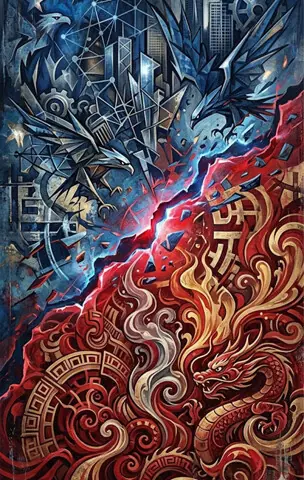
THE recent meeting between United States President Donald Trump and Chinese President Xi Jinping has failed to deliver any positive sign for the world at large. If anything, the meeting civilised the rivalry for the time being, while the deeper competition for global influence is bound to continue.
What passes for influence in the modern world is far less about the number of aircraft carriers than about chips, supply chains, data, development loans, shipping lanes and the authority to define what ‘order’ means. In all these critical domains, China is gaining ground. Its tentative pre-eminence in development finance and trade gives it leverage in capitals that prefer offers in project-sized instalments: a road, a port, a power plant. In theory this is an attractive proposition.
After all, who rejects cheap power or faster rail? In practice, though, the calculus is complicated. Infrastructure deals also create long-term economic linkages with Chinese firms, and questions are often raised in policy circles about financing structures and transparency. Where Beijing’s approach appears pragmatic and transactional, some analysts argue that such arrangements may create uneven economic dependencies between partners.
The US, in contrast, remains stronger in military reach, finance and the dense web of alliance networks built over decades. The American leadership is loud and visible: bases, exercises, sanctions and institutions that map power into rules. That style creates predictability for friends and discomfort for rivals. It insists that the world follow a vocabulary marked by freedom, open markets and norms that implicitly preserves American primacy. That insistence can breed resentment, especially when American influence is often accompanied by normative and strategic arguments that critics sometimes view as selective.
China’s emerging institutions operate alongside a global architecture historically shaped by the US. Beijing’s diplomacy is selective; its governance and diplomatic norms are still evolving in terms of broader international acceptance; its model does not translate easily into soft power the way American culture and institutions once did.
The result is a world that resists a single narrative, which in the years ahead may lead to overlapping zones of influence rather than a single empire. China may dominate trade links with parts of Africa, Asia and Latin America. The US will likely retain superiority in security and in the financial plumbing that lubricates global markets.
The idea of a single country leading the world feels increasingly anachronistic. The old templates fit less well in an era shaped by networks, platforms and transnational flows of capital and data. Power today looks like a web: nodes of strength in different domains, sometimes cooperating, sometimes clashing, and often competing for the loyalties of the same small states and corporations. In this multiplex, the capacity to shape rules, and to persuade others that the rules are in their interest, may matter more than raw dominance.
For Beijing, the challenge is to convert leverage into legitimate authority. For Washington, the challenge is to update the grammar of leadership so it feels less like hierarchy and more like partnership. Both must learn that influence now is often mediated by private actors and multi-national institutions as much as by embassies and warships.
The emerging global order is likely to remain multiplex, which is not necessarily bad, but it will be harder to manage. In a crowded bazaar of ambition, stability will come from constellations of agree- ments rather than single hegemonic bargain.
Dr Muhammad Anwar Farooq
Rahim Yar Khan
Published in Dawn, June 1st, 2026