China leaders skip Singapore defence summit headlined by US
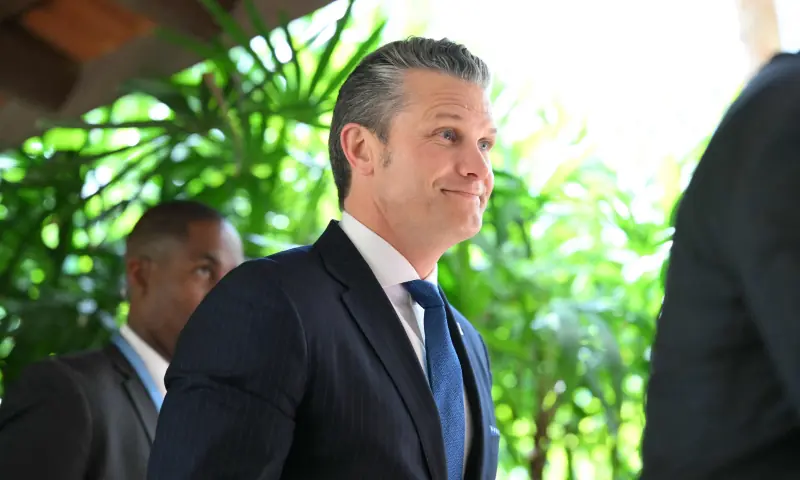
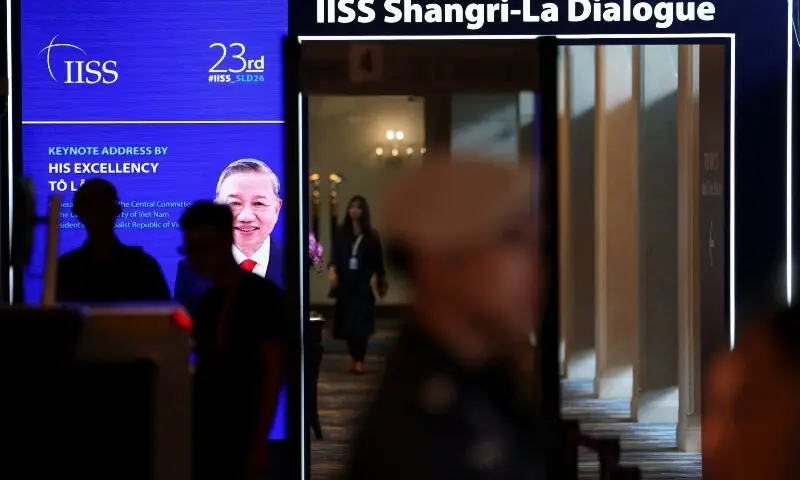
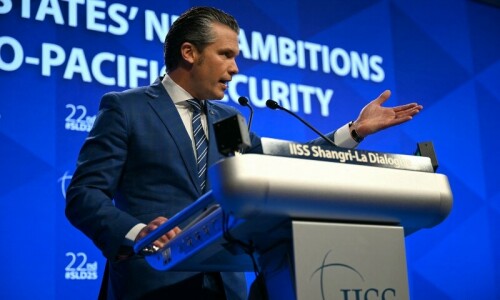
Pentagon chief Pete Hegseth is the headline speaker at Asia’s premier defence summit opening on Friday, but China’s top officials are not expected, despite weighty questions like Taiwan and the war in Iran.
Beijing’s defence minister is to skip the three-day Shangri-La Dialogue in Singapore for the second year running, which analysts viewed as a sign of China’s rising power.
Yet, the forum that brings together top officials from around 45 nations has historically provided a setting for debate as well as quiet and high-profile diplomacy.
Defence Minister Dong Jun’s absence means no meeting there with Hegseth as China warns the US over its involvement with Taiwan and Washington seeks an end to the Middle East war.
The Middle East was the source of 57 per cent of China’s direct seaborne crude imports in 2025 — 5.9 million barrels per day (mbd) — maritime tracking firm Kpler said.
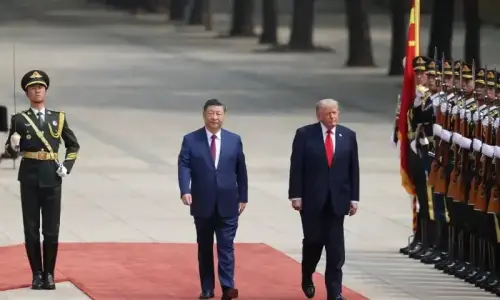
Hegseth’s second trip to the Shangri-La Dialogue comes after US President Donald Trump’s visit to China in May, and his subsequent suggestion that US arms sales to Taiwan could be used as a bargaining chip with Beijing.
Hegseth’s speech on Saturday is expected to be “quite strong against China, but mainly for internal [US] consumption”, said Oh Ei Sun, senior fellow at the Singapore Institute of International Affairs.
“I think under Trump anything is negotiable and even with enemies deals can be done… [even] with Taiwan as a negotiating chip,” Oh told AFP.
Trump said “fantastic” trade deals were struck after his visit to China, although details were vague and no breakthrough with Beijing emerged in the war in Iran.
China arrived as a ‘major power’
As the US and Iran clashed again on Thursday, threatening to derail a fragile push for peace, it “is unlikely that any possible deal will be discussed at the Shangri-La Dialogue”, Oh said.
China sent Dong to the dialogue as recently as 2024, where he and then Pentagon chief Lloyd Austin met for their first substantive face-to-face talks in 18 months.
But Dong was absent last year, and China said Thursday it would send experts and scholars from its army’s study institutions this time.
Major General Meng Xiangqing of the National Defence University will lead the delegation, including scholars from the National Defence University, the Academy of Military Sciences and the Navy.
“For one thing, China has truly arrived as a major power in the region, so it does not really need to send its defence minister to brave a fusillade of questions and try to ‘score’ brownie points,” said William Choong, principal fellow at the ISEAS-Yusof Ishak Institute think-tank.
Two other former defence ministers, Wei Fenghe and Li Shangfu, previously spoke at Shangri-La. Both were subsequently handed suspended death sentences on graft charges.
“It’s kind of a poisoned chalice for any Chinese defence minister to speak out publicly,” said Jennifer Parker, adjunct professor at the University of Western Australia’s Defence and Security Institute.
But like last year, Beijing again risked not having a senior leader present if the two most pertinent global security issues — Taiwan and the opening of the Strait of Hormuz — do come up.
“At a time when perceptions of US leadership are falling, Beijing could soothe some jangled nerves in the region by reassuring delegates that it would use force against the island only as a last resort,” Choong said.
AUKUS focus
The defence ministers of the United States, Britain and Australia — the members of the AUKUS security alliance — are also due to convene.
AUKUS’s stated goal is to ensure a free and open Indo-Pacific region, though it is widely seen as a bulwark against a rising China, which strongly opposes the pact.
Australian Defence Minister Richard Marles said on Friday that Canberra was seeking “the maintenance of the global rules-based order” in the region.
“We’ve seen China engage in a very significant military buildup… and it has not happened with the kind of strategic reassurance which (we) would expect,” he told journalists at the forum.
“Fundamentally, we want to have a productive relationship with China. We want to live in a world which is governed by rules.”
Australian media outlets have reported, citing unnamed sources, that the AUKUS nations are expected to announce a major project, perhaps involving uncrewed underwater vehicles.