NA panel takes govt to task over budget preparation, reforms
• Naveed Qamar criticises continued reliance on indirect taxes, petroleum levy
• UNDP consultants warn Pakistan remains on a ‘fragile stabilisation path’
• Inflation projected to exceed 12pc despite gradual economic recovery
ISLAMABAD: A parliamentary committee on Monday accused the government of persistently violating its own laws by failing to circulate and publish the Budget Strategy Paper (BSP) by May 10, besides doing little on economic reforms.
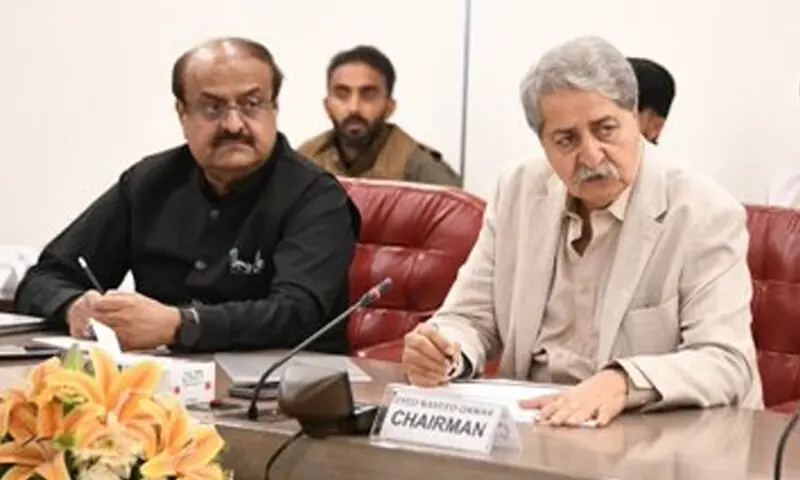
A meeting of the National Assembly’s Standing Committee on Finance and Revenue, presided over by former finance minister Syed Naveed Qamar of the PPP, also expressed serious concern over the continued heavy reliance on indirect taxes and petroleum levy instead of sustainable expansion of the tax base.
The panel was equally worried over sluggish progress on critical structural reforms when briefed by private economic analysts representing the United Nations Development Programme (UNDP). Qamar voiced concern over the growing burden of circular debt in the energy sector, the slow pace of reforms in state-owned enterprises, and rising socio-economic pressures caused by inflation, unemployment and poverty.
Private economist and public financial management specialist Dr Ali Salman, representing the UNDP, told the committee that economic growth was recovering slowly but per capita income remained weak. He warned that higher-than-projected inflation could undermine economic growth.
“Inflationary pressures are becoming increasingly concentrated in energy and essential food items, raising risks to household purchasing power,” he said, noting that prices of petrol, diesel, LPG, wheat flour, electricity and onions had risen between 43 per cent and 68pc during the current fiscal year.
Salman said inward remittances from overseas Pakistanis and government expenditure management were performing relatively well, although he added that expenditure control was mainly supported by the fall in interest rates. His colleague Bilal Bangash could not explain whether other expenditure heads also reflected improved management.
Salman reported that total revenues as a percentage of GDP had declined from 10.9pc to 10.6pc during the first three quarters of the current fiscal year, while total taxes remained stagnant at 7pc of GDP. He further said the fiscal deficit during the first nine months had declined to 2pc of GDP from 3pc a year earlier, mainly due to increased provincial cash surpluses, which rose to 1.3pc of GDP from 1pc last year. However, the primary balance declined to 3.2pc from 3.7pc.
Naveed Qamar observed that Pakistan and the Federal Board of Revenue (FBR) appeared unable to co-exist effectively, as the tax machinery continued to rely on higher tax rates instead of broadening the tax base. He noted that the tax shortfall had exceeded Rs680 billion during the first 10 months of the fiscal year, while direct taxes accounted for only 50pc of total collections.
“A surge in non-tax revenue — with 86pc of the target achieved in nine months — driven by SBP profits and petroleum development levy, artificially masked the FBR shortfall,” he said.
Salman informed the committee that circular debt, which stood at Rs3.5 trillion at the start of the fiscal year, had crossed Rs5.1tr by February 2026 as liabilities from the power sector were shifted to the gas sector, whose share rose from Rs1.8tr in July 2025 to Rs3.3tr by February 2026.
The UNDP consultants also pointed out that the government had failed to circulate the BSP this year by May 10 as required under the Public Finance Management Act. They noted that even last year the document was released just a day before the budget presentation in parliament.
The committee took serious note of the delay in circulation of the BSP and observed that the Ministry of Finance was legally bound under the Public Finance Management Act, 2019, to share the document in time to allow meaningful parliamentary scrutiny before the budget session.
The committee was informed that Pakistan remained on a “fragile stabilisation path” despite signs of gradual economic recovery. GDP growth for FY27 was projected between 3.5pc and 4.5pc, while inflation had again entered double digits, reaching 10.9pc year-on-year in April 2026 and projected to exceed 12pc.
Independent experts informed the panel that Pakistan’s total foreign exchange reserves stood at $22.58bn, providing import cover for about 2.58 months. Gross public debt had reached Rs83.28tr, while external debt stood at $137.56bn.
The committee was told that the trade deficit widened to $32.19bn during July-April FY26 due to weak export performance and rising imports. Meanwhile, remittance inflows remained strong at $33.86bn during July 2025-April 2026, with projections for FY26 estimated at $41.2bn.
The presentation further highlighted that Pakistan sourced nearly 90pc of its energy imports from the Middle East, making the economy highly vulnerable to regional geopolitical instability and oil price shocks. The committee was informed that any prolonged regional conflict could significantly increase inflation, widen the current account deficit and place renewed pressure on the exchange rate.
Naveed Qamar said the FBR had consistently failed to meet collection targets despite repeated taxation measures imposed on existing taxpayers. He emphasised the urgent need to broaden the tax base through sustainable and equitable reforms instead of placing additional burdens on already documented sectors of the economy.
Members observed that provincial fiscal surpluses were disproportionately supporting federal IMF compliance targets, while development expenditure remained compressed in favour of current expenditure and debt servicing. They also noted that Pakistan’s export sector continued to underperform compared to regional economies.
The committee further emphasised that excessive taxation on digital connectivity and telecom services was restricting digital inclusion, freelancing opportunities and broader economic participation, particularly among youth and low-income groups. It called for broadening the tax base through documentation, enforcement and administrative reforms rather than repeated increases in tax rates.
Members also called for stronger action against illicit trade, counterfeit markets and undocumented economic activity. The committee highlighted the importance of increasing investment in renewable energy, climate resilience and energy-efficiency initiatives.
The committee stressed that the FY27 budget must move beyond short-term stabilisation measures and instead serve as a platform for sustainable economic reform, fiscal transparency, improved governance and inclusive growth.
Published in Dawn, May 26th, 2026