Western analysts don’t have high hopes for Trump’s China visit

• Experts fear there won’t be many breakthroughs in trade, technology due to tensions
• Neither side expected to make ‘much progress’ on Iran, Taiwan issues
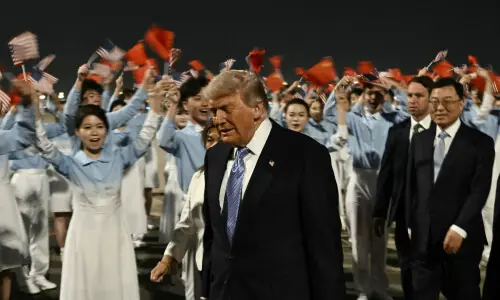
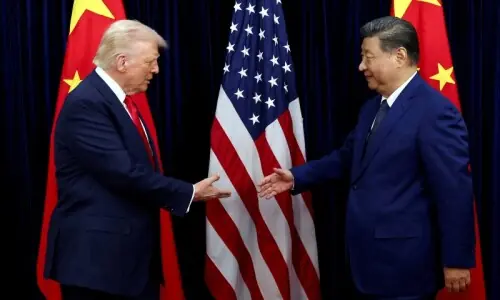
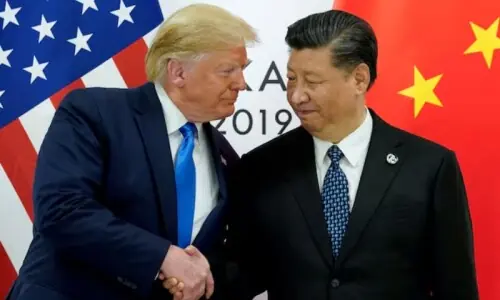
WASHINGTON: As US President Donald Trump begins a high-level summit with Chinese President Xi Jinping in Beijing on Wednesday, analysts in Washington said the talks were likely to be defined less by any breakthroughs in trade or technology and more by intensifying geopolitical tensions, with the Iran crisis emerging as a key, if indirect, test of US-China strategic competition.
At an on-the-record briefing on Tuesday hosted by the Washington-based Centre for European Policy Analysis (CEPA), experts argued that the US-China relationship has entered a largely transactional phase, in which both sides pursue narrow gains rather than structural accommodation.
The discussion featured Reinhard Butikofer, senior fellow at CEPA’s tech policy programme and former member of the European Parliament; James Lewis, distinguished fellow at CEPA’s tech policy programme; Christopher Walker, vice president of CEPA; and William Echikson, senior fellow and moderator of the session.
Across their interventions, a consistent theme emerged: Iran is becoming a stress test for US-China diplomacy, even if it is not formally the centrepiece of the summit agenda.
Analysts cautioned against expectations of a substantive reset in US-China relations, describing the summit as narrowly transactional, with limited scope for agreement on core geopolitical disputes.
James Lewis argued that both sides were approaching the talks from a position of self-confidence rather than compromise. “Both sides are convinced that they are the winning side, and that means limited room for concessions,” he said.
He added that the structural divide between Washington and Beijing would constrain outcomes on the most sensitive issues. “Neither side will make much progress on the two most contentious geopolitical issues — Iran and Taiwan.”
According to Mr Lewis, Washington is likely to press Beijing to use its “influence over Tehran” to stabilise tensions in the Middle East, particularly around the Strait of Hormuz, a critical global energy chokepoint. However, he doubted China would comply in any meaningful way.
At the same time, he noted that Beijing was expected to seek concessions from Washington in return, particularly on Taiwan and advanced technology restrictions, reinforcing a cycle of reciprocal but limited bargaining.
Christopher Walker argued that China’s alignment with Russia and Iran reflected a deeper structural shift in global politics rather than a temporary alignment of interests. “Russia, as a weaker power, has decided to side with China and other like-minded regimes, including Iran, against the United States and its ‘natural’ allies,” he said. Mr Walker suggested that Beijing may view instability in the Middle East as strategically useful, at least in limiting US bandwidth. “They would see this as leverage to use against the US and to see the US be more distracted,” noted Mr Walker.
His remarks pointed to a broader concern among Western analysts: that the emerging China-Russia-Iran alignment was increasingly functional, linking conflicts in Ukraine and the Middle East within a loosely coordinated challenge to US influence.
Sarah Cook, an analyst focusing on China, cautioned against any expectation that Beijing would meaningfully distance itself from Tehran in exchange for US concessions. “I would be very careful about making concessions, really, on anything for a promise that they’re going to whisper in the ears of their friends in Iran,” she said.
She also pointed to China’s continued economic engagement with Iran, even amid Western sanctions pressure. “Don’t forget, it was China who also helped Iran rebuild after the bombing campaign last year as well,” she said.
Reinhard Butikofer, also a former German MEP, was even more direct in questioning Beijing’s position. “If the Chinese want the Americans to open the Strait of Hormuz, why don’t they stop sharing intelligence with Iran?” he asked. “Why don’t they stop sharing drone parts with Iran? That would be an adequate deal,” he claimed.
He also noted that Europe’s criticism of US military actions in the Middle East was largely rhetorical and unlikely to influence the trajectory of US-China diplomacy. Despite the high expectations surrounding the summit, analysts agreed it was unlikely to produce major breakthroughs. Instead, it was expected to yield limited, transactional understandings at best.
Published in Dawn, May 14th, 2026