Water crisis beyond scarcity
Pakistan’s water debate has long been dominated by questions of quantity — how much water is available, how much is stored, and how much is lost. Yet an equally serious, though far less acknowledged, crisis is the persistent deterioration of both surface and groundwater quality across the country.
So far, discussions on water pollution have largely centred on industrial effluents and untreated sewage from urban centres. These polluted discharges — containing hazardous chemicals, heavy metals, and disease-causing pathogens — are routinely released into rivers, canals, and drains. At the same time, in many areas, untreated wastewater is either directly injected into the ground or percolates into the soil. All these further contaminate already stressed groundwater resources.
However, the water pollution crisis extends well beyond industrial and urban sources. The agriculture sector occupies a paradoxical position in Pakistan. On the one hand, it is a victim, as a significant portion of this contaminated water is used for irrigation. Toxic substances, including heavy metals such as lead, cadmium, and arsenic, are absorbed by plant roots and, in turn, moved upward through the plant’s vascular system. Eventually, they accumulate in edible parts such as grains, leaves, fruits, and vegetables. In this way, these pollutants enter the food chain and pose serious health risks, including organ damage, neurological disorders, and long-term chronic diseases.
On the other hand, agriculture itself has emerged as a major contributor to declining water quality, as runoff from agricultural fields carries chemical residues, nitrates, and other pollutants into rivers and canals, while leaching and deep percolation transport these contaminants into aquifers (groundwater).
In many peri-urban and irrigated areas of Pakistan, nitrate concentrations exceed the WHO recommended limits
Nitrate — a highly water-soluble form of nitrogen derived mainly from nitrogenous fertilisers and animal waste — is considered a key indicator of water quality in agricultural regions. In Pakistan, farmers often apply nitrogen-rich fertilisers such as urea in excessive quantities to maximise crop yields. Nitrogen accounts for around 78 per cent of total crop nutrients in Pakistan; however, only about 30–40pc of the applied nitrogen is actually utilised by crops. The remainder leaches into groundwater, mainly in nitrate form.
Likewise, improper handling of animal waste also contributes significantly to nitrate contamination. Pakistan’s livestock population, estimated at around 250 million, adds considerable pressure on water quality through surface flow and seepage.
High nitrate levels, above the World Health Organisation’s permissible limit of 50 mg/litre, pose serious long-term health risks, including cancers. In many peri-urban and irrigated areas of Pakistan, nitrate concentrations even exceed 100 mg/litre. Notably, groundwater from relatively shallow aquifers, drawn by hand pumps and wells, is more susceptible to nitrate contamination.
Another major concern is the excessive use of agrochemicals. Due to limited adoption of integrated pest management (IPM), our farmers solely depend on indiscriminate use of pesticides, herbicides, and fungicides. When these are sprayed excessively, a portion remains on the soil surface. During rainfall or irrigation, these chemicals are washed into nearby water bodies or seep into groundwater through infiltration and percolation, gradually deteriorating drinking water quality.
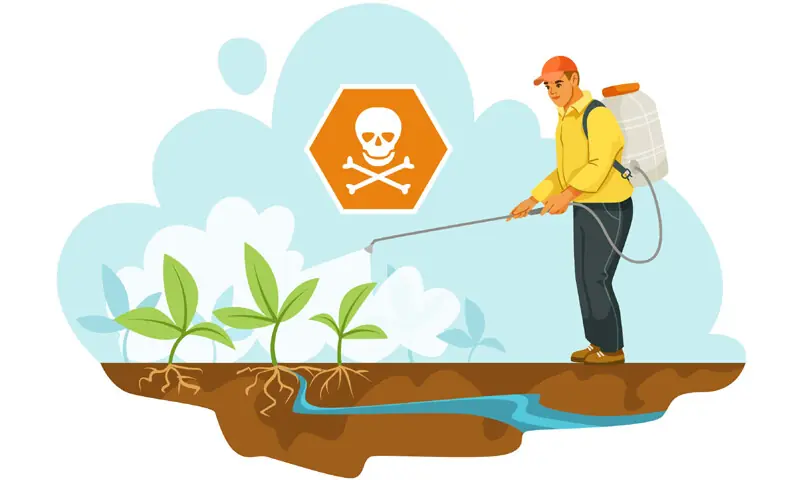
The problem is relatively serious in the cotton belt and other intensively cultivated districts, especially where pesticides with long half-lives are widely used, soils have low organic matter, and safe pesticide application practices remain limited due to small landholdings and limited mechanisation.
Another major factor is flood irrigation, which still dominates Pakistan’s irrigation system. Besides wasting water, it accelerates runoff and leaching of salts, nutrients, and chemicals. Excessive groundwater pumping is also lowering water tables, and in most areas, this decline is associated with deteriorating water quality due to higher salt concentration.
In short, the scale and severity of agriculture’s impact on water quality are growing, yet this dimension remains largely absent from policy debates. It is therefore imperative to bring this issue to the forefront, given its serious implications for food safety, environmental sustainability, public health, and rising government healthcare expenditures.
To mitigate the problem, Pakistan urgently needs to promote regenerative agriculture — a farming approach that improves soil health and biodiversity. Likewise, awareness campaigns are needed to improve fertiliser-use efficiency and to dispel farmers’ perception that higher input use necessarily guarantees higher yields. Moreover, soil testing should be encouraged to support site-specific nutrient management instead of one-size-fits-all practices.
To reduce pesticide use, IPM — based on biological, cultural, mechanical, and physical pest control, along with judicious pesticide application — must be promoted. Similarly, crop varieties less vulnerable to pest attacks, such as Bt cotton, should be encouraged.
Given worsening water stress, Pakistan must also gradually move away from deeply entrenched flood irrigation practices toward high-efficiency irrigation systems. Since these technologies remain expensive, the government should develop a local industry to expand scale and reduce costs instead of giving subsidies to a few thousand selected farmers.
To sum it up, Pakistan’s water crisis is no longer just about scarcity. It is also about the deterioration of the quality of water we already have. Agricultural water pollution is a systemic problem rooted in flawed farming practices, institutional weaknesses, and distorted market incentives.
Therefore, alongside efforts to enhance water availability in the country, there is an urgent need for targeted policy interventions aimed at improving water quality at the source, rather than relying primarily on the installation of hundreds of thousands of reverse osmosis plants at the village level to provide clean drinking water.
Chaudhary Mohammad Ashraff is the former Director General (On-Farm Water Management) of the Punjab Agriculture Department, and Khalid Wattoo is a development professional and a farmer.
Published in Dawn, The Business and Finance Weekly, May 11th, 2026