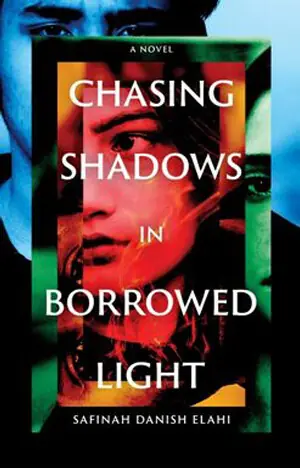
Chasing Shadows in Borrowed Light
By Safinah Danish Elahi
Liberty Publishing
ISBN: 978-6277626877
294pp.
In the opening paragraph of The Kite Runner, Afghan-American author Khaled Hosseini’s narrator reflects on the past as an untamed beast that “claws its way out” at the most unexpected moments. With this familiar yet prosaic observation, the narrator invokes one of literature’s most enduring tropes.
Fiction writers often peel back the layers of their characters’ histories to make them more three-dimensional, realistic and intriguing. This technique opens a doorway into their hidden emotional lives and even allows them an opportunity to identify and address their traumas.
Poet, publisher and novelist Safinah Danish Elahi’s oeuvre also harbours a preoccupation with the past. However, her three novels don’t employ the motif in a clichéd manner, where scandalous revelations about characters overshadow their emotional and spiritual growth. Instead, turning the clock back to a bygone era serves as a clarion call, urging people to recognise their responsibilities to themselves and others.
In Eye on the Prize, fragile bonds remain intact because the characters choose to overlook an adolescent mistake in order to protect those who are vulnerable. The Idle Stance of the Tippler Pigeon explores the lingering echoes of a traumatic childhood tragedy in the life of two unlikely friends. As they deal with their dilemmas, the protagonists learn a valuable lesson about empathy and humanity.
Across time and space, four friends discover that the past is not something left behind — but something that shapes the present
Chasing Shadows in Borrowed Light is built on a similar template, insofar as it offers yet another captivating exploration of how the past seeps into the present. Like her previous fictional offerings, Elahi’s third novel places the turmoil of a troubled girl at its epicentre.
Above all, this new work, like The Idle Stance of the Tippler Pigeon, adopts a multi-character perspective. However, each character’s viewpoint is filtered through a detached third-person voice, rather than the immersive first-person perspective employed in Elahi’s sophomore novel. This stylistic shift constructs a barrier between the characters and readers, thereby lending an aura of mystery to the narrative.
A quick glance at the back cover text promises a poignant tale about adolescent friendships that evolve as time, distance and dark secrets threaten old affinities. The plot is deceptively simple yet layered. Saira, Ashar, Usman and Areen once lived in Karachi, the city of their teenage triumphs, rebellions and emotional catastrophes. Now, three of them have fashioned new homes for themselves in Australia and the US, and inhabit different spheres largely detached from their roots. Nevertheless, their destinies remain inextricably linked to Karachi because of a secret that scars all of them, especially Areen.

Years later, when Karachi-based Saira receives an unsettling message from Areen — now an artist in New York — she reaches out to Ashar and Usman to enlist them in yet another attempt to ensure their friend’s well-being. Fuelled by habit, or a desire to protect their struggling companion, Saira, Usman and Ashar slip back into their predefined and well-rehearsed roles. It does not take them long to realise that the thrills and terrors of the past run the risk of obstructing the dynamics of the present, leading all four of them to revive their forgotten, transgressive selves.
The twists and turns of Chasing Shadows in Borrowed Light cannot be delineated without revealing spoilers. The strength of Elahi’s narrative lies in its ability to deviate from the predictable path and employ numerous methods to draw readers into this suspenseful work. The narrative is sculpted as a mosaic, and readers are encouraged to piece together a sea of fragments into a cohesive whole. Instead of following a linear trajectory, the story alternates between past and present, specifically 2008 and 2022.
The reader’s curiosity is initially sparked by a succinct prologue, in which ravenous flames lick every corner of a room and reduce it to ashes. As the “flames glow bright orange like the sun in its prime”, fear instantly finds residence in the room. Through this opening sequence, readers gain an inkling of the personal and emotional degradation that haunts the pages of Elahi’s novel.
The sinister undertone of Chasing Shadows in Borrowed Light is reinforced by an omniscient yet reserved narrator. Resembling a strategic poker player, the all-knowing, wily narrator conceals their hand and allows key information to fall gradually into the reader’s lap. These techniques transform the novel into an intricate puzzle for readers to solve.
The plot is deceptively simple yet layered. Saira, Ashar, Usman and Areen once lived in Karachi, the city of their teenage triumphs, rebellions and emotional catastrophes. Now, three of them have fashioned new homes for themselves in Australia and the US, and inhabit different spheres largely detached from their roots. Nevertheless, their destinies remain inextricably linked to Karachi because of a secret that scars all of them, especially Areen.
The centrepiece of Elahi’s third novel is the final section, which skilfully employs the second-person perspective to reveal the fragility of Areen’s fractured mind. This proves to be an effective technique, as it achieves a level of intimacy and discomfort that a first-person account might not have conveyed.
Driven by quiet but chaotic restraint, the final section begins to resemble the pages of an emotionally disturbed artist’s diary. The peculiar darkness of Areen’s mind is mirrored in the urgent, affecting prose, which reminds readers of the importance of therapy in addressing the burdens of unresolved traumas.
Elahi’s novels have sought to eliminate the stigma surrounding mental health. Chasing Shadows in Borrowed Light consolidates this commitment by urging us to prioritise our own psychological well-being while also recognising the plight of those who must carry the debilitating weight of emotional trauma.
Elahi ought to be commended for the profoundly original title of her new novel that, incidentally, echoes her characters’ emotional trajectory. Throughout the novel, the four friends are haunted by the shadows of the past, which they pursue and seek to escape in equal measure.
Ashar struggles to cope with a painful history of grief. Saira is driven by the muscle memory of empathy she once exercised as a silent witness to Areen’s traumatic experiences during their teenage years. Usman, who has escaped and created some semblance of a stable future for himself, is still guided by the pleasant memories of someone he once abandoned. Areen carries the trauma of an abusive childhood, compounded by the guilt of the actions she took to shield herself from harm. The group gradually learns to deal with the futility of their individual pursuits, except for Areen, who plunges deeper into an emotional vortex.
Beyond its focus on the psychological journey of its cast of characters, Chasing Shadows in Borrowed Light captures the complexities of Pakistani expatriate life without relying on stereotypical assumptions. Furthermore, the novel carries faint echoes of Kamila Shamsie’s Kartography, albeit without its political dimensions.
Stripped of this layer, Elahi’s new work emerges as a more personal glimpse into the lives of ordinary Karachiites grappling with childhood trauma, and their complex relationship with home amid the pressures of globalisation.
The reviewer is the author of the critically acclaimed novels Typically Tanya and No Funeral for Nazia.
X: @TahaKehar
Published in Dawn, Books & Authors, May 10th, 2026