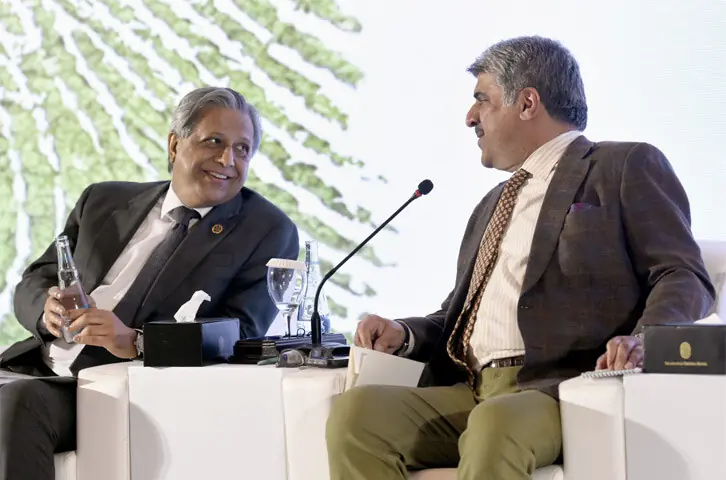
ISLAMABAD: Law Minister Azam Nazir Tarar on Wednesday stressed the need for behavioural change in the nation to meet the challenges of climate change.
He decried the “lack of will” in tackling the climate crisis was the basic problem. “Many such talks will remain futile unless people change themselves. We still use plastic shopping bags to carry eatables and use our own cars to reach everywhere instead of using public transport,” he added.
He urged the public to change its practices, especially regarding using public transport.
“We drive huge vehicles for minor tasks,” the minister said while speaking at two-day Breath Pakistan Climate Conference organised by Dawn Media Group.
Stresses shift to public transport, cut to single-use plastic
Mr Tarar lauded Lahore’s Orange Line metro train for providing fast and clean transport, urging people, saying: “Change your attitude. Start from yourself. I am not defending any government or person, but this is not one person’s duty alone.”
Delivering a keynote address of the day’s last session, the law minister highlighted, “There are not a lot of gaps in the legal framework, but there is in the will to do.”
He warned that “unless these gaps are addressed, our kids will grow up in the same environment”. Tarrar recalled that for the past 20 years, “we have been hearing that plastic bags are banned, but we still see them everywhere”.
On the occasion, National Assembly Deputy Speaker Ghulam Mustafa Shah emphasised that climate action required strong coordination between federal and provincial governments.
He noted that the 18th and 26th Amendments accorded greater constitutional significance to climate change and the role of Parliament.
“The challenge is no longer policy formation; it is effective enforcement,” the deputy speaker contended.

The NA deputy speaker called for the need for a “robust legislative backbone” to tackle the climate crisis. Shah noted that the climate-induced calamities “have exposed how vulnerable our economy and infrastructure are to climate shocks,” recalling the 2022 and 2025 floods.
He maintained that the present challenge was not the “absence of policy but the urgency of the implementation”. He pointed out that under Article 9-A, the Constitution had recognised the right to “a clean and healthy environment as a fundamental right”.
Sindh MPA Makhdoom Fakhar Zaman detailed the climate realities faced by Sindh, noting that the province was “living in a reality that many still debate”.
He recalled that in 2022, Sindh faced floods, displacing over 12m people. He added that the province also represented 90pc of Pakistan’s coastal exposure while the Indus Delta had shrunk by “over 90pc”.
“It is not just a crisis, but a turning point,” Zaman said, stressing that Sindh should not be seen as a “victim” of climate change but rather the focus should be towards “moving from response to resilience”.
“We must legislate for reality and not theory,” Zaman added.
Published in Dawn, May 7th, 2026