THE citizenry forgets, to its own peril, how important a free and independent media is in the preservation of their personal freedoms.
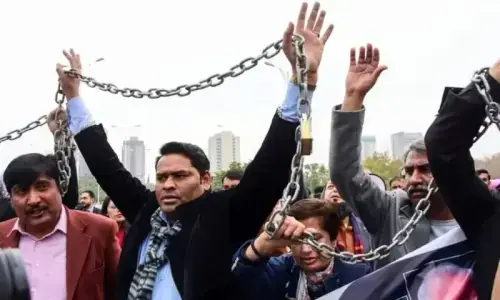
Today, on World Press Freedom Day, it is worth reflecting on the state of our media and how continuing restrictions on its ability to function independently may, in fact, jeopardise individual liberties.
A sobering report on this matter has been issued recently by the Pakistan Press Foundation. It notes, by way of introduction, that Pakistani media has, over the past year, “been placed in a bind with the use of more emboldened […] methods of restrictions, repercussions, intimidation and threats…”.
It describes the “reality of journalism in Pakistan” as an ordeal involving “overly active forms of legal challenges — from criminal complaints to summons, the continuation of violent physical attacks coupled with threats of violence, digital threats and harassment online, further amplified in an age of Artificial Intelligence…”.
The report makes note of “censorship and silencing tactics, including through regulatory mechanisms and in other instances through suspension of advertisements”, and highlights more than 230 instances of violence, threats and legal actions targeting journalists, among other incidents.
The complete report is instructive in outlining the full scope of repressive actions the Pakistani media is being subjected to and should be a must-read for critics who believe Pakistani journalism is somehow willfully unwilling to cater to the needs of citizens today.
The fact is that the entire industry is being slowly suffocated by the repressive actions of a state that has gradually come untethered from law and principle. The choices faced by many of its practitioners every day are often stark and binary: choose between survival and principles. It is not easy for journalists to continue fighting alone, and the rise of opportunists who put profit over principle has greatly weakened the industry’s ability to fend for itself.
The public must ask why populists and despots the world over continue fanning discontent against organised media, often holding up opinion polls depicting declining public trust as ‘proof’ that traditional media is no longer relevant.
‘Fake news media’ is the pejorative of choice that gets thrown at platforms for the ‘crime’ of not siding with the powers of the day. The goal seems simple: a fragmented, influencer-dependent public is far easier to manipulate than one anchored by an organised, independent press. A public that abandons its press abandons its last organised defence against the unchecked ambitions of power.
The slow strangulation of independent media is, therefore, not merely a professional crisis for journalists but an existential one for democracy itself. On this World Press Freedom Day, the most meaningful act of solidarity any citizen can offer is simply to recognise that a free press and a free people are, in the end, inseparable.
Published in Dawn, May 3rd, 2026