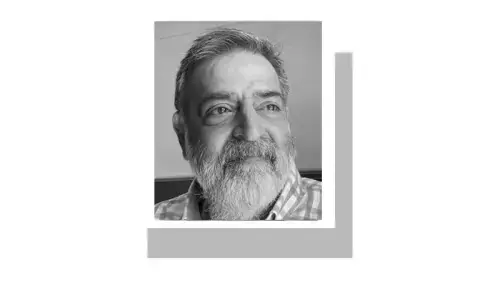
KARACHI: Eminent educationist Prof Dr Pervez Hoodbhoy has said that Pakistani universities have become “barren” and the standard of education and research has fallen to a very low level.
He was speaking at a two-day “4th Global Conference on Research in Education and Social Sciences 2026” that opened at the Shaheed Zulfikar Ali Bhutto Institute of Science and Technology (SZABIST) on Tuesday.
Dr Hoodbhoy spoke about the structural gaps within Pakistan’s education system and stressed the human abilities of reading and writing in the era of artificial intelligence.
He underscored the urgency of strengthening scientific inquiry, rational thinking and academic freedom and called for systemic reforms to improve quality and accessibility of education nationwide.
Hoodbhoy stresses need for scientific inquiry and academic freedom
He said the real strength of any country lay in its education and research, particularly within universities.
Referring to Iran, he said that despite being targeted, the country remained steadfast and stood on its own feet because its real strength lay in its universities.
He said Pakistan needed to work seriously on improving its universities and research.
At the inaugural session, keynote speakers focused on the link between education, technology and social development.
Prof Dr Noman Ahmed, pro-vice chancellor of the NED University of Engineering and Technology, focused on the intersection of urban development, governance, and education.
He said that development should be pro-people and people-centric and academic institutions can play a pivotal role in addressing urban challenges through research-driven policy interventions and community engagement.
Dr Shahid Siddiqui, dean of Faculty of Social Sciences, Media Studies, Art, and Design at Lahore School of Economics, emphasised the transformative role of education in shaping inclusive societies.
He highlighted the need to reorient curricula towards critical thinking, creativity and ethical responsibility, stressing that education must go beyond rote learning to address contemporary socio-economic challenges.
Gulab Khan Khilji, chairman of the Balochistan Textbook Board, highlighted the importance of curriculum reforms and contextualised learning. He stressed the need for inclusive and regionally relevant educational content to ensure equitable learning outcomes across provinces.
Earlier, the event commenced with an address by SZABIST President Shehnaz Wazir Ali.
Published in Dawn, April 29th, 2026