US PRESIDENT Donald Trump has been waging multiple battles all at once, some on the ground, others through rhetoric. Among the most striking has been his recent war of words with Pope Leo XIV, who has emerged as a moral counterweight to Washington’s hard-line posture.
The pope openly criticised what he describes as America’s war-mongering approach and has urged the US and Iran to stay the course of dialogue, warning that the ongoing conflict is exacting a devastating toll on innocent lives, particularly inside Iran and Lebanon.
But who listens to such voices of restraint when the drums of war grow louder? Despite the so-called ceasefire being extended, the losses of the war continue, and the global economy is suffering because of the blockade of the Strait of Hormuz. American losses are also increasing, and according to the Iran War Cost Tracker, Operation Epic Fury has been burning through an estimated $41.6 million per hour since Feb 28.
This staggering figure does not even account for the broader ripple effects on global consumers, including nearly $21 billion in additional fuel costs borne by ordinary citizens. War, in this sense, is not only fought on battlefields; it is paid for in the everyday lives of millions.
The US has suffered fewer human losses compared to Iran. The tracker reports that 13 US service members have lost their lives, compared to the loss of Iranian military personnel and civilians which is reportedly in the thousands.
The other direct and indirect stakeholders in the region have also suffered losses, as Israel, despite maintaining military pressure, has absorbed missile strikes and rising civilian disruption, alongside a noticeable erosion of its global image.
Meanwhile, Gulf states such as Saudi Arabia, Bahrain, and Qatar have avoided large-scale casualties but remain economically and strategically exposed through attacks on energy infrastructure and regional instability. Globally, public opinion reflects growing fatigue with the conflict, widespread reluctance to take sides, declining support for Washington and Tel Aviv, and only limited gains in legitimacy for Tehran, underscoring that while the war continues militarily, it is steadily eroding political capital on all fronts.
The details of human and physical losses can be tracked, and the image of nations gauged. However, wars test the trust of nations, cast doubt on allies, break old relationships, and nurture new beginnings.
The war has also tested the strengths of both major and middle powers.
The war has exposed clear fault lines within Nato, or more precisely, between the US and its Western allies. While these factors were known, the extent of the widening gulf had not been fully assessed before the Iran war.
Although civilisational bonds among Western nations will remain strong, their political and strategic cohesion is loosening. This will ultimately foster new partnerships among themselves and with the Global South, which has several contenders for leadership, led by China and Russia. Others such as India are also in the race.
Yet, this competition is not causing major friction; instead, these states are strengthening economic and political ties with the West, and in the coming years, some of these relationships may evolve into long-term strategic partnerships.
Such partnerships were already taking shape before the recent Gulf crisis, but American and Israeli attacks have accelerated some while opening avenues for new ones. Most of these alliances are emerging in West Asia and the extended region.
A prominent grouping includes Saudi Arabia, Pakistan, Turkiye and Egypt, with potential for expansion. Another grouping involves Israel, the UAE and India. The distinctive geopolitical feature is that middle powers are forming new alliances and blocs, multiplying their geostrategic, geo-economic, and political strength.
These alliances will still engage with the major powers — the US, China and Russia — but the nature and terms of these relationships are changing. As discussed earlier, in the context of ‘swing states’, major powers incentivise them through economic and defence deals. However, future relationships will depend not only on incentives but also on trust, with middle powers securing a greater voice.
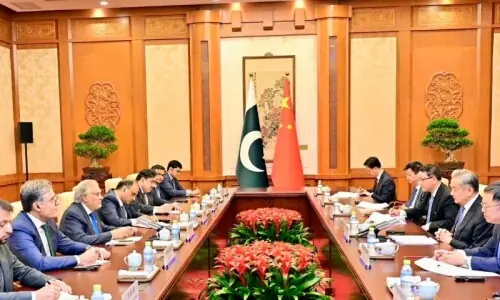
The war has also tested the strengths of both major and middle powers. China’s case is particularly instructive. China is arguably the biggest indirect geopolitical beneficiary of the war while avoiding open alignment with any side. It has benefited from US overstretch, expanded diplomatic space and energy leverage, yet it also faces vulnerabilities stemming from its dependence on Middle Eastern stability.
Despite these gains and fewer setbacks, a crack in trusting China has appeared among Arab nations, especially after reports that it provided technical support to Iran, support that is consequential yet deniable. A Wall Street Journal report has highlighted growing trust concerns among Arab states regarding China.
Arab nations have largely viewed China as an economic partner with a politically neutral and diplomatic profile, a role that has significantly influenced West Asian geopolitics. Beijing notably demonstrated this posture when it brokered the rapprochement between Iran and Saudi Arabia in 2023, helping restore diplomatic relations after years of tension.
However, during the war, Arab states may not have anticipated that China, despite its neutral image, would appear to lean, even indirectly, towards one side. This perception has introduced a degree of strategic uncertainty, raising questions in the region about whether China can maintain its long-standing balance or will, when required, choose its partners based on shifting geopolitical interests.
China, however, retains leverage to engage with other middle-power blocs in the region, including those led by the UAE, Israel and India. While it may seem unlikely, even China and India could find areas of partnership, as regional dynamics remain fluid and context-specific; alliances in one region do not necessarily translate into others. In essence, major powers themselves may increasingly adopt a ‘swing’ character, recalibrating their positions in line with national, regional and global interests.
In other words, whatever remains of morality in the realpolitik of international affairs may erode further. One can only hope that voices of amity, such as those of Pope Leo XIV, prevail in such a context.
The writer is a security analyst.
Published in Dawn, April 26th, 2026