US calls off Pakistan trip as Iran replies to proposals


 0
0

• Trump says his envoys will not travel to Islamabad to ‘talk about nothing’, says new proposal from Tehran offers ‘a lot but not enough’
• Iran’s top diplomat lands in Muscat after meeting PM, army chief during ‘fruitful visit’; Araghchi to ‘return today’
• Shehbaz speaks to Iranian president; meets FM to discuss ‘regional situation’
• Field Marshal Munir reaffirms Pakistan’s readiness to continue mediation
ISLAMABAD: Iranian Foreign Minister Abbas Araghchi on Saturday handed over Tehran’s response to US proposals for ending the war during meetings with Pakistan’s civil and military leadership and left Islamabad the same evening without waiting for an expected US delegation, prompting President Donald Trump to cancel the visit of his envoys.
FM Araghchi departed for Muscat after a day of intensive consultations, reportedly aboard a Gulfstream G600 owned by the Pakistan military. Neither the Pakistani military nor the Iranian officials confirmed or denied this. This suggested Pakistani facilitation of his regional tour to find a diplomatic solution to the conflict.
According to Al Arabiya, FM Araghchi will return to Islamabad on Sunday (today).
In a post on X after landing in Muscat, he said: “Very fruitful visit to Pakistan, whose good offices and brotherly efforts to bring back peace to our region we very much value.”
He said he had “shared Iran’s position concerning a workable framework to permanently end the war on Iran”, adding that it remained to be seen “if the US is truly serious about diplomacy”.
The Iranian minister, who arrived late Friday night, held his first working meeting on Saturday morning with Chief of Defence Forces Field Marshal Asim Munir. According to the official statement, the two sides discussed the ceasefire, the end of what Tehran described as the imposed war, and cooperation for “regional stability”.
During the meeting, FM Araghchi explained Iran’s views and considerations, said a source. The army chief, in turn, reaffirmed Pakistan’s readiness to continue its mediation role and noted Iran’s trust in Pakistan as a neighbouring Muslim country.
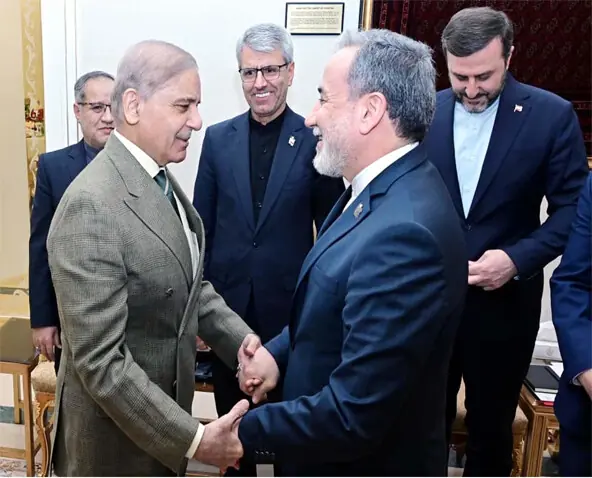
The Iranian delegation later met Prime Minister Shehbaz Sharif, with Deputy Prime Minister and Foreign Minister Ishaq Dar also present.
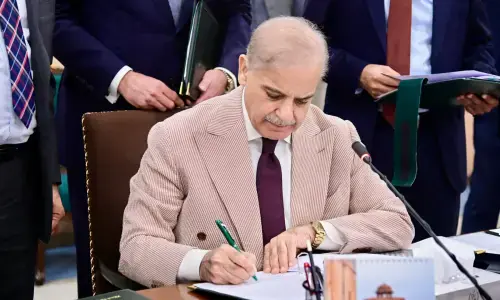
“Was pleased to meet H.E. Seyed Abbas Araghchi, Foreign Minister of Iran, and his delegation in Islamabad today. Had a most warm, cordial exchange of views on the current regional situation,” the prime minister said on X, adding that bilateral ties were also discussed. The PM also spoke to the Iranian president, Masoud Pezeshkian. He welcomed Iran’s decision to send a delegation led by Foreign Minister Abbas Araghchi to Islamabad. While sharing with President Pezeshkian an overview of his recent diplomatic outreach to a number of world leaders, the PM emphasised that these interactions had been helpful in building broader consensus in support of sustained dialogue and diplomacy aimed at achieving lasting peace in the war-affected region.
While reassuring the Iranian president of Pakistan’s firm commitment to regional peace, the PM said that Pakistan would continue its sincere and honest endeavours to promote regional peace and security.
Formal response to US proposal
According to the officials, the talks in Islamabad covered Iran’s formal response to proposals earlier conveyed by Washington through Pakistan, along with Tehran’s demands and reservations regarding the US position. A Pakistani source involved in the process said the Iranian side had delivered both its proposals and its perspective on the American proposals. Sources said Iran emphasised its terms while indicating readiness to remain engaged in shaping a future diplomatic course.
Officials familiar with the discussions said Tehran stressed that any framework must be “rational and fair” and maintained that negotiations cannot proceed under pressure, particularly in the presence of the naval blockade. At the same time, the Iranian side signalled willingness to stay engaged through Pakistan’s mediation but insisted that it would not accept terms seen as undermining its sovereignty or security interests.
No details of the proposals were made public.
The visit unfolded amid indications earlier from Washington that Special Envoy Steve Witkoff and adviser Jared Kushner would travel to Islamabad to engage with the Iranian delegation. However, FM Araghchi’s departure and the absence of any direct engagement led President Trump to call off the trip.
“I’ve told my people a little while ago they were getting ready to leave, and I said, ‘Nope, you’re not making an 18-hour flight to go there. We have all the cards. They can call us anytime they want, but you’re not going to be making any more 18 hour flights to sit around talking about nothing’,” President Trump said.
According to CNN, Trump said he received a new proposal from Tehran after he cancelled the trip, offering “a lot but not enough”. He did not elaborate. President Trump said the trip’s cancellation does not mean the resumption of fighting, it reported.
Iranian officials had maintained that no direct talks with the United States were planned during Mr Araghchi’s visit and that any communication would remain through Pakistani mediation.
Mr Araghchi’s trip followed the first round of talks in Islamabad earlier this month, which ended without agreement but kept the channel open. Pakistan has since continued to relay messages between the two sides as the ceasefire holds without a broader settlement.
Despite uncertainty over the second round of talks, officials on both sides indicated that the process was by no means dead, with Washington and Tehran continuing to look for off-ramps that could align with their respective positions.
Diplomats said the continued exchange of messages through Pakistan and parallel diplomatic contacts suggested that both sides were keeping the channel open, even as public positions remain hard.
Published in Dawn, April 26th, 2026