0
0

HYDERABAD: Stakeholders at a seminar held in the local press club on Saturday supported the proposal regarding constitutional protection for the local government (LG) system with some serious reservations.
The seminar was organised under former Pakistan Tehreek-i-Insaf leader Asad Umar’s Ba-Ikhtiyar Awam (or empowered public)’ initiative. It was titled Behtar local government key liye … aik tarmeen awam key liye.
Besides Asad Umar, who chaired the seminar, Sindh United Party (SUP) President Syd Zain Shah, Jeay Sindh Mahaz-Riaz (JSM-R) Chairman Riaz Ali Chandio, Barrister Hasnain Mirza and former Sindh Minister Arif Mustafa Jatoi took part in the debate and presented divergent views on the proposal.
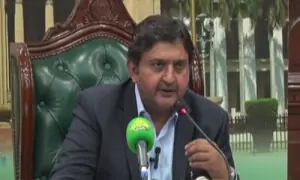
Asad Umar presented his proposals which stressed that LG representatives, not Islamabad or Rawalpindi, should have powers to take decisions on people’s fundamental issues.
Constitutional protection to local govt system backed with reservations
He believed that centralisation would not serve Pakistan but empowered LGs would benefit people.
He said LGs were constitutionally the third tier of government but sans constitutional protection.
He pointed out that conditions in southern Punjab were different from those in central Punjab; and same goes for some districts of Khyber Pakhtunkhwa and Sindh. “We don’t want exclusion of provinces while empowering LGs,” he said.
Mr Umar clarified that new provinces could only be created if the concerned assembly passes a resolution for it, otherwise anything introduced forcibly would lead to bloodshed.
He said that a charter of democracy among political parties and a powerful LG system were something closest to his heart. He said that democracy in Pakistan had been derailed and needed to be put back on track; and it was the right time to seriously discuss this LG issue threadbare before finding a solution.
Those who came to Sindh in 1947 are as equal Sindhis as those who had come here 250 years ago,” he remarked.
Riaz Chandio was of the view that LG powers should not undermine provinces’ identity and they should be based on parity. He termed the present governance in Pakistan as a product that best suited powers that be, pointing out that it was a hybrid system introduced by military generals and certain civilians.
He was critical of Mr Umar’s proposals shared with him and said that the 18th Amendment had devolved education to provinces but this proposal called for a common syllabus.
Arif Mustafa Jatoi noted that a powerful local government continued to elude Pakistan. Politicians take different positions on LG system while on opposition and treasury benches. Unfortunately, he said, dictators came up with LG systems.
When dictators introduced LG systems, politicians felt offended but they themselves failed to introduce one. “We have experienced three LG systems, and may pick positive things from them to create a new one with constitutional protection,” he remarked.
Barrister Hasnain Mirza of the Grand Democratic Alliance (GDA) asserted that it is basically ‘intention’ behind every plan that matters. So far LG systems were introduced with ‘centralised’ approach while bypassing ‘provinces. It is yet to be seen whether the purpose is indeed a strong LG system or some hidden agenda is there. He said Sindh Local Government Act, 2015 was amended 11 times ever since its enactment and implementation stages.
“In Karachi, people were not even allowed to choose their own mayor. To facilitate election of the incumbent mayor, an amendment was introduced to enable ‘anyone’ contest for the mayoral slot provided he would get himself elected as a UC chairman within three months,” he noted.
He wondered whether people would support such a proposal for the election of a prime minister or chief minister in this fashion.
SUP President Syed Zain Shah appeared sceptical about Asad’s proposals, saying they looked to be part of a plan which seeks to create new provinces or administrative units. He said limited empowerment of LG system could be discussed but not at the cost of ‘identity’ and ‘resources’ of Sindh that seemed to be the agenda of some elements. He described it as an attempt to roll back the 18th Amendment.
He equated the proposal with the 2012 dual LG system that PPP had introduced with MQM’s support but had to withdraw under masses’ pressure. He felt that this plan looked harsher than the dual LG system.
He said there were talks of allowing the National Assembly to alter limits which tended to seek unitary form of government. “If this were to happen, then we will not be part of it,” he said.
Published in Dawn, April 26th, 2026