CJP Afridi openly opposes Judicial Commission of Pakistan meeting for judges’ transfer


 0
0

• In letter to commission, Justice Afridi warns move will set ‘undesirable and potentially far-reaching precedent’
• Fears it will ‘erode public confidence’ in judiciary’s independence and stability
• Last year, he described transfer of three judges to IHC from different provinces under Article 200 as something to be ‘rejoiced’
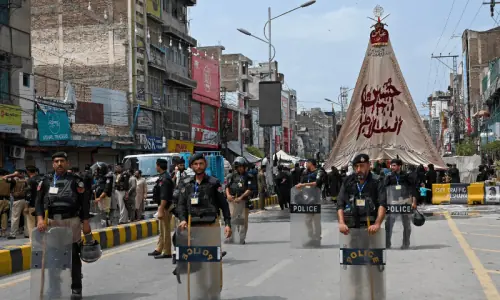
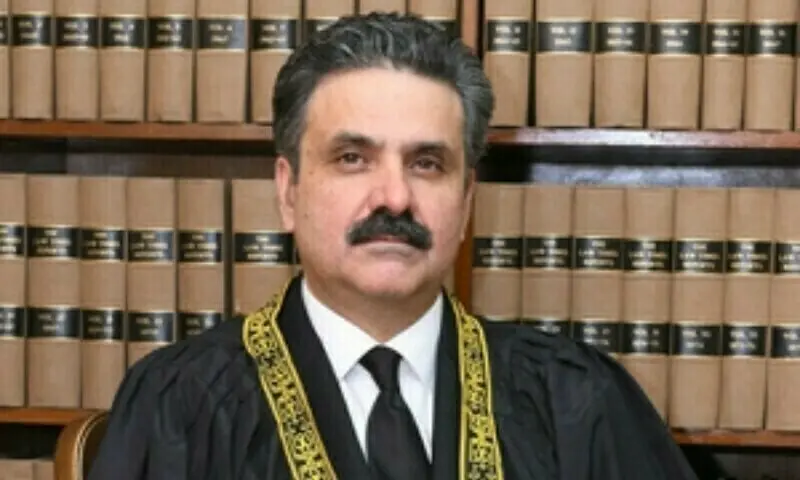
ISLAMABAD: Chief Justice of Pakistan (CJP) Yahya Afridi has opposed the scheduled meeting of the Judicial Commission of Pakistan (JCP) being called to consider the transfer of five judges of the Islamabad High Court (IHC) to different high courts of the country.
Although the CJP had earlier declined to call the meeting of the JCP, he eventually scheduled the session after it was requisitioned by a two-thirds majority of the commission’s members, an informed source privy to the development confided.
The commission is scheduled to meet at 1pm on April 28, during which it may consider the contents of the CJP’s letter to the JCP in which he expressed his reservations as well as deliberate upon the transfer of five serving IHC judges to different provincial high courts.
In his letter, the CJP expressed concern that allowing transfers of sitting IHC judges would set an “undesirable and potentially far-reaching precedent, effectively normalising the treatment of judges as administratively interchangeable or disposable”.
Such an approach, the source stated while citing the CJP’s letter, would “carry serious implications for the institutional integrity of the judiciary”, thus “eroding public confidence” in its independence and stability.
Article 200 of the Constitution empowers the JCP to recommend transfers without the consent of the judges concerned. However, the consent of judges was mandatory before the 27th Constitution Amendment. The amended provision has now vested this authority in the JCP, where decisions are taken by majority vote, whether the CJP agrees or not.
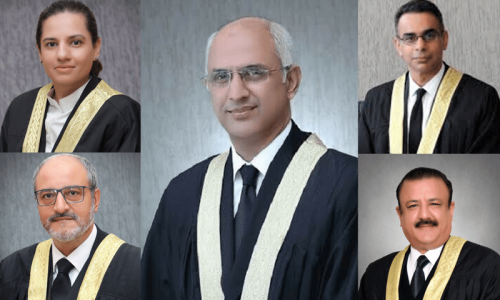
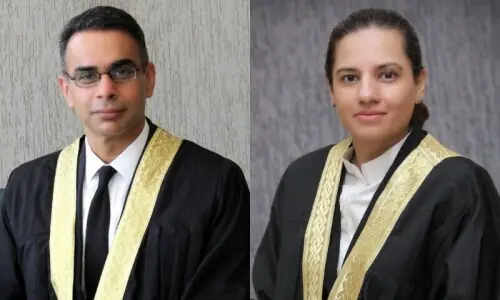
It is believed that the judges under consideration for transfer include IHC’s senior puisne judge Justice Mohsin Akhtar Kayani, Justice Babar Sattar, Justice Arbab Muhammad Tahir, Justice Saman Rafat Imtiaz and Justice Khadim Hussain Soomro.
‘Rejoiced’
In one of his interactions with the media on Feb 3, 2025, the CJP had supported the idea of transferring judges to the IHC, even though he acknowledged reservations regarding the seniority principle.
At the time, the CJP described the transfer of three judges to the IHC from different provinces under Article 200 as something to be “rejoiced”, setting a precedent that should be followed in the future. “The IHC is the symbol of four federating units and not merely a white marble building,” the CJP had observed while sharing his reason why he agreed with the proposal to transfer three judges to the high court. He had also read out a summary stating that the transfer of the judges from different federating units was fully “synchronised with the spirit of federalism as enshrined in the Constitution”.
“It is also in conformity with Section 3 of the Islamabad High Court (IHC) Act 2010… [there is] thoughtful consideration behind the proposal, [which] illustrates the resolve and equitable share to the linguistic diversity of our country and [a] fair chance of representation to all the federating units in the high court of the common capital of the federation i.e. [the] IHC,” the summary stated.
“Rejoice the fact that the IHC now has judges who are Balochi-speaking or Sindhi-speaking,” the CJP had emphasised, adding: “Had we had a judge from the tribal area in Peshawar, I would have asked to bring him to the IHC too.”
In his current letter to the JCP, the CJP is said to have stated that the proposed transfer of sitting judges out of the IHC would “in substance assume a punitive character” [and pave the way for] “an outcome that finds no sanction anywhere in the constitutional scheme governing the superior judiciary”.
“Besides, such transfer is entirely alien to the purpose of Article 200 of the Constitution and runs contrary to the foundational principles of judicial independence and security of tenure,” the CJP stated.
The CJP observed, the requisition for convening the JCP meeting for the purpose of transferring the IHC judges “could not be acceded to by the undersigned”. On June 19 last year, the SC’s Constitutional Bench, constituted under the 26th Constitutional Amendment, had, by a 3-2 majority, ruled that the transfer of three judges from provincial high courts to the IHC was in line with the Constitution.
Five IHC judges, the Karachi Bar Association, the IHC Bar Association and others had challenged the transfer of Chief Justice Sardar Mohammad Sarfraz Dogar, Khadim Hussain Soomro and Muhammad Asif from the Lahore, Sindh and Balochistan high courts, respectively, before the SC.
The controversy revolved around the alteration of the IHC judges’ seniority list after these transfers, as Justice Dogar was made the senior puisne judge, paving the way for his appointment as IHC chief justice after Justice Aamer Farooq’s elevation to the SC.
Published in Dawn, April 24th, 2026