CJP Afridi welcomes transfer of judges to IHC, hails ‘fair chance’ for provinces



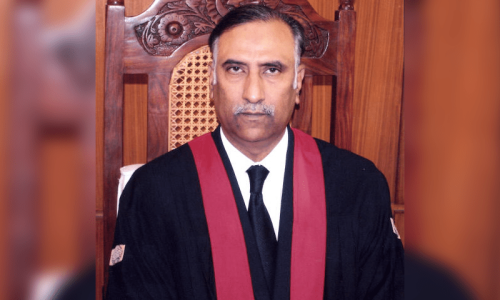
Chief Justice of Pakistan Yahya Afridi on Monday welcomed the transfer of judges to the Islamabad High Court (IHC) amid opposition from the capital’s legal fraternity, terming the move a “fair chance” for judges from other provinces.
President Asif Ali Zardari on Saturday approved the transfer of one judge each from the high courts of Lahore, Balochistan and Sindh to the IHC, despite opposition from five IHC judges. They had warned in a letter to top judges that any such move would “violate constitutional procedures and judicial norms”.
The CJP’s remarks come as the Islamabad Bar Council, Islamabad High Court Bar Association, and Islamabad District Bar Association observed a strike in the district courts and the IHC today to protest what they called “unconstitutional measures” undermining the judiciary and legal profession.
During the oath-taking ceremony of the Press Association of the Supreme Court (PAS), CJP Afridi — while welcoming the transfer of judges — said that the IHC was not part of any area rather it belonged to the entire country.
“Judges from other provinces should also get a fair chance,” CJP Afridi said.
The CJP said that the issue regarding the transfer of judges should not be confused with the appointment of judges.
“Appointment and transfer of judges are two separate issues,” CJP Afridi said, adding that judges who were transferred to the IHC were already high court judges.
He appreciated the initiative and said that the process should continue in the future.
“Islamabad is the symbol of federation. A Baloch-speaking judge has joined, a Sindhi-speaking judge has joined, so you should rejoice [this moment],” the CJP said, stating that the federation belonged to everyone.
“The transfer happened according to the Constitution. It is a good step taken under Article 200,” he said. “More judges should come from other provinces,” the CJP added.
He said that as the chief justice, his vision should be broader and that there was a need for more judges in the SC, highlighting that he heard 40 cases today.
Traditionally, the senior puisne judge of a high court is appointed as the chief justice. Still, the Judicial Commission of Pakistan (JCP) last year introduced new rules to bypass the seniority criterion in light of the 26th Amendment. The commission proposed that the chief justice of a high court could be appointed from among the panel of five senior-most judges.
SCBA welcomes ‘healthy exercise’ of judges’ transfer
Separately, the Supreme Court Bar Association Of Pakistan (SCBA) also welcomed the transfer of judges from other high courts to IHC, terming it a “healthy exercise”.
“We believe that the rotation of judges among different high courts under constitutional provisions is a healthy exercise,” read a press release issued by SCBA President Mian Rauf Atta.
Affirming that the association has always stood for the rule of law, the judiciary’s independence and the Constitution’s supremacy, the SCBA said, “We welcome and approve the transfer of judges to the Islamabad High Court.”
“We believe that the rotation of judges among different high courts under constitutional provisions is a healthy exercise,” it stated.
“It allows the best legal minds to gain exposure in different high courts, further cementing and strengthening the judiciary while countering any impression of selective justice.”
The SCBA also categorically disapproved of “all criticism on the matter, which, in our view, is undue, unfounded, and politically motivated”.
The SCBA explained that Article 200 (transfer of high court judges) “allows the president to transfer high court judges with their consent and after consulting the chief justices of both the concerned high courts and the Chief Justice of Pakistan”.
“We note that the president has exercised this constitutional provision, and the due process for such transfers has been fully adhered to,” it added.
The association went on to contend that Article 194 (oath of office) of the Constitution did not apply in the current matter, as the judges were transferred and “not appointments to the IHC”.
The SCBA highlighted that the IHC was “once regarded as the federal high court, ensuring equal representation from all provinces”, adding that the recent transfers had restored that status.
It also stressed that the recent development was not the first of its kind. “In the IHC alone, there [have been] numerous instances, even among the incumbent judges, who have been transferred from other high courts.”
“Needless to mention that the judges recently transferred to the IHC shall retain their seniority from the date of their initial appointments in the high courts from which they have been transferred,” the SCBA statement read.