0
0

KARACHI, June 29: A 10-member committee, having five representatives from textile industry and five bureaucrats with Prime Minister Shaukat Aziz as its patron, has been formed on Thursday to review a Rs50 billion package of incentives and concessions being sought by the textile sector from the government to enable it compete with Bangladesh, India and China in the international export market.
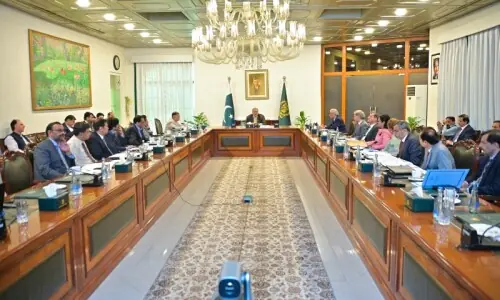
The committee was formed at a meeting held in Islamabad on Thursday chaired by the prime minister in which representatives of all sub sectors of the textile industry, the State Bank governor and senior bureaucrats of the finance and commerce ministries were present to discuss the Rs50 billion package.
Zubair Motiwala, a textile businessman from Karachi who led the team that drew up the package, told Dawn from Islamabad that the committee had been given three months to complete its recommendations with reference to the incentives and concessions being sought by the textile industry. The bureaucrats on the committee will be from ministries of finance, commerce, and gas and petroleum, State Bank of Pakistan and the Central Board of Revenue.
The committee is expected to come up with a consensus package by October next when it would be reviewed again with the government before any final decision.
Zubair said that the textile representatives held detailed meeting with the federal secretary of oil and gas to discuss the impact of gas tariff on cost of doing business.
The textile businessmen want their business to be declared a “priority sector” for the application of a separate lower gas tariff in line with those prevailing in Bangladesh.
The argument is that the two gas distribution companies of Pakistan — Sui Southern Gas Company Limited (SSGCL) and Sui Northern Gas Pakistan Limited (SNGPL) collect Rs23.90 billion from the value added textile sector. In Bangladesh gas tariff is 42 per cent less than that of Pakistan. The demand is to reduce this cost by Rs10 billion to bring gas tariff for textile industry in Pakistan at par with Bangladesh.
In addition, the captive power plants in the industry consume gas worth Rs12.15 billion. Applying same formula of keeping gas tariff at par with Bangladesh, the industry would need Rs4.85 billion from the government.
In other argument, the textile leaders contend that their industry bear the burden of Rs4.5 billion from cross subsidy being offered to feedstock of the fertiliser and to the domestic consumers by the two gas companies.
According to Zubair Motiwala, the prime minister asked State Bank Governor Dr Shamshad to look into the loan portfolio and export refinance of the textile sector.
The total loan portfolio of textile on banks is estimated at around Rs127 billion from January 2003. The industry wants reimbursement of 5 percentage points by reducing Kibor on outstanding long term loans. It also wants a 5 per cent interest on the existing long term loans as well as on future advances for the new projects. Total reimbursement amount involved is estimated at around Rs6.5 billion.
A 50 per cent cut is sought on 7.5 per cent interest on export refinance. Assuming demand of export refinance to be 40 per cent of total $9 billion textile exports, the textile business is asking for Rs8 billion assistance from the government.
Textile leaders argue that Pakistan has highest wage cost, electric and gas tariff and tax rates which put them at disadvantage with Bangladesh, India and China. India, the textile leaders say, offers a 10 per cent financial support in capital build up for new textile projects because it is desperate to increase its share in global textile market.
Textile trade is expected to increase from existing $300 billion to $800 billion. Involved in a race to grab a big share in this pie is China, India, Malaysia, Indonesia, Vietnam and Pakistan.
In the financial year 2005-06, after expiry of the textile export quota regime in January 2005, Pakistan has shown 18 per cent growth in textile export. The growth is impressive but insignificant when compared with export of China, India and Bangladesh.
Our reporter adds from Islamabad: According to an official announcement addressing the meeting the prime minister said that textiles were the premier industry and core business of the country. Contributing 66 per cent to the exports, 40 per cent to employment and 8.5 per cent to the GDP growth, it has become the backbone of our economy and the government will take all the steps required not only to help the industry sustain its present position in the global trade but also to increase its share to avail the opportunities of the quota free scenario, he added
He said that textile sector had shown substantial development during the last few years as a result of the government's initiatives including; tariff rationalisation, long-term policy approach, conducive trade finance and fiscal policies, removal of sales tax on textile value chain, reduction in import duty on polyester chain, and availability of development finance and export refinance at low mark up rate and a hassle free environment provided by the government.