PEACEMAKING becomes increasingly difficult when belligerents continue to resort to threats, bullying and insults. Where the US-Iran peace process is concerned, President Donald Trump’s routinely irrational public comments serve to complicate matters, and may even scuttle behind-the-scenes efforts to arrive at an agreement.
After the American and Iranian delegations left Islamabad on Sunday without a deal — the probability of agreeing on a solution to a complicated dispute in a short span of time was always remote — Mr Trump took to social media to unleash a barrage of bellicosity. He once against threatened Iran, saying his forces were “locked and loaded”, while announcing that a US blockade of the Strait of Hormuz would take effect, restricting the passage of vessels using Iranian ports, or those that pay toll to Tehran.
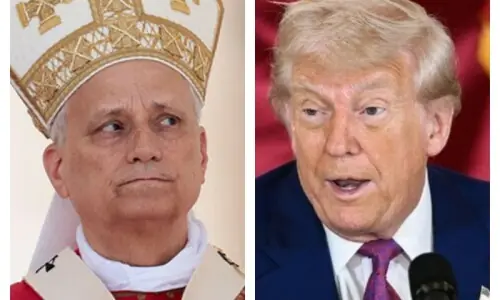
Mr Trump has not even spared the pope. After the pontiff strongly criticised war, the US leader said he was “not a big fan” of Pope Leo XIV. The holy father remained unrepentant, saying he would continue to denounce war.
Mr Trump’s frequent rants aside, there is a very real threat of hostilities restarting if American and Iranian forces come face to face in the Strait of Hormuz. While the maritime passage is essential to global commerce, attempts to reopen it by force, or stop Iranian ships from crossing the strait, will only exacerbate matters and harden Tehran’s posture. The key to opening the strait, and ending hostilities across the region, continues to lie in a peaceful resolution to the conflict. Suffice it to say, Mr Trump’s belligerent social media missives are hardly creating conditions conducive to diplomacy.
As per reports, Iranian Foreign Minister Abbas Araghchi has said that both sides were “inches away” from an “Islamabad MoU”, yet an agreement could not be reached because the US ‘shifted the goalposts’. If this is the case, then a second round of talks becomes imperative. The Americans say that Iran is not willing to give up its pursuit of nuclear weapons. Yet the facts state otherwise as before the American attack in February, Tehran was willing to make significant concessions to its nuclear programme — short of abandoning enrichment — in the Omani-facilitated dialogue process.
The fact is that if Iran is approached with respect, and serious diplomats from the US engage with their Iranian counterparts, facilitated by committed interlocutors such as Pakistan and others, a peaceful resolution is very much possible. For such a process to deliver, the US must resolve to end its aggression against Iran, and prevent its proxy Israel from causing chaos across the region.
Equally important, the US president must refrain from issuing bombastic threats on social media, and leave the Iran file to seasoned diplomats in his administration, who are actually capable of reaching a workable agreement.
Published in Dawn, April 14th, 2026