
Riyadh rolls over $3bn as prospects of $10bn US facility wane
• Aurangzeb says proposed US facility is not essential, would provide additional support if secured
• Further Eurobond, Panda bond and rupee-linked dollar-settled issuances planned
• Govt targets $4bn reduction in external debt
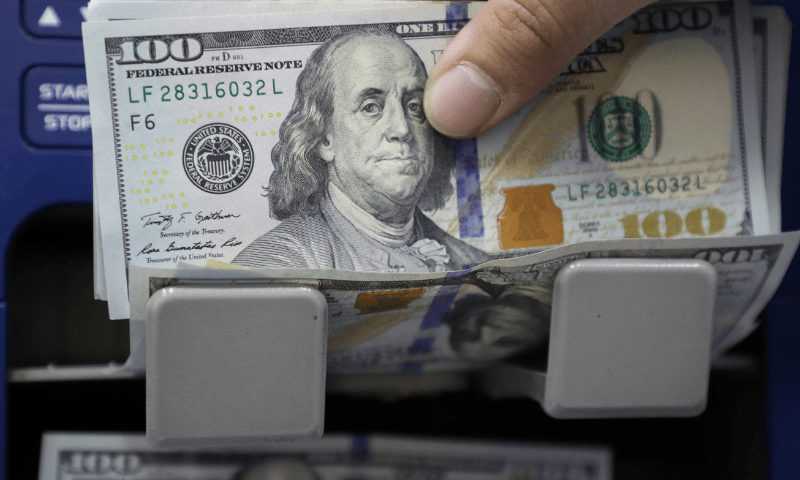
ISLAMABAD: Pakistan has secured a $3 billion rollover from Saudi Arabia, as prospects of a proposed $10bn US backstop facility appear to have waned, it emerged on Wednesday.
Speaking to journalists at Parliament House, Finance Minister Muhammad Aurangzeb confirmed that Riyadh had extended the $3bn financing it provided in April this year to bridge a gap arising from $3.5bn in repayments to the United Arab Emirates.
“It has been extended and for a reasonable period. You don’t need to worry as to for how long given the kind of strategic relationship we have,” he said when asked about the facility, which matured on Oct 31 under its three-month term.
He said he had a very good meeting with his Saudi counterpart, Mohammed Al-Jadaan, during the recent World Bank-IMF meetings in Bangkok. Saudi Arabia had already extended its $5bn facility until 2028.
Asked whether Pakistan had also sought additional support, the minister categorically denied it, saying this was not needed as foreign exchange reserves covered more than three months of imports and would be strengthened to provide a four-month import cover by the end of the year through capital markets.
Responding to another question about the prospects of the $10bn Exchange Stabilisation Support Facility (ESSF) requested from the US in July this year, he sought to lower expectations that he himself had raised over the past several months. “What we asked for back in July and were looking at was the market access. We have got the market access,” he said, referring to the $3bn bond Pakistan issued in September against orders worth $6bn.
“If that (ESSF) materialises, fantastic, it will be a liquidity support facility. Otherwise, we have plans for further Eurobond issuance, Panda bond issuance and rupee-linked dollar-settled bond,” the minister said.
He added that he had held meetings with 70-80 institutional investors in Bangkok, who had a very clear view of Pakistan, and that offers were available for five-year and 10-year maturities, “because clearly we are looking beyond the [IMF] programme”.
He said the government was looking at the US from a broader perspective, as the US Export-Import Bank and Development Finance Corporation (DFC) needed to support their investors and exporters in Pakistan. “That is real financing and real credit,” he said, adding that the ESSF request was for a liquidity support facility to help the sovereign. “If possible, fine; if not, we are going to move forward, with or without it.”
The finance minister also reported that the IMF Executive Board meeting to approve a disbursement of $1.2bn to Pakistan would be held in December.
External debt
Earlier, he told the Senate Standing Committee on Finance that Pakistan was targeting a reduction of $4bn in external debt during the current fiscal year and $3.5bn next year, compared with $4.5bn in the last fiscal year.
He said the government was seeking to replace expensive short-term borrowing with longer-maturity financing through bonds and private placements to reduce refinancing risks. He said external debt had been rising by $5-6bn annually, from $45bn in 2014-15 to around $100bn, but had increased by only $1bn annually over the past two years.
“Our objective is not to increase external debt. All the transactions like Eurobond, Panda bond or private placements have been replacement bonds to replace expensive with cheaper facilities,” he said, adding that fiscal discipline had helped contain the fiscal and current account deficits and, despite oil and wheat import bills, the current account deficit would be no more than 1pc this year.
“This is hard-earned stability that helped create buffers to meet our requirements despite floods and war in the region, and foreign exchange reserves crossed $21.5bn, which is the best-ever level of reserves in our history,” he said, adding that Pakistan could not afford to lose this basic hygiene.
Finance Secretary Imdadullah Bosal told the committee, which was presided over by Senator Saleem Mandviwalla, that public debt had declined to 68.6pc of GDP by the end of June 2026, from 75.1pc in fiscal year 2022-23. Year-on-year growth in public debt had slowed to 7.7pc in the last fiscal year, the lowest in 20 years, he said.
The secretary said domestic debt amounted to Rs58.8 trillion by the end of August 2026, down from Rs68.4tr at the end of June, while foreign debt remained stable at $98.2bn.
He reported net financing requirements of $11bn after rollovers and refinancing, of which $5bn had already been repaid in the first four months of the current fiscal year. The remaining $6bn was payable over the next seven months.
The committee took strong exception to the difficulties faced by parliamentarians in obtaining foreign exchange for personal travel, saying the humiliation they faced at the hands of banks and the central bank was unacceptable.
Mr Mandviwalla directed the State Bank of Pakistan (SBP) to review existing procedures, including clearance requirements relating to politically exposed persons (PEPs) and the mandatory personal appearance of parliamentarians before exchange companies, despite their submission of valid passports, tickets and visas.
The committee also expressed serious displeasure over the SBP’s response, dated Oct 30, 2026, to a letter sent by the committee secretary on its behalf to the SBP governor. It observed that the matter had been addressed by a deputy director-level officer instead of an appropriately senior authority.
The chairman termed the requirement for personal appearance humiliating and called for an immediate review of the existing procedures, warning that the committee would take serious notice if the matter remained unresolved.
Published in Dawn, November 5th, 2026