0
0

• Vance says Iran rejected ‘final and best offer’; US delegation departs after 21-hour negotiations
• Strait of Hormuz emerges as key flashpoint; Trump orders Navy to interdict vessels linked to Iran
• US to target ships paying ‘tolls’ to Tehran, plans to clear Iranian mines in Hormuz
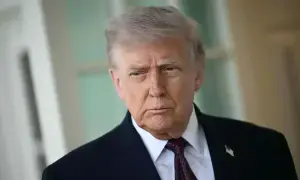
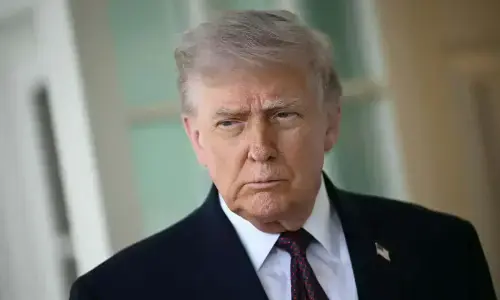
WASHINGTON: US President Donald J. Trump on Sunday ordered sweeping naval measures, including a blockade of the Strait of Hormuz, after high-level negotiations in Islamabad failed to produce an agreement, while simultaneously praising Pakistan’s civil and military leadership for hosting the talks.
The inaugural round of direct Iran-US dialogue, mediated by Pakistan, concluded early on Sunday after nearly 21 hours of talks without a breakthrough. However, officials indicated that the process had not collapsed and could continue.
“We have been at it now for 21 hours, and we have had a number of substantive discussions, that’s the good news,” US Vice President J.D. Vance, who was heading the American delegation, said at the end of the talks. “The bad news is that we have not reached an agreement,” he added.
“We have made very clear what our red lines are, what things we are willing to accommodate them on and what things we are not willing to accommodate them on,” he said, adding that the Iranian delegation had “chosen not to accept our terms”.
Mr Vance said they were returning to US with their “final and best offer” on the table, while Iranian statements suggested that responsibility for the next step lay with Washington.
Within hours after the talks concluded, both the US and Iranian delegations headed home.
The talks, the highest-level face-to-face engagement between Washington and Tehran since the 1979 Iranian Revolution, were held in multiple formats, including expert-level discussions, under the facilitation of Deputy Prime Minister and Foreign Minister Ishaq Dar and Chief of Defence Forces Field Marshal Asim Munir.
Escalation after talks
Announcing immediate action following the talks, Mr Trump said the US Navy would begin blocking maritime traffic linked to Iran.
“Effective immediately, the United States Navy, the Finest in the World, will begin the process of BLOCKADING any and all Ships trying to enter, or leave, the Strait of Hormuz,” he wrote on Truth Social.
Mr Trump focused heavily on maritime security in the Strait of Hormuz, accusing Tehran of destabilising global shipping routes. “Iran promised to open the Strait of Hormuz, and they knowingly failed to do so,” he wrote, alleging that “they say they put mines in the water”.
He questioned maritime risk perceptions, saying: “What ship owner would want to take the chance?” and warned that Iran’s actions would have lasting consequences, including “great dishonour and permanent harm to the reputation of Iran.”
He added that the United States would also target vessels allegedly cooperating with Iran. “I have also instructed our Navy to seek and interdict every vessel in International Waters that has paid a toll to Iran,” he said, adding: “No one who pays an illegal toll will have safe passage on the high seas.”
Mr Trump further warned that efforts to disrupt shipping would be met with force. “THIS IS WORLD EXTORTION, and Leaders of Countries, especially the United States of America, will never be extorted,” he said. He also stated that “The Blockade will begin shortly.”
In some of his most forceful language, the US president warned Iran against any escalation at sea. “Any Iranian who fires at us, or at peaceful vessels, will be BLOWN TO HELL!” he wrote, adding that American forces were “fully ‘LOCKED AND LOADED,’ and our Military will finish up the little that is left of Iran!”
He also said that US forces would move to neutralise threats in the waterway, stating: “We will also begin destroying the mines the Iranians laid in the Straits.”
The Strait of Hormuz emerged as a central point of contention during the talks, with Washington insisting on unrestricted navigation while Tehran maintained its right to regulate traffic.
Iran’s Revolutionary Guards said on Sunday that any military vessels attempting to approach the Strait of Hormuz will be considered a violation of the two-week US ceasefire and will be dealt with harshly and decisively.
The strait is under the control and ‘smart management’ of Iran’s Navy, the Guards said in a statement reported by Iranian state media, adding it is “open for the safe passage of non-military vessels in accordance with specific regulations”.
Nuclear dispute
According to Mr Trump, the negotiations with Iranian officials stretched over nearly a full day. “The meeting with Iran began early in the morning, and lasted throughout the night — Close to 20 hours,” he said. However, he claimed that despite progress on several points, the core issue remained unresolved.
“I could go into great detail, and talk about much that has been gotten but, there is only one thing that matters — IRAN IS UNWILLING TO GIVE UP ITS NUCLEAR AMBITIONS!” he wrote, adding: “IRAN WILL NEVER HAVE A NUCLEAR WEAPON!”
The US president said that while “most points were agreed to”, the failure to reach consensus on the nuclear question rendered the broader outcome irrelevant.
“In many ways, the points that were agreed to are better than us continuing our Military Operations to conclusion,” he said, “but all of those points don’t matter compared to allowing Nuclear Power to be in the hands of such volatile, difficult, unpredictable people.”
Pakistan’s role
In his posts on Truth Social, Mr Trump said he had been briefed by senior US officials on the Islamabad meeting and explicitly acknowledged Pakistan’s role in facilitating the dialogue.
“I have been fully debriefed by Vice President J.D. Vance, Special Envoy Steve Witkoff and Jared Kushner, on the meeting that took place in Islamabad through the kind and very competent leadership of Field Marshal Asim Munir, and Prime Minister Shehbaz Sharif, of Pakistan,” he wrote, adding that the Pakistani leadership were “very extraordinary men”.
“They are very extraordinary men and continuously thank me for saving 30 to 50 million lives in what would have been a horrendous War with India. I always appreciate hearing that — The amount of Humanity spoken of is incomprehensible,” he added.
The talks followed weeks of Pakistani mediation that resulted in a fragile two-week ceasefire, pausing the active phase of the conflict and opening a narrow window for diplomacy.
While no breakthrough could be achieved, it was, however, significant that neither side walked away, and officials indicated that the process could continue.
Published in Dawn, April 13th, 2026