UNSC divided as Gulf pushes to reopen Hormuz
• Vote on Bahrain-led, US-backed resolution postponed twice
• Russia, China raise objections to certain parts
• Iran warns against ‘provocative move’
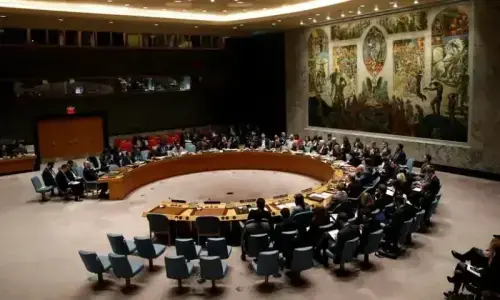
UNITED NATIONS: The UN Security Council remains sharply divided over a Gulf Arab initiative to reopen the Strait of Hormuz, the strategic waterway through which roughly a fifth of the world’s oil and gas supplies pass.
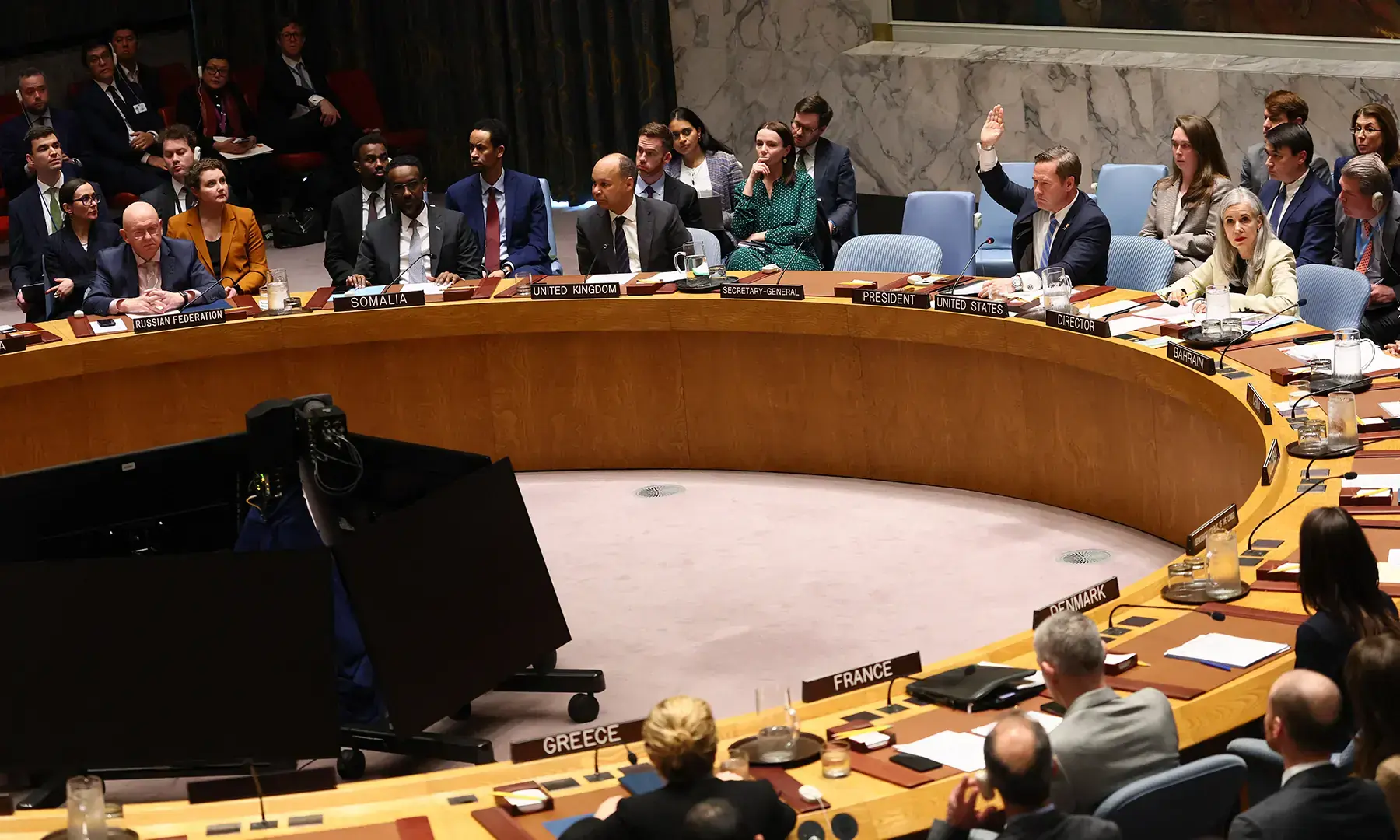
The vote on the resolution, initially scheduled for Thursday, has been postponed twice — first to Friday and then to Saturday — as Bahrain, the current council president and mover of the resolution, intensifies lobbying efforts. The United States has thrown its full support behind the measure.
The push comes from member states of the Gulf Cooperation Council (GCC), a political and economic bloc comprising Saudi Arabia, the United Arab Emirates, Qatar, Kuwait, Oman, and Bahrain. Formed in 1981 to coordinate security and economic policy among the Arab monarchies bordering the Persian Gulf, the GCC has increasingly acted collectively on regional crises.
Bahrain has tabled the fifth draft of a resolution that would allow countries to use “all defensive means” to secure maritime transit through the strait. Earlier drafts had included broader language, including references to Chapter VII of the UN Charter, which authorizes enforcement measures — potentially including force.
China, Russia, and France strongly objected to Chapter VII, and as a concession to build consensus, it was removed in the fourth draft. However, objections remain, particularly from Russia and China, over the language of operating paragraph 2 (OP2).
OP2 also seeks authorisation for “using all defensive means necessary and commensurate with the circumstances”, in the Strait of Hormuz and adjacent waters to “secure transit passage and to deter attempts to close, obstruct or otherwise interfere with international navigation … for a period of at least six months from the date of adoption and until such time as the Council decides otherwise”.
Bahrain has engaged in extensive bilateral lobbying, with active support from the UAE, meeting individually with all 15 Security Council members, including Pakistan, with particular focus on persuading China and Russia not to exercise their veto. The United States has also been actively supporting the resolution and the lobbying campaign.
The delay and debate reflect deeper disagreements over how far the Security Council should go in responding to Iran’s closure of the strait. Tehran shut down the narrow shipping lane shortly after US and Israeli military strikes on February 28, disrupting global energy markets, halting key exports from Gulf producers, and sharply raising shipping and insurance costs.
Under the UN Charter, a resolution requires at least nine votes in favor and no veto from any of the five permanent members — the United States, Russia, China, France, and the United Kingdom. Any one of them can block adoption.
President Donald Trump has publicly warned that the United States could expand its military targets inside Iran, including infrastructure such as bridges and power plants. Within the council, however, American diplomats face resistance not only from Russia and China, who emphasize Iranian sovereignty, but also from France, whose president has described calls to forcibly reopen the strait as unrealistic and fraught with risk.
Iran warns against ‘provocative move’
Iran has warned the Security Council against what it calls “provocative action”, with its foreign minister saying any such move would complicate the situation.
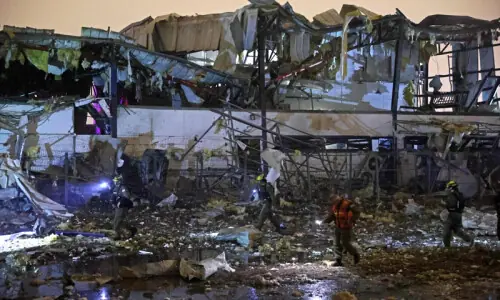
For the GCC countries, the stakes are existential. Their economies depend heavily on fossil fuel exports that transit the strait. Qatar, one of the world’s largest exporters of liquefied natural gas, has had to halt production and declare force majeure. Other Gulf states report mounting revenue losses and damage from Iranian retaliatory strikes targeting infrastructure and civilian facilities.
The diplomatic rift also marks a sharp deterioration in Gulf-Iran relations. In recent years, several GCC states had pursued cautious rapprochement with Tehran, seeking to manage tensions through diplomacy. The war has upended that strategy, pushing even previously neutral actors closer to a collective stance against Iran.
Analysts say the Bahrain-led resolution serves both practical and symbolic purposes. Militarily, most GCC states rely heavily on US support and have limited capacity to secure the strait independently. Politically, however, taking the matter to the Security Council internationalizes the dispute and places Iran’s actions formally on the UN agenda.
Whether the resolution passes will depend on last-minute diplomacy. If Russia, China, or France cast a veto, the measure will fail regardless of how many members support it. If they abstain and at least nine countries vote in favour, it could be adopted.
For now, the Security Council remains divided — caught between the urgency of restoring global energy flows and the risks of authorising force in an already volatile region.
Published in Dawn, April 4th, 2026