THE ICON REVIEW: STORY VERSUS SPECTACLE

I wonder why we don’t have Eids like this year’s anymore.
The rush at ticket windows, shows packed till early morning, big box-office numbers — almost all of them real, to an extent — the dismissiveness of ride-hailing services as their drivers leave you stranded in the cinema lobby for hours before one of them takes pity on you… It is, suddenly, a great time for movies — at least for the next week or so!
While three Eid movies were set to debut this Eidul Fitr, one of them — Delhi Gate — bowed out in Sindh. The DCP [Digital Cinema Package], I am told, had a technical error but, as I personally witnessed, a lack of ticket sales and audience interest also played a part (I was the only one with a reservation for the one show at Karachi’s Nueplex Askari).
Delhi Gate, its director confirmed to Icon, will return to cinemas — as soon as Bullah and Aag Lagay Basti Mein’s audiences thin out. The reviews below tell you how good each film is.
Aag Lagay Basti Mein
Recently, at the end of a long discussion, an actor friend asked me the most basic of questions — one everyone knows, but only filmmakers persistently (and cynically) ask film critics: what, pray tell, is a good movie?
One could answer this in a few dozen ways (I’ve done it enough times that my eyes roll reflexively), but since this is show business, it’s better to lead with an example: Aag Lagay Basti Mein (ALBM) — it is, perhaps, as fine a specimen of a good motion picture as you’ll get.
Icon checks out the two Pakistani Eidul Fitr film releases — the Fahad Mustafa and Mahira Khan-starrer Aag Lagay Basti Mein and the Shaan Shahid-starrer Bullah — which present contrasting approaches to filmmaking. One shows attention to good storytelling. The other chooses spectacle and relies on star power
Irrespective of box-office numbers, ALBM is a smash, as we predicted in Icon a few weeks ago (Betting on Eid Again, published last month). It is a winner, not because of its expansive advertising campaign on distributor ARY Film’s sister television networks but because the filmmaker is smart enough to identify and neutralise the tripwires of narrative filmmaking.
That filmmaker is Bilal Atif Khan, one of the most promising newcomers in the recent Pakistani cinema landscape.
Bilal, who has directed and co-written the film with Naeem Ali, addresses the biggest gripes I have with our movies: forgetting the big picture, injustice to the premise, the inability to foresee structural and production pitfalls, and the absence of intelligently laid-out conflicts and resolutions.
ALBM is full of big and small conflicts — not the makeshift kind, but the character- and emotion-driven kind.
Barkat (at first played by Aashir Wajahat, then Fahad Mustafa) is a meek pacifist with a big heart, born into the wrong family: a bloodline of Sindhi dacoits. When things get tough in interior Sindh, the family migrates to Karachi and immediately learns that the city is a far bigger mugger than they ever were. While his dad (Shabbir Jan) and brother adjust — the latter snatches mobiles and purses — Barkat ends up in jail.

For Barkat, a life of crime — even one he is remotely connected to — gets a no-go from the heavens. This bedding, neatly tucked under the main narrative layer, pays off in spades later.
Before that, another key conflict enters the picture: the leading lady.
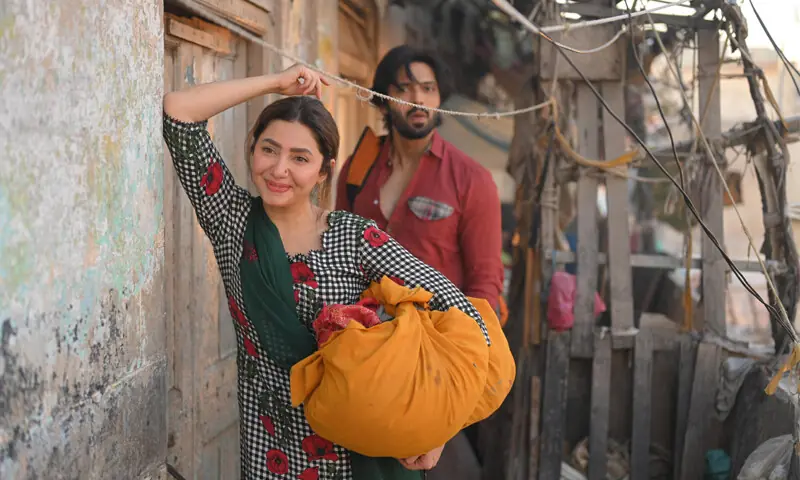
Almas (Mahira Khan) is a maid who loves to swipe left, right and centre — not on social media but anything that catches her eye: lipsticks, blushes, foundations and the odd Rs1,000 currency note.
Already divorced, she’s hardly interested when Barkat’s family comes calling with a rishta [marriage proposal]. However, her eyes pop open when she overhears that Barkat spent years in Dubai (he was in the slammer).
Almas had always dreamt of living in Dubai, so it’s an easy, romance-less ‘yes’ — until she learns the truth: the family simply wanted to be rid of Barkat. She and Barkat are sent packing right after the wedding, to a dingy, leaky, one-room house in a smelly corner of a railway colony.
They quickly learn to compromise. Barkat promises to save enough for their move to Dubai, gets a job, and the two place a savings jar titled ‘Doobai’ on their shelf. She, meanwhile, continues pilfering, without his knowledge. There’s a subtle hint here about relationships, about how, even in a marriage, things remain hidden.
ALBM bets the farm on building a unique relationship between Almas and Barkat; their romance takes a backseat to a more resilient bond of companionship and understanding.
Almas, like Barkat, has a kind heart — evident in a scene where she tries to make up with him after he takes money from their ‘Doobai’ jar to pay a neighbour’s child’s medical bills. This minor track, like most subplots in ALBM, leads to a quiet but harrowing moment of realisation that propels the film into the second half. By then, the emotional foundation — the similarities and differing worldviews — has been firmly laid by the director and co-writer.
Post-intermission, we get the kinetic turn. Barkat, realising life will never be fair, tells Almas they’re going to pull off one big robbery to set things right.
Enter — by a strange twist of fate — underworld don Marble Seth (Javed Sheikh), and his son Changezi (Tabish Hashmi), a petty young man wearing a ring with a poisonous sting.
You’re wrong if you think the story becomes predictable from here. Bilal and Naeem’s screenplay doesn’t lag. Nothing is superfluous. Every scene either builds character or plants tidbits they later cash in. Placing breadcrumbs with just enough emphasis that they register is a rarity in Pakistani cinema.
The screenplay gets perfect support from cinematographer Abid Rizvi’s wide-angle lens choices. Switching between 18 and 35mm cameras, these spherical lenses expand the frame just enough that the background and production design (credited to Team Big Bang) become as integral a character as Barkat and Almas. The wider field of view also makes the storytelling more immersive.
Unlike most Pakistani films, ALBM feels like a streamlined production whose screenplay was polished well before it went on set. That sheen reflects in the choreography of shots, leading to a lean, effective edit with nary a loose frame offsetting the narrative balance (the editors are Rasheed Khan, Salman Noorani and Bilal).
In the acting department, Tabish Hashmi is a pleasant surprise. His overweening bad guy gives him just enough leeway to become a villain worth remembering.
Javed Sheikh, too, is a surprise. During the film, I kept thinking back to a conversation I had with him, where I urged him to pursue roles that allow him to do something different (the topic of Meet the Supporting Cast, published in Icon two years ago). Marble Seth is that rare ‘different’ role — one he nails effortlessly.
Ayub Khosa and the supporting cast are just as good. Also — need one say it — Fahad Mustafa is a gem. Barkat, upon whose shoulders the narrative hangs, is a fragile, sensible, deeply conflicted human being, with a big, easily overwhelmed heart. He and Almas are as precise a representation of realistic human beings as commercial motion pictures allow.
Almas has a devilish side, but a line or two — and Mahira’s performance — reveal that her emotional barriers are rooted in hurt. This is Mahira’s most immersive and divergent role yet. Note the realistic, unflattering, mismatched make-up she wears and the slightly mangy hairdo; these small choices go a long way toward authenticating her character.
Like most women — and men — she pines for a better life that is forever out of the reach of the underprivileged. This makes their struggle more real, even when the film swivels into the fantastic — though never ludicrous — part of the story.
ALBM has only two minor shortfalls: the soundtrack is just okay, and there’s a negligible story hiccup at the very end involving Mahira and Ayub Khosa’s characters. Even so, the film easily slides into the list of the finest entertainers from Pakistani cinema.
It is a whip-smart, well-rounded film that shows you don’t need sultry item numbers or faux extravagance to tell a good story. A small, dingy house and two people will suffice if you have a clear head and the cinematic flair to make the mundane feel magical. You won’t find a better example of a good Pakistani film than this.
Bullah
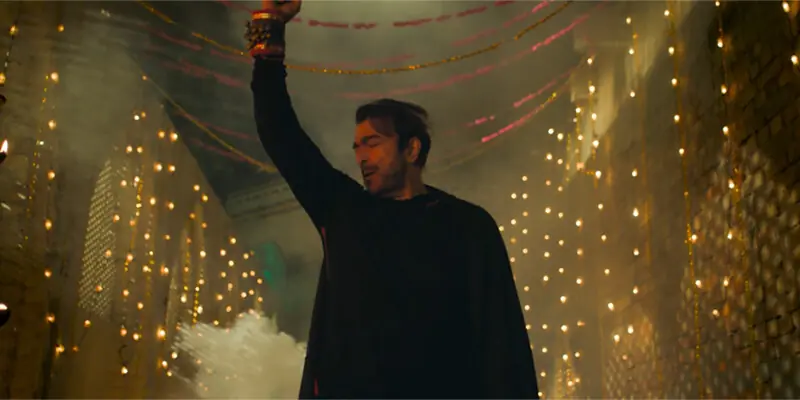
In Bullah, the new action film starring Shaan Shahid — where the superstar does all the heavy lifting — the viewer is at the mercy of a warped sense of time, space and a truckload of unanswered questions.
Before we get to those questions (that get no answers), here’s the plot: Bullah (Shaan), a man who rives his SUV across Punjab farmlands, has a saviour complex. He saves a Sikh woman (Maham Mirza) from India, who is fleeing a gang of rural hoodlum rapists, then saves an infiltrator who is running from another rapist villain’s gang. Yes, almost all villains here are rapists.
The rural gang falls under Faqeera (Naeema Butt), the extravagantly stylised, brutal lord-of-lords of an agrestic mafia that mostly hurts or rapes people — the film never explains why. The modern mob in the city — whose main madman, Sahoo (Adnan Butt), also lingers in the countryside — is run by Bakshi (Saleem Sheikh).
Bullah is a man of justice who, we learn quite late in a passing line, was trained by — and later became a trainer of — US military men. The film leaves it at that.
If there is one thing Bullah is clear about, it is its adherence to the superficiality of its premise and an utter disinterest in answering even the most basic questions about its characters and story. One can almost feel the filmmakers’ shrug each time a question arises in your mind.
For every question the viewer has, Bullah has two responses: “It just is” and “Suspend your disbelief.” Mostly, it is the latter. For instance, these are the answers to some of the questions that arise in the viewer’s mind — or so one assumes from the narrative:
Q: Who is Bullah, the affluent man who walks into frames rescuing people?
A: Duh. He’s a good guy.
Q: What makes him tick?
A: He’s just like this. Why do you want to know more?
Q: What makes the villains evil? Why are they rapists?
A: They just are.
Q: Why does the film need three parallel villain tracks (Faqeera, Bakshi, Sahoo) when they never converge naturally?
A: Suspend your disbelief.
Q: Who is Sophia (Sara Loren), and why was she necessary — especially when she is never integral to the narrative?
A: The film needs glamour, and the hero needs a romantic subplot. You ask too many questions!
Writer Nasir Adeeb’s script — the screenplay is by director Shoaib Khan (Jackpot) — harks back to old Lollywood. Back then, a story made do with a simple premise and simplistic scene set-ups stitched together in the edit. The result felt rough, with too many narrative divergences — the story went here, there, everywhere before returning to the main idea at the climax. During this haphazardness, the passage of time often felt off.
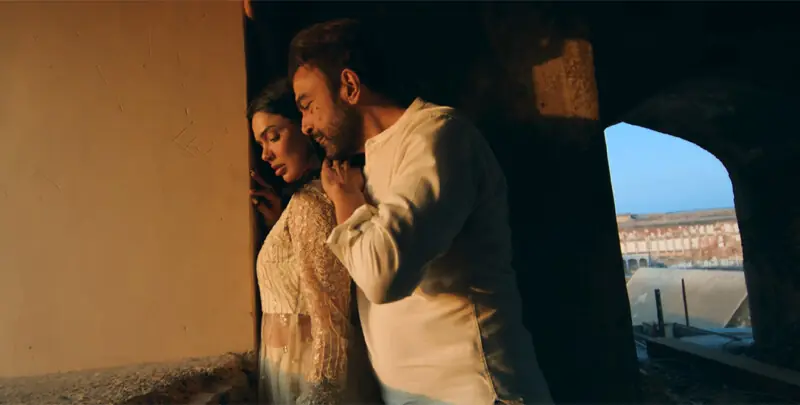
In Bullah, this becomes a glaring oversight — particularly during the stretch where he meets, falls in love with and marries Sophia. One wonders: was that a dream or reality? And in either case, why is she such a passive, forsaken character, when her track naturally puts her dead centre in the plot?
The premise is still ideal for a Shaan Shahid actioner. It merges old Lollywood with new-age Hollywood, where the gandasa and lungi seamlessly give way to suits and martial arts gunplay. It’s a pity that Shaan doesn’t get to wear a lungi or wield a gandasa before donning a suit. His choice of clothes and artillery is defiantly modern, almost as if he’d do anything but step back into those roots.
The action by Azam Bhatti is mostly basic and fake. Punches land with hollow impact, bullets hit with lesser intensity, people fly and smash into things like a 2000s’ Bollywood flick. John Wick, this definitely ain’t.
It’s not all bad technically. Asrad Khan’s cinematography, though constricted to small sets and presumably quick light set-ups, is fine for the most part. The songs — especially Lajpalan’(Nik D. Gill and Miel) and Wekhi Kithay (Rehan Abbas) — are fantastic, though good music in a Shaan film is hardly a surprise.
The actors are professionals in every sense of the word. Adnan Butt and Saleem Sheikh growl, smirk and threaten as convincingly as their one-line characterisations allow. Naeema Butt is the standout, carving a major villain from a bland, superficially imagined character that meets a truly tragic end, screenwriting-wise (it is a bad cop-out).
Bullah would be a royal mess if Shaan weren’t holding the narrative and screen together with herculean might. Infusing emotion and conviction into Bullah, one sees him adjusting to the story’s pitfalls while adding small grounding touches on the fly.
Leaving make-up kits unpacked like Robert Redford (who was famous for his near non-use of make-up), Shaan could have used a touch-up or two in several scenes. The same can’t be said for Sara Loren, whose overdone “beauty” seems like a by-product of cosmetic surgery. While Shaan definitely looks older than usual, his performance is still top-notch (again, the same cannot be said for Loren).
However, one pattern needs addressing: after Waar, Yalghaar, O21, Zarrar and now Bullah, the covert-military man-saviour character has run dry. For Shaan, it is time to put it to rest, unless there is a genuinely unique story worth telling.
A better version of Bullah is buried within its janky exterior. Had editor Adeeb Khan and scriptwriter Nasir Adeeb asked themselves the basic questions mentioned above, found believable reasons for the story’s conflicts, and cut the superfluous tracks (Bakshi, Sahoo and the Sikh girl’s tracks are expendable), Bullah’s roar might have shaken the box office. Right now, it is a whimper.
At the end of the day, the choice between ALBM and Bullah is the choice between story and (something resembling) spectacle. Both films are still running in theatres and, given the gloom and doom of real life, I would strongly suggest you head to the cinema — if only to watch ALBM.
Rated “U”, Aag Lagay Basti Mein is an ARY Films’ release. Bullah, rated “PG” for fake blood, violence and adult themes, is an HKC release
The writer is Icon’s primary film reviewer
Published in Dawn, ICON, March 29th, 2026