Interest rate hike likely as oil drives inflation up


KARACHI: The State Bank of Pakistan (SBP) has created room to increase its policy rate at the next monetary policy meeting, following an expected sharp rise in headline inflation after a jump in oil prices due to Middle East crisis.
Financial experts watching the unexpectedly high cut-off yields of the treasury bills in the latest auction said that a 100-basis-point increase in treasury bill returns created visible room for an interest rate hike at the next monetary policy scheduled for April 27.
The trade and industry, already crying out under the hike in petroleum prices, could hardly afford a further increase in the benchmark interest rate, is 10.5 per cent, and it was expected that the State Bank might reduce the policy rate in the Monetary Policy announced on 9 March. However, the war had started in the Gulf, and expectations of a new wave of inflation were clear, prompting the State Bank to keep the interest rate unchanged.
In the auction held on Monday, returns on treasury bills increased by up to 100 basis points. The interest rate is below 100 basis points for most of the T-bills.
Possibility of tight monetary policy grows after 100bps hike in T-bill yields
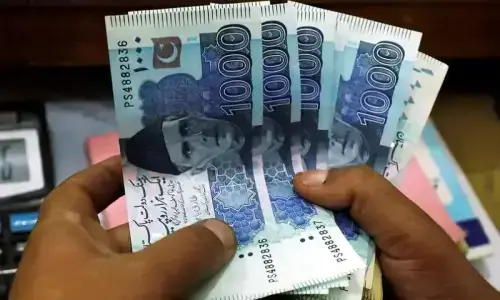
The return on T-bills for one month was increased by 98.4bps to 11.47pc; for three months 100bps to 11.5pc; for six months 76bps to 11.5pc, and for 12 months 50.7bps to 11.5pc.
The Gulf War has entered its 18th day, and oil prices have risen to unexpected highs, with prices ranging from $110 to $130 per barrel. The prices quoted in the international market are not settled, as changes are too rapid due to the escalation of the war in the Gulf.
The government raised over Rs1 trillion in the auction by selling T-bills, reflecting its growing need for liquidity. Pakistan is also engaged in a war with Afghanistan, which requires additional financial support for the defence forces.
The bids also showed that the banks had no option but to lend their money to the government, as the total amount offered against the t-bills was Rs 1.358 trillion.
Due to high oil prices and high insurance costs for shipping amid growing uncertainty in the region, investors are reluctant to borrow and invest in domestic ventures.
Published in Dawn, March 18th, 2026