Society: PAKISTAN’S SEASON OF CHARITY
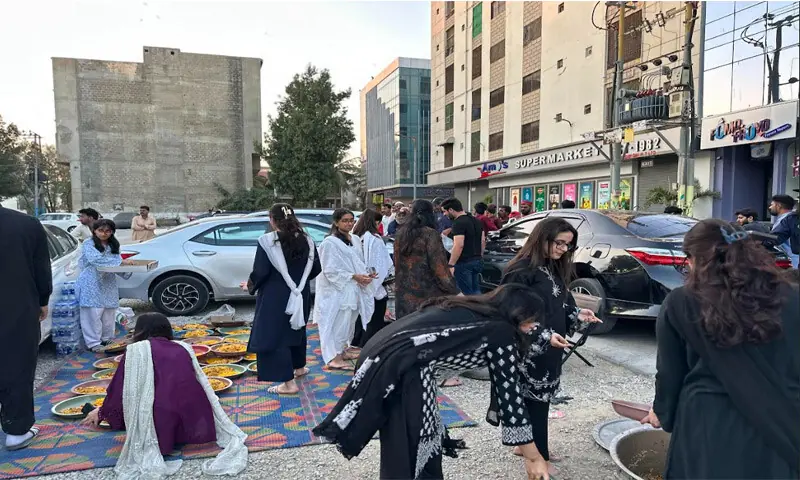

The mats go down first. Long strips of plastic or matted dastarkhwaans [dining spreads], unrolled across the vacant plot. Then come the boxes — stacked earlier in the afternoon by hands that have been at this for hours — each one packed with dates, water, and a small parcel of food.
Someone is stirring a massive pot of Rooh Afza, the deep red syrup catching the last of the daylight as it bleeds into the water. Nearby, a cloud of fragrant vapour escapes as someone lifts the cloth draped over a deg [cauldron] filled with rice and meat.
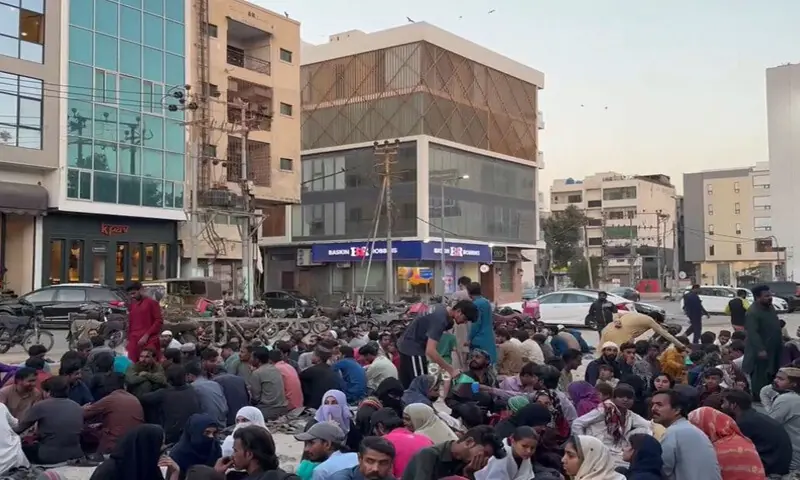
People begin to arrive before the call to prayer. A security guard still in uniform. A food-delivery rider with a helmet under his arm. A woman with three children who hang close to her sides, wide-eyed and quiet. A roadside worker, hands still carrying the dust of the day. Beggars who have learned the address. An elderly man who walks slowly and says nothing to anyone. Entire families — grandparents, parents, small children — who settle on to the mats with the ease of people who have done this before, because they have.
By the time the azaan [call to prayer] sounds, there are over 200 people seated, shoulder to shoulder, waiting for the moment they may eat.
Pakistan’s charitable instinct during Ramazan is genuine and considerable. For the student collectives, the decade-long volunteers and the organisations that depend on it to survive, the generosity is real. But so is the 11-month gap that follows…
PAYING IT FORWARD
The volunteers handing out the food are from a collective called SindhuNamah.
Abier Kachelo, a third-year student at the Institute of Business Administration, started it in the wake of devastation caused by the 2022 floods, which displaced a third of the country’s population. She was fresh into university at the time and, with her friends’ support, she organised food rations to be sent to flood-affected villages in Sindh.
“In this time, we also learned about malnutrition, stunting and food insecurity, particularly in Sindh,” says Zoya Hemani, Abier’s classmate and an integral part of SindhuNamah. The situation compelled them to increase their efforts, which now include medical drives and school restoration, alongside the daily iftar dastarkhwaan that has run every Ramazan for the past three years.
“When we started, we were a team of no more than 10 students,” Abier tells Eos. “Today, we have over 100 student volunteers in our network.” For funds, they rely on friends and relatives, while they also get unsolicited donations via social media. “We have definitely formed meaningful connections with many of the donors over the years,” she adds.
Zoya points out that they keep donors apprised of how their money is being spent to avoid concerns over transparency. “And there will always be people who will accuse you of ‘chasing clout’, but that is quickly swept away by the kindness you come across,” she continues.
THE KINDNESS OF STRANGERS
“Once, instead of the usual 250 people at our dastarkhwaan, more than 500 arrived, just minutes before iftar. We didn’t want to turn anyone away, but we simply didn’t have enough food,” narrates Zoya.
“As our team scrambled to manage the situation, a man we had never seen before suddenly stopped by and dropped off three degs of rice, no questions asked, no words exchanged. In that moment, with minutes to spare before iftar, it felt like everything fell into place exactly when it was needed,” she says. “Running this initiative, we watch our prayers manifest in real time, miracles unfold and doors open in ways we can never fully comprehend.”
SindhuNamah is one expression of an impulse that surfaces across the city every Ramazan. Sadia, 27, found her way into this world the same way many do — through a single social media post, back in 2015. She has since become the linchpin of the dastarkhwaan efforts, returning to managing it without fail every Ramazan.
“If we are privileged enough and have a network, it is our duty to become a source of help or means for the underprivileged communities” she says.
GOING YEAR-ROUND
I am also reminded of a memory from 15 years ago. From the first-floor balcony of my apartment in a middle-class neighbourhood, I would watch a college student set up a small classroom in our building’s compound every evening.
The students were the children of the maids and workers who kept the building running — children with nowhere else to go for structured learning. He brought his own chalk. No one had asked him to come.
Saqlain Shariff is in his late-thirties now. That compound classroom became Kaizen Pakistan, an organisation he co-founded with a friend that today runs a classroom providing education to children from multiple slum communities who would otherwise have none.
Some of those first students are in university. He still works a regular job to keep himself afloat, while managing the organisation through financial shortfalls that recur with a regularity that would have defeated most people long ago.
“We run into trouble every few months,” he says. “Ramazan is when we breathe again.”
AN INTERTWINED HISTORY
While dastarkhwaans are a Ramazan-specific phenomenon, they do serve as the gateway to the wider world of charity and volunteerism. But charity is also very much part of Pakistan’s social fabric, as much due to the religious concepts of zakat [obligatory charity] and sadqa [voluntary charity], as it is due to Partition — the tradition of taking in strangers, of communal obligation to those with nothing, runs deep in a country born from displacement.
Even young Abier and Zoya of SindhuNamah allude to this culture. “Sindh has always celebrated the essence of communal service, through a longstanding tradition of langars [free communal kitchens], musaafir khanas [travellers’ lodges] and dastarkhwaans,” Abier tells Eos. “We couldn’t bear to see these values disintegrate as suffering rises.”
As Sindh and the rest of the country continues to experience various degrees of calamities, including regular floods, such interventions are needed more than ever. The latest global food security report estimates that 60.3 percent of Pakistanis cannot afford a healthy diet, while some 16.5 percent are undernourished.
THE GAP THAT FOLLOWS
The numbers make the case for why efforts like SindhuNamah’s matter — but they also expose the limits of what any dastarkhwaan can do. Major charities suggest that roughly 80 percent of annual donations collected by them arrive during Ramazan alone. For smaller organisations, the proportion is often higher. The generosity is real. So is the 11-month gap that follows.
This is the tension that sits beneath the warmth of every dastarkhwaan. Pakistan’s charitable instinct during Ramazan is genuine and considerable — but it is also concentrated, compressed into 30 days and then largely withdrawn. Donor fatigue sets in quickly once the month ends.
Saqlain feels it every year, the particular quiet of the post-Ramazan weeks when the messages slow and the accounts thin. SindhuNamah feels it too, Zoya acknowledges — the bulk of their operations are carried out during this month precisely because sustaining donor attention beyond it is difficult. “The need doesn’t stop,” she says. “But the giving does.”
Back on the vacant plot, the azaan has sounded. Two hundred people reach for dates at the same moment — the quiet collective exhale of a fast being broken. The Rooh Afza moves along the mats in jugs. Children who arrived silent are now animated, reaching across their parents. The elderly man who said nothing to anyone is being served by a volunteer crouching beside him, unhurried.
There is enough food tonight. There is, for now, enough of everything.
The writer is a member of staff. X: @hydada83
Published in Dawn, EOS, March 15th, 2026