The Middle East war has unleashed a torrent of AI-driven disinformation. Beyond entirely fabricated visuals, another kind of content is spreading: authentic images “enhanced” in ways that experts say are subtly distorting perceptions of what’s happening on the ground.
In one striking photo, a kneeling US pilot is confronted by a Kuwaiti local, moments after parachuting from his jet. The high-quality image was widely shared online and even published by media outlets. Yet the pilot appears to have only four fingers on each hand.
AFP fact-checkers ran the photo through AI detection tools and found it contained a SynthID, an invisible watermark meant to identify images made with Google AI. But that’s not the whole story.
The situation itself appears to be genuine. A video showing the same scene began circulating on social media on March 2, and satellite imagery verified the location. It also corresponded with reports that day that Kuwait had mistakenly shot down three US warplanes.
AFP was also able to locate an earlier version of the photo on Telegram that matched the high-resolution photo exactly, except that it was blurry.
AI verification tools determined this image, which had none of the same detail in the pilot’s face, was real. This suggests it may have served as the starting point for the image that returned the Google AI result.
“AI-enhancement may subtly alter textures, faces, lighting, or background details, creating an image that looks more ‘real’ than the original,” said Evangelos Kanoulas, a professor in AI at the University of Amsterdam.
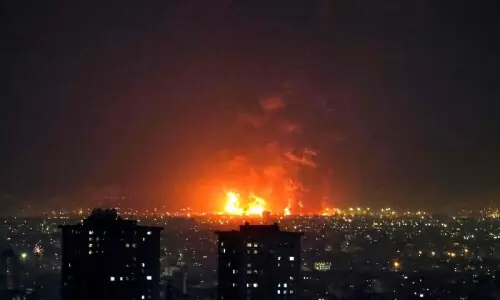
This can “strengthen a particular narrative about an event — for example, making a protest appear more violent, making a crowd appear larger, making facial expressions more intense.” In another case, social media users shared a dramatic image of a huge blaze near Erbil airport in Iraq, after the area was targeted by Iranian strikes on March 1.
Although SynthID detection recognised the use of Google AI in the picture, it was not a total fabrication. The original version of the image shows the same scene but with a far smaller fire and smoke column, and less vivid colours.
‘Very different story’
Experts warned that the line between enhancement and content generation, accidentally or intentionally, was a thin one.
“Even little changes can end up telling a very different story,” said James O’Brien, a professor of computer science at the University of California, Berkeley, and “could change the perception of events”.
Generative artificial intelligence is also still prone to error and may “hallucinate” elements that were not in the original image, Kanoulas added.
This happened following the shooting of Alex Pretti by federal immigration agents in the US state of Minneapolis in January, when an AI-enhanced image of the incident went viral.
The image was based on a frame taken from a genuine video of the shooting, showing Pretti falling to his knees with officers beside him, one of them holding a gun to his head.
In the grainy, low-quality frame, Pretti holds an object that in reality was a phone. In the AI-treated image, some social media users wrongly saw a weapon in his hand.
As the war triggered by the US-Israeli attacks on Iran rages on, experts said that without proper labelling, AI-enhanced images further eroded the public’s trust.
This kind of content was already having “a huge impact on people and their ability to trust the truth,” said O’Brien.
“People start doubting authentic images as well,” Kanoulas agreed.