Govt deplores opposition’s boycott of in-camera briefing on national security


 1
1

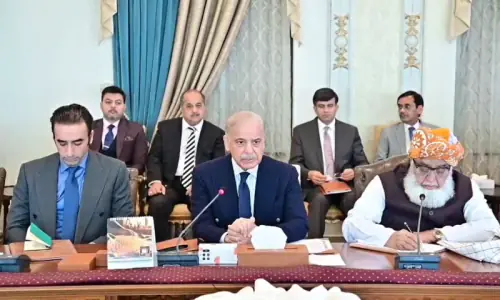
ISLAMABAD: The government on Wednesday deplored the opposition’s decision to boycott an in-camera briefing convened on national security, advising it to rethink its policy on issues linked to national interests.
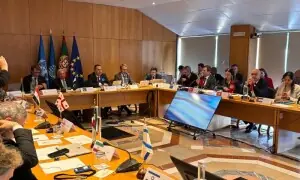
Earlier in the day, the government had invited the heads of all parliamentary parties to an in-camera briefing on national security convened by Prime Minister Shehbaz Sharif at his office. However, the PTI had decided not to attend any meeting unless a meeting with its founder Imran Khan was arranged.
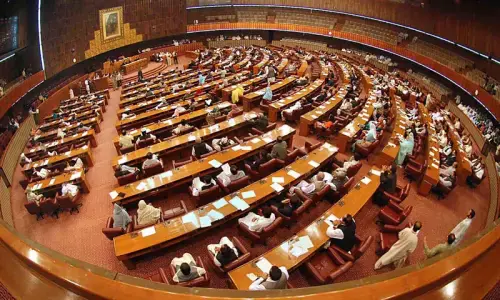
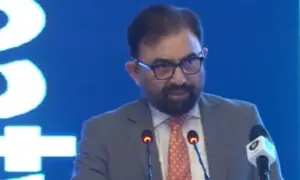
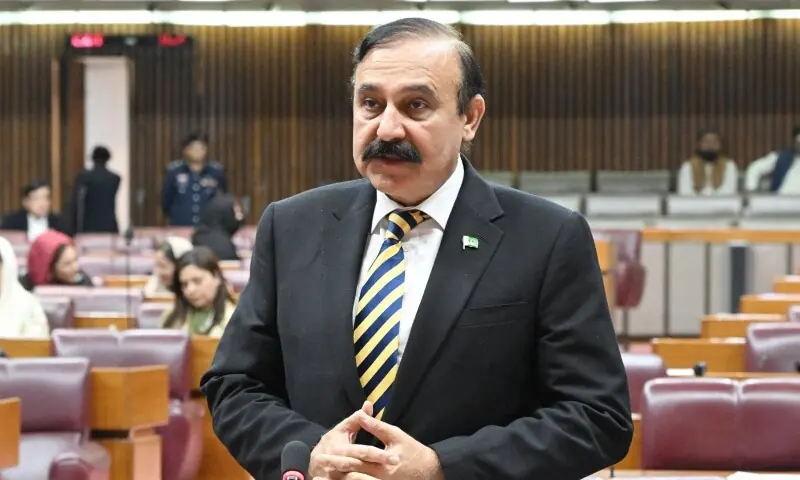
Talking about the development in the National Assembly, Minister for Parliamentary Affairs Dr Tariq Fazal Chaudhry said the opposition should demonstrate seriousness on issues of national interest.
He said political differences aside, this was the time to send a message of complete unity in Pakistan on matters of national interest. The minister said the session was organised neither to promote the agenda of any political party nor to benefit anyone individually.
“It was a matter of Pakistan’s security and of evolving a rational policy to move forward while safeguarding the country’s interests under the prevailing circumstances,” he said.
The minister said the government valued input from all political parties, including those from the opposition, in shaping the country’s future policies amid the prevailing regional situation.
“PM Shehbaz had invited the opposition to an important briefing regarding Afghanistan, Iran, the Gulf countries, and the overall regional situation,” he said.
Chaudhry said Deputy Prime Minister and Foreign Minister Ishaq Dar and Foreign Secretary Amna Baloch gave a detailed briefing to parliamentarians and the country’s political leadership.
He added that PPP Chairman Bilawal Bhutto-Zardari, Jamiat Ulema-i-Islam-Fazl (JUI-F) chief Maulana Fazlur Rehman, Muttahida Qaumi Movement-Pakistan (MQM) leader Khalid Maqbool Siddiqui, and other leaders of the government’s coalition partners gave valuable input. He assured the House that political leaders’ input would be incorporated into the formulation of future policies.
He said Pakistan was making efforts for de-escalation in the region following attacks on Iran. He said Pakistan was playing its role as a responsible state in the current situation and would continue to do so.
“We neither want to jump into the war nor will we take sides. Our efforts are directed at bringing the conflict to an end and de-escalating heightened tension in the region,” he remarked.
Chaudhry said that Pakistan, as a peace-loving country and as a good neighbour, desired peace in the region.
“We want to spread the message of peace to all countries,” he said. The minister said Pakistan had borne the brunt of terrorism and bomb blasts, but still advocated for peace.
He cautioned that the ongoing conflict was also negatively impacting the economy and that the coming days could be more challenging. The minister said that Iran was a brotherly country and Pakistan strongly condemned the US-Israeli attack on Tehran.
He recalled that Pakistan also strongly condemned the assassination of Iranian Supreme Leader Ali Hosseini Khamenei and other leaders.
“We are also concerned over attacks on the Gulf states and desire immediate de-escalation,” he added.
Talking about Operation Ghazab lil-Haq, the minister said that Pakistani forces launched the offensive against the Afghan Taliban, which would continue till its objectives were achieved.
“The operation will continue till the ultimate objective is achieved, which is to make Pakistan’s border safe, stop [terrorists’] infiltration from Afghanistan and attacks on the civilian population,” he said.
He asserted that the operation would continue till the Afghan regime took solid measures to stop infiltration inside Pakistan.
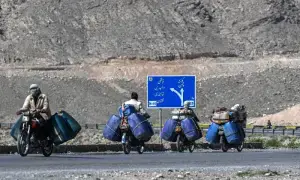
He said that Deputy Prime Minister and Foreign Minister Ishaq Dar had also visited Afghanistan thrice since the Taliban came into power, but to no avail. He regretted that Afghan soil continued to be used for terrorism inside Pakistan.
Chaudhry said that since 2022, over 8,000 civilians and security and law enforcement personnel had been martyred as a result of terrorist activities originating from Afghanistan. He said the government continued to inform the Afghan regime of the situation, but no action was taken.
He said that the government, during talks with the Afghan Taliban in Doha, had expressed readiness to give Rs10 billion for resettling the banned Tehreek-i-Taliban Pakistan (TTP) away from the Pak-Afghan border, but they refused to provide a guarantee.
The minister said that all the terror attacks in Pakistan, including the suicide attack on the imambargah in Islamabad and attacks in Bannu and Bajaur, originated from Afghanistan.
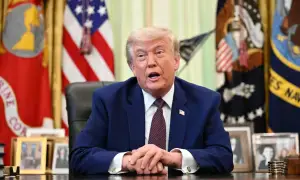
Meanwhile, PTI lawmaker Ali Muhammad Khan strongly condemned the attack on Iran. Without naming US President Donald Trump, he said that he would also ask PM Shehbaz if a person who murdered a great Muslim leader could ever be a messenger of peace.
JUI-F’s Naeema Kishwar asked the government to play it wisely in the present situation and try to find a peaceful solution.
Moreover, MQM parliamentary leader Dr Farooq Sattar said that PM Shehbaz and Field Marshal Asim Munir could also talk to the US leadership.
“As per a well-planned conspiracy, other Muslim countries are also being dragged into war without any reason,” he said.
He said that a proposal was floated at the in-camera meeting chaired by the prime minister that a joint sitting of the Parliament be convened so that those who did not get the opportunity could also express their views.
However, MQM parliamentarians walked out of the proceedings after Deputy Speaker Ghulam Mustafa Shah refused to give Sattar extra time express his views.