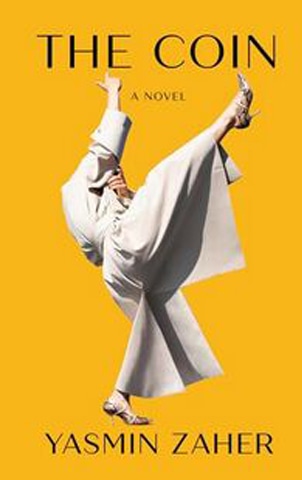
The Coin
By Yasmin Zaher
Catapult
ISBN: 978-1646222100
240pp.
Yasmin Zaher is a Palestinian author and her debut novel, The Coin, was awarded the Dylan Thomas Prize 2025. The book is unique in its premise, as it explores themes of identity and homeland.
Zaher’s unnamed narrator is Palestinian, lives in New York, has impeccable taste and meticulous hygiene. She is wealthy but has limited access to her wealth. Her homeland exists exceedingly in her imagination, as she struggles to thrive in America.
She is also a teacher working at a school for underprivileged boys. It is here that she feels the most in control. Her unconventional teaching methods resonate with the seventh graders, as they feel their voices matter the most within the four walls of their classroom.
Throughout the book there is a symbiotic relationship between the narrator and her students — “They were on the margins, and I understand the drive to reclaim American democracy for all, but I think it’s an afterthought.” She is acutely aware of their circumstances and looks beyond their shortcomings, focusing on their intellect and strengths that might not be visible at first glance but which are still there.
The winner of the Dylan Thomas Prize 2025 is a debut novel by a Palestinian author about the complexities that lie at the heart of identity politics and the struggle to reclaim oneself
In turn, the students provide her a semblance of control and stability that she struggles for outside the classroom. They value her presence in their lives and provide meaning to her daily routine. For me, this was one of the most endearing parts of this book.
The Coin reads at a frenetic pace. Like a kaleidoscope, it flits between the various aspects of the narrator’s identity, going back and forth as she grapples with transactional relationships outside of her work. She finds herself searching for something throughout the book. As a reader you can’t place your finger on it. Neither can she. This is the strength of Zaher’s writing, she keeps her reader at par with the narrator, so we go through the motions with her.
She is a Palestinian living in New York trying to reconcile the fractures that exist within her identity. Zaher writes, “I used to think that if people saw the real face of wickedness, not the mask, they would revolt… When Netanyahu and Trump were elected, I thought those were good days, because the truth had come to light. But it seemed not only that the truth was ugly, but also that ugly was beautiful. The people adore the monster, the rich want to look poor.”
It is here you realise that, perhaps, what the narrator is looking for in her relationships and daily interactions is a sense of homeland. In a deeply profound way, Zaher highlights how important it is to have a strong sense of identity and belonging. The narrator finds making connections a tedious business, even though she tries her best but, eventually, every relationship she has reaches a point where her need to belong remains unfulfilled.
The Coin is a study in resistance. One of the most defining features of Zaher’s protagonist is her militant obsession with hygiene, which stems from a childhood trauma when she accidentally swallowed a shekel that she believes is still lodged somewhere in her body. This fixation on an internal impurity is what drives her to scrub, sanitise and control her external world with a ferocity that contributes in alienating her from those around her.
The Coin reads at a frenetic pace. Like a kaleidoscope, it flits between the various aspects of the narrator’s identity, going back and forth as she grapples with transactional relationships outside of her work. She finds herself searching for something throughout the book. As a reader you can’t place your finger on it. Neither can she. This is the strength of Zaher’s writing, she keeps her reader at par with the narrator, so we go through the motions with her.
This struggle for bodily autonomy also puts her at odds with the society that she is a part of. Despite her wealth and expensive taste, she remains an outsider as a stateless Palestinian in America. Her involvement in a Birkin bag pyramid scheme further isolates her. Her rebellion is complex and sheds light on rampant American consumerism and casual racism.
Zaher’s writing is witty, chaotic and stylish, as it compels the reader to be pulled into the narrator’s increasingly unhinged stream of consciousness. The reasons for her bizarre behaviour slowly become easier to understand as you become privy to her every thought and justification.
In the landscape of contemporary writing, Zaher’s novel will remind the reader of Han Kang’s The Vegetarian, in which the protagonist asserts herself through a singular obsessive act that becomes an external manifestation of rebellion against societal norms that seek to imprison. Both Yasmin Zaher and Han Kang explore the harrowing consequences of seeking absolute control over one’s own body in societies that demand conformity, arriving at a similar chilling conclusion: that the struggle for autonomy in a repressive world can lead to alienation from the self and society.
Zaher has a profound control over language. She writes with devastating certainty: “Maybe pretence was all there was. Fashion is pretence, education is pretence, personality, too, is a form of internalised pretence. I wondered what my true essence would be, if I were solitary, in nature, untamed and unconditioned.”
The Coin is a novel that Yasmin Zaher identifies with complexities that lie at the heart of identity politics and the struggle to reclaim oneself. Zaher’s use of tightly controlled yet vivid imagery allows an exploration into themes of privilege, suffering and statelessness. There is no excessive moralising or conclusion, while the novel traces the unravelling of Zaher’s protagonist.
Yasmin Zaher’s writing is intimate and focuses on the sensory nature and physicality of language to convey her narrator’s escalating obsession. The Coin will stay with the reader, for better or for worse, much like life. It is an amalgamation of chaos and calm, where a lot happens over the course of time but, at the same time, nothing happens at all.
The reviewer is a freelance writer with a background in law and literature.
Published in Dawn, Books & Authors, March 1st, 2026