IMF discusses economic outlook with multinationals
KARACHI: The visiting International Monetary Fund (IMF) mission engaged with foreign multinationals to discuss Pakistan’s macroeconomic stability, future economic outlook, export-led growth, taxation measures, and the perspectives of foreign investors operating in the country.
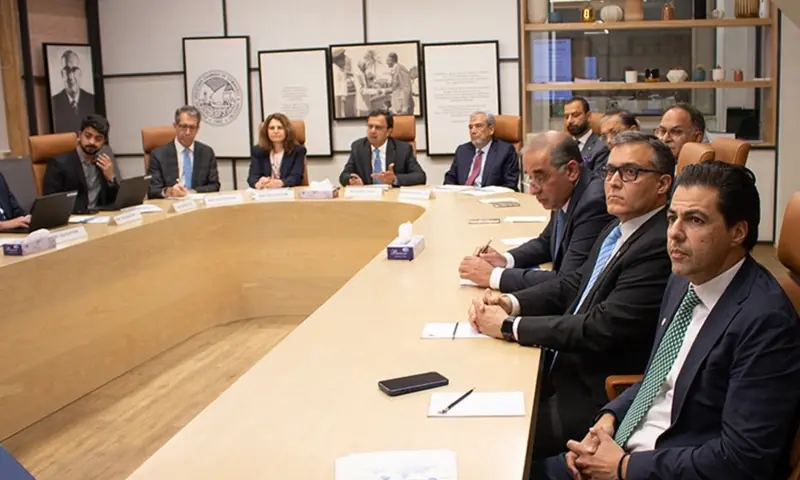
A team from the Pakistan Business Council (PBC), led by its Chairperson, Dr Zeelaf Munir, met on Friday with Ms Iva Petrova, who is heading the IMF mission, and the resident representative, Mahir Binici. A delegation from the Overseas Investors Chambers of Commerce and Industry (OICCI) also met with the IMF officials.
The statements issued by the PBC and OICCI, however, didn’t mention what the IMF team said during the discussions.
The PBC delegation noted that stabilisation must now translate into investment, productivity and employment generation. With the SBP’s policy rate at 10.5 per cent and a primary surplus recorded, the discussion focused on structural measures needed to restore private-sector confidence.
Foreign investors seek ‘super tax’ abolition
On tax rationalisation, the delegation highlighted that the current structure places a disproportionate burden on compliant, documented enterprises. The continuation of the super tax across income, dividends and capital gains, along with extensive advance and withholding tax regimes, has elevated effective corporate taxation at a time when Pakistan requires export expansion and industrial scaling.
Dr Zeelaf called for the abolition of the super tax in all its forms, a phased reduction of the corporate tax rate to 25 per cent, and the rationalisation of advance and withholding tax regimes that act as de facto minimum taxes.
OICCI President Yousaf Hussain emphasised that the priority now is to transition from stabilisation to a phased yet sustained export-led growth path. Translating macroeconomic stability into higher productivity, employment, and investment requires a shift from fragmented measures to a centrally coordinated medium-term reform programme under a comprehensive National Economic Plan.
Such a plan should integrate fiscal, trade, industrial, energy, and human capital policies with clear milestones, transparent monitoring, and deeper coordination between the federation and provinces to achieve national economic priorities, he said.
OICCI Secretary General M. Abdul Aleem noted that Pakistan’s strong geo-economic positioning offers significant potential that must be unlocked through greater policy coherence, predictability, and investment-focused improvements to the regulatory framework.
Published in Dawn, March 1st, 2026