0
0
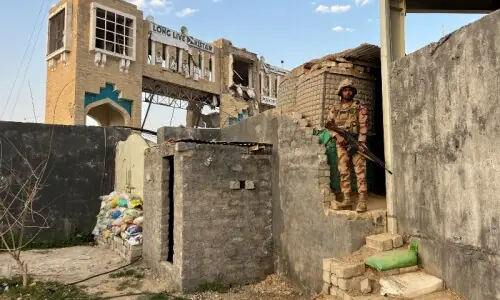
KARACHI: Amid an ongoing International Monetary Fund (IMF) review, the Pakistan Stock Exchange (PSX) remained under pressure for a fifth consecutive week, as jittery investors trimmed positions amid heightened cross-border tensions with Afghanistan and the US-Iran conflict.
The benchmark KSE-100 index fell 2.9 per cent week-on-week, shedding 5,108 points to close at 168,062.
Brokerage houses attributed the decline to weak sentiment during the futures contract rollover week and persistent foreign selling. Foreign corporates were net sellers of equities worth $13 million during the outgoing week. Local individuals and mutual funds also offloaded shares worth $11.5m and $8.8m, respectively. Banks and companies provided support, recording net purchases of $23.4m and $10.7m.
Analysts at Topline Securities said regional tensions, with both Pakistan and Afghanistan carrying out airstrikes across the border, dampened investor confidence. Average daily traded volume stood at 599 million shares, while average daily value clocked in at Rs30.8 billion.
Benchmark index sheds 5,108 points; investors wary of Pak-Afghan, US-Iran conflicts
Arif Habib Ltd (AHL) noted that persistent selling pressure and geopolitical concerns drove the market lower despite some supportive macroeconomic indicators.
On Feb 25, an IMF mission led by Iva Petrova began technical-level discussions with the State Bank of Pakistan in Karachi for the third review of the $7bn Extended Fund Facility and the second review of the $1.1bn Resilience and Sustainability Facility. The mission will stay in Karachi this week before commencing policy talks with federal and provincial authorities on Monday.
Corporate earnings offered some support. As many as 69 companies, representing 83pc of the KSE-100’s market capitalisation, announced their 2025 results by Feb 26. Their combined profit reached Rs1.6 trillion, up 5.9pc year-on-year. Investment banking, auto assemblers, miscellaneous sectors and textiles posted strong profit growth of 50pc, 44pc, 36pc and 31pc, respectively.
On the energy front, gas production declined 4.4pc WoW to 2,688 million cubic feet per day, while oil output fell 3pc to 60,888 barrels per day.
The State Bank of Pakistan’s (SBP) liquid foreign exchange reserves rose marginally by $16m to $16.2bn. The rupee remained largely stable, appreciating 0.02pc week-on-week to close at Rs279.50 against the dollar.
AHL reported that the textile, automobile parts, fertiliser, refinery and vanaspati sectors dragged the index down. In contrast, the banking, exploration and production, cement, technology, and pharmaceutical sectors contributed positively.
Among individual stocks, United Bank, Mari Energies, MCB Bank, Systems Ltd and Pakistan Petroleum weighed on the index, while Bank Alfalah, Pakistan Oilfields, Askari Bank, Fatima Fertiliser and Engro Fertilisers provided support.
AKD Securities highlighted that the market remained volatile amid geopolitical tensions, including friction between the US and Iran, as well as the Pak-Afghan situation, before staging a partial recovery on Thursday, gaining 4,267 points.
Market participation showed mixed trends. While one set of data indicated an 8.3pc decline in average weekly volume week-on-week.
On the external front, Finance Minister Muhammad Aurangzeb remarks regarding the UAE’s $2bn loan rollover offered some comfort on Pakistan’s financing position. The SBP’s net foreign exchange interventions reached $11bn over the past 18 months as of November 2025. Reserves rose despite repayment of a $700m loan to the China Development Bank.
Other key developments during the week included an increase in the US global tariff rate to 15pc, IMF signals of a phased tax cut approach, higher profit repatriation of $1.67bn in 7MFY26 and regulatory approval for Abu Dhabi-based Eve Holdings to acquire First Women Bank.
Flow-wise, AKD Securities reported net selling of $18m by individuals and $17.3m by foreigners, while banks absorbed most of the selling with net purchases of $33.9m.
Analysts expect the market’s near-term trajectory to hinge on developments in cross-border tensions and progress in IMF talks. A de-escalation and positive review outcome could revive sentiment.
The KSE-100 is currently trading at a price-to-earnings ratio of around 8.3 times, offering a dividend yield of about 6pc, which analysts describe as attractive relative to historical averages.
Published in Dawn, March 1st, 2026