New report reveals 26.2 million children still out of school
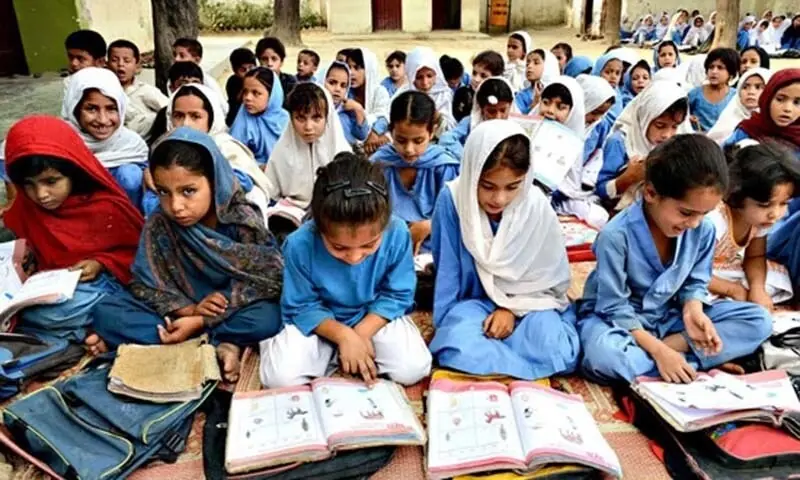


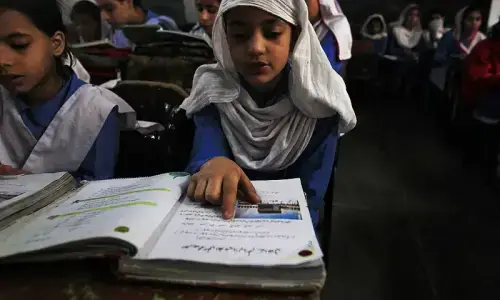
ISLAMABAD: Despite efforts by the federal and provincial governments, the number of out-of-school children remains alarming, as a new government report revealed that 26.2 million children nationwide are still out of school.
The Federal Ministry of Education and Professional Training on Thursday released the “Girls’ Education Statistics and Trends Report 2023-24,” which also showed the number of out of school children.
It said that 26.2 million children remain out of schools, including 3.4 million girls. The report also pointed out funding issues, stating that the country’s education financing had weakened with the national education share falling from 13pc to 11pc and most provinces reducing allocations, “particularly Punjab and Sindh while AJK remained stable. Development spending showed limited growth as budget remained heavily dominated by recurring expenditures excepts for a notable federal shift towards development.”
Despite these constraints, the overall budget utilisation remained strong at 94pc with improvement in Punjab, Sindh and Balochistan, though KP experienced a significant decline.
Girls’ Education Statistics and Trends Report 2023-24 shows education financing share falling from 13pc to 11pc
“Overall, provinces demonstrated reasonable execution capacity, but declining prioritization of education remains a key concern.” The report revealed a landmark shift in the country’s educational landscape.
The report, launched by Federal Minister Khalid Maqbool Siddiqui, stated that the primary school completion rate for girls had surged from 75pc to 89pc, reflecting a significant return on infrastructure investment.
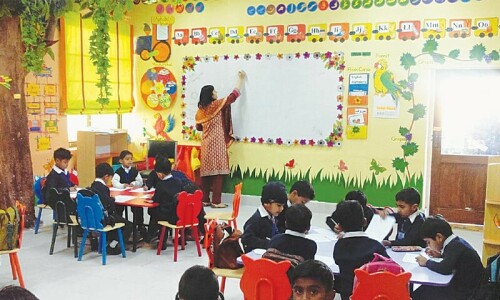
“This progress is underscored by a drastic improvement in the learning environment across Pakistan, where 96pc of schools are now housed in permanent buildings, 92pc of institutions are equipped with functional toilets, and 82pc provide access to clean drinking water,” read the report.
It stated that despite these gains, malnutrition remains a persistent challenge, negatively impacting students’ physical growth in terms of height and weight, which remains a priority for future policy interventions.
Data from the National Achievement Test (NAT) 2023 confirmed that female students are leading academically across the board. Girls secured higher average scores in English, Urdu/Sindhi, and Mathematics compared to their male counterparts. In Grade 8 specifically, girls demonstrated clear superiority in Science and Math subjects.
However, a significant socio-economic gap remains. While women have achieved near-parity with men in university enrollment, their actual labour force participation stands at only 24pc.
Minister Siddiqui described this disparity as a “waste of human capital,” noting that the transition from education to the professional workforce remains a critical hurdle for the nation.
While the progress in completion rates is evident, the report underscores significant systemic hurdles that continue to plague the sector.
Approximately 26.2 million children remain out of school nationwide, including 13.4 million girls. Furthermore, the education budget’s share has decreased from 13pc to 11pc, with a staggering 94pc of available funds consumed by salaries, leaving minimal room for developmental projects or maintenance.
The report stated that 19pc of schools possessed digital tools.
Additionally, while 23pc of schools have installed ramps for students with disabilities, specialised assistive learning materials remains scarce.
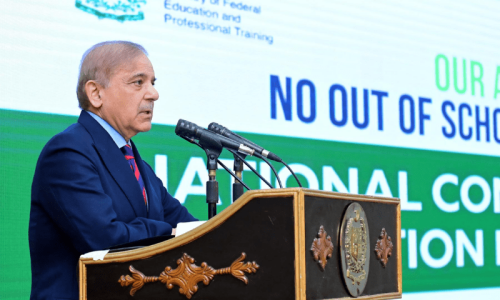
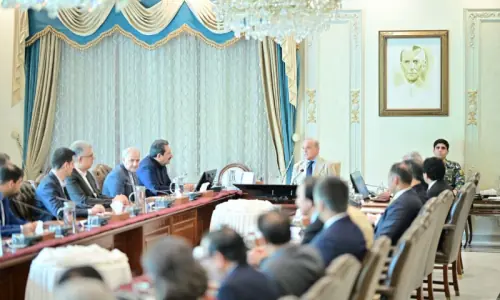
Addressing the launch ceremony at the Pakistan Institute of Education (PIE), Mr Siddiqui said accurate data must be the bedrock of future policy. He said with 140 million youth, the state must decide whether to view this demographic as a burden or a strategic asset.
He called for a widespread societal shift, adding that any girl who receives a degree or a skill from the state has a fundamental right to move forward professionally.
Minister of State Wajiha Qamar added that the ministry is already developing a targeted Action Plan to address the gaps identified in the report, with a specific focus on teacher training and digital integration.
Earlier, PIE Director General Dr Shahid Soroya shared important points of the report with the participants of the launching ceremony.
Published in Dawn, February 27th, 2026