0
0

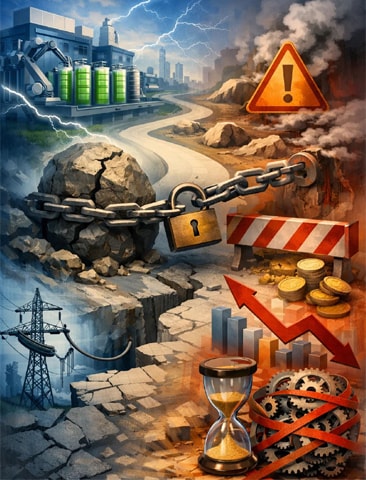
PAKISTAN plans to introduce a National Lithium-Ion Battery Manufacturing Policy for 2026-31, aimed at developing a domestic battery industry and reducing the country’s growing dependence on imports. The initiative follows a sharp rise in lithium-ion battery imports, driven by accelerating demand for solar energy storage systems and electric vehicles (EVs).
In 2024, Pakistan imported an estimated 1.25GWh of lithium-ion battery packs. Demand is projected to increase to around 8.7GWh by 2030, in line with the National Electric Vehicle Policy (NEVP) 2025-30, which targets converting 30 per cent of all vehicles to electric by the end of the decade.
With certain global EV manufacturers planning local assembly operations by the end of this year, competition for battery supplies is expected to intensify. Some local firms are already moving in with the help of collaborating Chinese partners.
Lithium, often described as ‘white gold’, is a strategic mineral with wide-ranging industrial uses and promising economic prospects. Substantial lithium deposits have reportedly been identified across several regions, including Balochistan, Gilgit-Baltistan (GB), Khyber Pakhtun-khwa (KP), Azad Jammu and Kashmir (AJK), and the Cholistan-Thar desert belt spanning Punjab and Sindh.
The Geological Survey of Pakistan is conducting geochemical exploration and feasibility studies in some areas, while geological mapping is under way in other areas to assess potential deposits of lithium and associated metals.
Globally, lithium has become one of the most sought-after minerals, with proven reserves concentrated in a handful of countries. Global lithium resources are estimated at about 105 million tonnes, with roughly 27.7 million tonnes classified as proven reserves. Chile leads with 9.3 million tonnes, followed by Australia, Argentina, China, the United States and Canada. Since 2023, notable deposits have also been reported in India, Iran and Afghanistan.
According to the United States Geo-logical Survey, global lithium mine production rose sharply to around 240,000 tonnes in 2024, up from 146,450 tonnes in 2023, while annual consumption remained above 100,000 tonnes. Beyond batteries for EVs and renewable energy storage, lithium is vital for electronics, aerospace, medical equipment, advanced industrial materials and nuclear technologies.
Despite the potential, Pakistan lacks comprehensive national frameworks for battery recycling, production quality standards, and safe installation practices. High upfront costs restrict access for lower-income households, risking an unequal energy transition.
With e-waste collection rates effectively negligible, most discarded batteries end up in landfills, posing serious environ-mental and health hazards. Given that lithium is infinitely recyclable, establishing a formal recycling ecosystem for lithium-ion battery is essential.
Finally, policy intent must be matched by execution. Bureaucratic delays, unclear governance and irritatingly overlapping federal-provincial jurisdictions continue to impede progress. To attract sustained investment, the country must ensure regulatory clarity, policy consistency, skilled human capital development and institutional coordination.
If these conditions are met, lithium-ion battery manufacturing could become a cornerstone of economic transformation rather than another unrealised promise.
Hussain Ahmad Siddiqui
Islamabad
Published in Dawn, February 24th, 2026