Nepra urges completion of key NGC projects
ISLAMABAD: Pakistan’s national transmission system — maintained by both the government and K-Electric — continues to struggle to provide cost-effective and reliable power supply to consumers due to grid weaknesses, project delays, underutilisation of expensive foreign-financed assets, and inadequate technical expertise.
This alarming situation has been highlighted by the National Electric Power Regulatory Authority (Nepra) in its Performance Evaluation Report of the Transmission Sector for FY2024-25, ending June 30, 2025.
It demanded that completion of key projects under the NGC was of utmost priority to enhance South-to-North power flow capability, minimise dependence on high-cost generation sources, and ensure optimal utilisation of the HVDC Matiari–Lahore transmission line.
“Timely execution of these projects is essential to avoid additional financial burden on the national exchequer”, the report noted.
Says around Rs80bn of electricity could not be transmitted in FY25 due to line tripping alone and higher system losses
It further said that electricity worth around Rs80bn — approximately 2.8bn units, could not be transmitted during the year due to line tripping alone.
“Despite repeated regulatory interventions and the availability of approved investment plans, the National Grid Company (NGC) was unable to complete its critical transmission projects during FY2024-25. As a result, several priority projects remain incomplete,” Nepra observed.
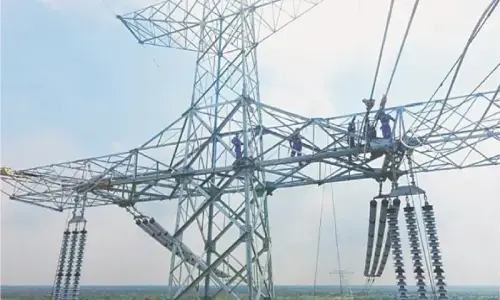
These delays have prolonged network constraints, overloading of grid stations and transmission lines, and underutilisation of major assets, including the 4,000 MW HVDC line (a Chinese investment) and several HVAC corridors.
The failure to timely commission the 500 kV Lahore North Grid Station and associated transmission lines exemplifies NGC’s poor project execution and inadequate coordination among planning, procurement and construction functions.
“Such inefficiencies have not only impeded the evacuation of economical generation but have also contributed to operational bottlenecks, higher system losses, and increased financial burdens on the sector,” the report said, adding that recurring implementation delays reflect systemic deficiencies in project management and governance.
These shortcomings pose serious impediments to achieving a reliable, efficient, and modern transmission network. Nepra called for immediate institutional reforms within NGC to ensure timely project completion and foster a more transparent and responsive system.
Similar delays have also affected several power evacuation projects within K-Electric’s networks, including the 220 kV GIS Landhi Grid and transmission line (TL), HVUB Grid and TL, 1x600 MVA ATR at 500 kV NKI with TL, 500kV KKI Grid and 220kV KKI TL. Major interconnection projects, including the 500 kV KKI-NGC Interconnection, 220 kV Dhabeji-NGC Interconnection, and 350 MW renewable interconnection at 220 kV Surjani Grid Station, are also facing challenges in smooth power evacuation.
The report noted that the loading position of transmission networks of both NGC and KE were under significant stress at the 500/220 kV level. In NGC, there are 20 grid stations equipped with 48 power transformers, of which 41 units are operating at more than 80pc of their rated capacity.
Similarly, at the 220/132 kV level, 49 grid stations with 187 power transformers are operational, with 87 units loaded beyond 80pc of their rated capacity. “Such a scenario poses reliability risks and underscores the urgent need for capacity augmentation and system reinforcement”.
KE’s transmission network also faces growing stress, with 35pc of transformers—mainly at the 132 kV level—operating beyond 80pc of their nameplate capacity, resulting in outages and reduced reliability in Karachi’s key demand centres.
The regulator also found inadequate NGC and KE Interconnection. In FY2024-25, K-Electric strengthened Karachi’s network through the commissioning of the Dhabeji-2 Grid Station and its interconnection with the national grid, energised in March 2025.
Published in Dawn, February 24th, 2026