Yellow Letters wins top prize; Gaza row dogs Berlin film festival
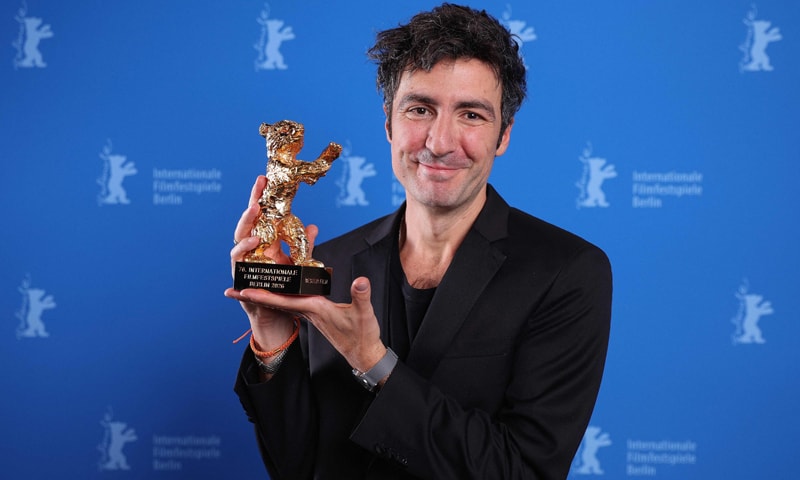
BERLIN: German filmmaker Ilker Catak’s Yellow Letters won the Golden Bear for Best Film at the Berlin Film Festival on Saturday in a ceremony reflecting the controversy over Gaza which dogged this year’s edition.
A political drama, Catak’s film tells the story of a Turkish director and his actor wife, suddenly barred from working because of their political opinions.
Jury president Wim Wenders called the film “a terrifying premonition, a look into the near future that could possibly happen in our countries as well”.
“This is a movie that speaks up very clearly about the political language of totalitarianism as opposed to the empathetic language of cinema,” Wenders said.
Catak called Wenders “one of my teachers”, adding: “It’s such an incredible thing to receive this award from you.”
The runner-up Silver Bear Grand Jury Prize went to Salvation by Emin Alper, who in his speech mentioned his solidarity with several high-profile opposition figures in prison in Turkiye, including jailed Istanbul mayor Ekrem Imamoglu.
Alper also took the opportunity to speak up for “the people of Iran suffering under tyranny” and the Palestinians in Gaza.
The film festival drew to a close on Saturday after 10 days of what its director called “stormy seas” unleashed by a controversy over the war in Gaza, which often overshadowed discussion of the 22 films in competition.
The row erupted at the beginning of the festival when jury president Wim Wenders answered a question about the German government’s support for Israel by saying: “We cannot really enter the field of politics.” At the same press conference he had said that films had the power to “change the world” but in a different way from politics. But his comments in response to the question on Israel prompted a storm of outrage.
Award-winning Indian novelist Arundhati Roy, who had been due to present a restored version of a 1989 film she wrote, pulled out of the event, branding Wenders’ words “unconscionable” and “jaw-dropping”.
On Tuesday, an open letter signed by dozens of film industry figures, including actors Javier Bardem and Tilda Swinton and director Adam McKay, condemned the Berlin festival’s silence on the genocide of Palestinians and accused it of being involved in “censoring” artists who oppose Israel’s actions.
Director Tricia Tuttle, in her second year at the helm of the Berlinale, has firmly rejected the accusations, describing some of the claims in the letter as “misinformation” and “inaccurate”.
Stormy seas
Speaking at the awards ceremony for prizes from the festival’s Independent Juries, Tuttle described the past 10 days as “stormy seas”.
Mexican director Fernando Eimbcke, whose film Flies is in official competition, used the occasion to protest civilian deaths in Gaza as well as US President Donald Trump’s immigration crackdown. “More than 17,000 kids have been killed in Gaza in the last two years,” he said.
“I should raise my voice and I ask all the governments and organisations to raise their voices too,” he said. He also referenced the arrest of a five-year-old Ecuadorian boy by Immigration and Customs Enforcement (ICE) in the US which sparked widespread outrage.
“ICE should stop persecuting and terrifying kids like Liam Conejo Ramos — ICE out!” Eimbcke said. Later on Saturday, prizes will be awarded by the main International Jury, including the coveted Golden Bear for best film.
Among the standout entries in the official competition was We Are All Strangers by Anthony Chen. Set in Chen’s native Singapore, the film is a moving family drama which playfully satirises the yawning social disparities to be found in the city-state’s glittering skyscrapers.
German actress Sandra Hueller, who gained international acclaim for her roles in The Zone of Interest and Anatomy of a Fall, received audience plaudits for her turn as the title character in Rose by Austrian director Markus Schleinzer.
The black-and-white drama tells the story of a woman passing herself off as a man in rural 17th-century Germany to escape the constraints of patriarchy.
Juliette Binoche, playing a woman caring for her mother with dementia, also moved cinema-goers in Queen at Sea by American director Lance Hammer, who had not made a feature film since 2008. The film sensitively portrays the devastation Alzheimer’s disease inflicts on a patient’s loved ones.
The first major event of the film calendar also provided a platform for Iranian filmmakers to address the anti-government protests in their home country.
Director Mahnaz Mohammadi, who has spent time in Tehran’s notorious Evin prison, presented Roya, a searing portrayal of conditions in the jail and the traces they leave on prisoners’ psyches.
Dissident director Jafar Panahi, who won the Cannes Palme d’Or for It Was Just An Accident, also spoke at the Berlinale to denounce the Iranian government’s ‘repression of protesters’.
“An unbelievable crime has happened. Mass murder has happened. People are not even allowed to mourn their loved ones,” Panahi told a talk organised as part of the festival. In December he was sentenced to one year in prison and a travel ban in Iran but has expressed his intention to return.
Published in Dawn, February 22nd, 2026