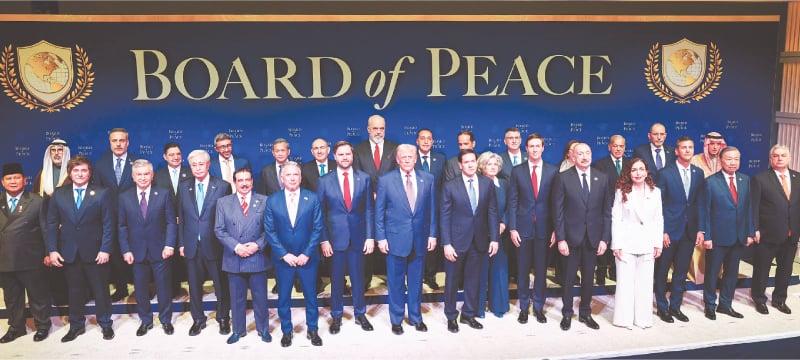
• At ‘Board of Peace’ summit, US president says Islamabad chose de-escalation in May conflict
• Praises PM Shehbaz, calls CDF Munir ‘tough man, good fighter’
• Premier lauds US president as ‘saviour of South Asia’, ‘man of peace’
• Backs Trump’s Gaza initiative, Palestinian resolution
WASHINGTON: US President Donald Trump on Thursday used the inaugural meeting of the Board of Peace, attended by more than 20 world leaders, to portray Pakistan as a responsible nuclear state that, he said, chose de-escalation over war during the May 2025 conflict with India.
Prime Minister Shehbaz Sharif also addressed the summit, praising Mr Trump for his efforts to help secure peace in South Asia and the Middle East. PM Shehbaz described the US president as a “saviour of South Asia” and a “man of peace”.
“Your great diplomacy has surely brought calm to many international, serious hotspots. Your timely and very effective intervention to achieve ceasefire between India and Pakistan potentially averted loss of tens of millions of people,” he told the gathering, also attended by leaders from Pakistan, Saudi Arabia, Turkiye, the United Arab Emirates, Uzbekistan, Kazakhstan, Indonesia, Azerbaijan, Qatar and others.
For Islamabad, Mr Trump’s speech marks a significant diplomatic moment: the first time a US president has publicly and repeatedly described Pakistan not only as a nuclear power but also as a country that preferred peace and “immediately” accepted a proposal to end hostilities.
The remarks also challenge New Delhi’s denial of a US role in the ceasefire and reinforce Pakistan’s long-standing position that international engagement is required to manage crises between the two South Asian rivals.
Recalling a conversation with PM Shehbaz, who shared the stage with him, Mr Trump said: “He said in front of our chief of staff … ‘Do you know nobody knows it, but I believe that President Trump saved 25 million lives when he stopped the war between us and India.’ Right, you made that statement?”
He added: “You said 25 million lives. It could be much more, actually, but it was really a beautiful thing.”
Underlining the scale of the confrontation, the US president rejected suggestions that the fighting had been limited. “That war was raging. Planes were being shot down, right? Yes, it was Pakistan and India.”
He later reiterated: “Eleven jets were shot down — very expensive jets — and both of them were all in it.”
The assertion directly contradicts India’s position that it suffered no aircraft losses during the crisis.
Explaining his intervention, Mr Trump said economic leverage proved decisive. “I got on the phone with both of them. I knew them a little bit. I knew Prime Minister Narendra Modi very well, actually. I got to know Pakistan through trade. I called them and I said, ‘Listen, I am not doing trade deals with you two guys if you don’t sort this out.’”
He said he warned both sides: “If you fight, I am going to put 200 per cent tariffs on each of your countries. It was essentially to make sure you cannot do any business.”
According to him, the response was immediate. “When it came to money, there’s nothing like money. When it came to losing a lot of money, they said, ‘We don’t want to fight.’ And we solved that deal in two, three days.”
Highlighting the nuclear danger, he told the audience: “These are two very powerful nuclear nations. And I don’t want to say what was going to happen — bad things happen.”
The US president also stressed how close the region had come to a catastrophic escalation, lamenting that “people have no idea” how serious the situation had been.
‘Tough man, good fighter’
Mr Trump also appreciated the leadership of PM Shehbaz and Chief of Defence Forces and Chief of the Army Staff Field Marshal Syed Asim Munir as he spoke at the board’s inaugural meeting.
“Thank you very much, Prime Minister Sharif. I like this man ... and field marshal, a great general, (and a) great field marshal,” Mr Trump told the gathering.
“They made a good deal (after the conflict with India), and I got to like them, the prime minister and the field marshal who’s a tough man, a tough good fighter, good, serious fighter. I like good fighters, actually,” Mr Trump remarked.
Thanking PM Shehbaz directly, he said: “Prime Minister, I want to thank you. That was a very big deal. People have no idea.”
Separately, an informal meeting was held between Mr Trump and PM Shehbaz at the end of the Board of Peace meeting. During the interaction, the two leaders expressed mutual goodwill and shook hands. The US president also hugged the premier and the meeting was “exceptionally warm”, the state-run APP news agency said.
Earlier, during the Board of Peace gathering, the US president also praised Mr Modi, calling him “a great man … a great guy” and adding, “They are both great. I was very proud of it,” while expressing confidence that Washington would “always be able to settle up with them”.
Delivered before a large international audience, the repeated acknowledgment strengthens Pakistan’s long-held position that it acted with restraint during a crisis between two nuclear-armed states and agreed to de-escalation under international engagement.
The high-visibility endorsement places Pakistan in a favourable diplomatic light at a time when it is seeking broader economic and strategic support from world capitals and associates the country with crisis management, nuclear responsibility and cooperation with Washington.
PM Shehbaz expressed Pakistan’s strong support for Mr Trump’s initiatives aimed at achieving a lasting resolution in Gaza and the Palestinian issue.
He also commended Mr Trump’s vision and leadership, stating, “Mr President, we deeply appreciate your unique initiative and your dynamic leadership in advancing peaceful solutions to conflicts across the globe.”
Highlighting the plight of the Palestinian people, the prime minister emphasised the need for adherence to international law and UN resolutions, saying, “The people of Palestine have long endured illegal occupation and immense suffering. To achieve long-lasting peace, it is very important that ceasefire violations must end. To preserve lives and advance reconstruction efforts, the people of Palestine must exercise full control of the land and the future, in line with UN Security Council resolutions.”
On the path forward, he added, “At present, we must work together towards a credible pathway to Palestinian self-determination through the establishment of an independent, sovereign and contiguous state of Palestine in line with the relevant resolutions.”
Concluding his remarks, PM Shehbaz hailed the historic significance of the meeting and President Trump’s role in it. “Today is the day which will mark a place in the annals of history that — through your efforts, your untiring support, and great efforts — long-lasting peace in Gaza will be achieved. It will be your legacy for all time to come.”
Published in Dawn, February 20th, 2026