Art outlives death in Mujh Mai Tu Moujood


 0
0
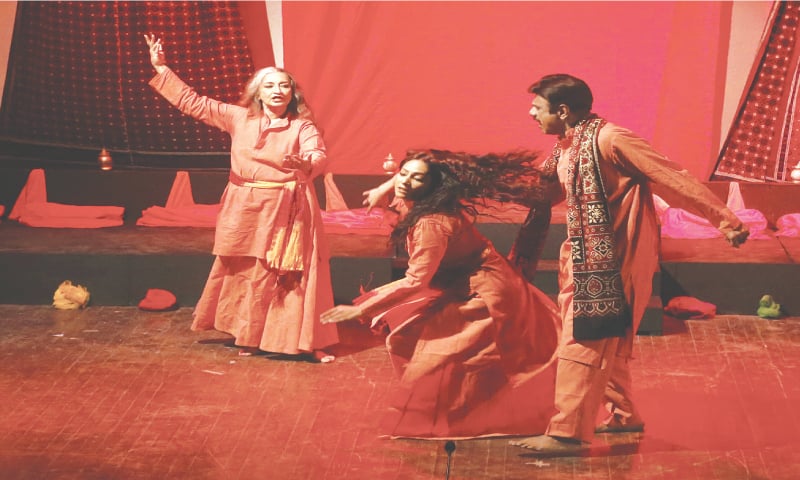
KARACHI: Classical dancer and human rights activist Sheema Kermani’s musical play Mujh Mai Tu Moujood, staged as part of the Awami Theatre Festival at the Arts Council of Pakistan, on Sunday, was an ensemble of diversity and cultural heritage.
Written for the stage by Anwer Jafri, the play is based on a serious short story by Amar Jaleel, titled ‘Love, longing and death’. It tells a mysterious and intriguing tale about Sufism and the mystical dimensions of the soul while also using the poetry of various Sindhi Sufi saints and poets.
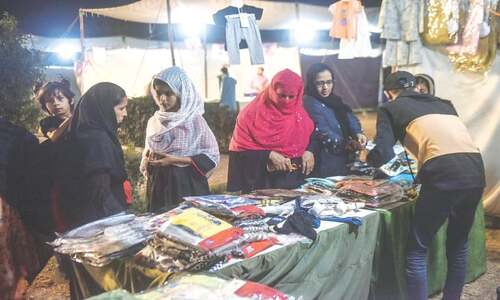
The play opens with a scene of a cultural festival. As some journalists, who covered the festival, are wrapping up on its penultimate day, they are informed by a middle-aged woman there that the last day of the festival will be particularly special, as it will include a performance by Madan Faqir.
Only one of the journalists, Shazia, has heard of Madan Faqir, because he went missing over 25 years ago. Before him, his teacher, Bhagat Kanwal, had also found fame in song and dance, but he had been shot dead by religious fanatics even before the Partition of the Subcontinent. But what happened to Madan Faqir? Shazia says that he was also killed. That is why she is sure he won’t be performing at the festival.
Sheema Kermani’s play traces love, longing and loss across generations, portraying how art can transcend fanaticism
A story then unfolds in flashback. A young girl, Tamanna, her father’s favourite, is shown asking him to find her the best teacher who can teach her song and dance. She mentions Madan Faqir, and the doting father makes her wish come true. Soon, Tamanna is learning from him. He teaches her about art, which he says is already there in your soul. You only need to discover it.
As Tamanna delves deeper into art and Sufism, her father is told by people that his daughter is not learning an art; rather, she is getting inclined towards Hinduism, as her music teacher is a Hindu. He tells her to stop taking classes from Madan Faqir at once. She tries explaining to him that art has no religion, but he doesn’t see reason. Tamanna also follows her teacher around like a vagabond. She sings and dances like him while wearing bells on her ankles.
The father has Madan Faqir thrown out of their village. It is said that he was killed later and thrown into the river. The father also gets Tamanna married off. Her husband moves to Canada with her, but the longing in her soul brings her back every year. She visits shrines, she visits festivals in search of her teacher until she finally discovers him within her soul.
As the journalists are sure that the woman who told them that Madan Faqir would sing at the culture festival was lying, they see him themselves though from afar. They are told not to disturb him, as he is busy practising for his grand performance on the final day of the festival. They force themselves to wait. And it is well worth their waiting when they finally see Madan Faqir dancing at the festival, wearing his big turban and ankle bells.
Everyone is in awe until the turban falls from the dancer’s head and they see the same middle-aged woman dancing. She is Tamanna, who has left her life in Canada to be here where her soul finds joy. She dances without a care in the world until she, too, is gunned down by unknown assailants.
But like her teacher and his teacher before him, she cannot truly die, because her art lives on.
Published in Dawn, February 17th, 2026